Search for “the most beautiful village near Madrid” and the first page of Google hands you lists of twelve, fifteen, twenty candidates, all carrying the same label. The name that wins the title most often is Patones de Arriba, the black slate village in the Sierra Norte. And that one does not appear on the only list with an audit behind it: the one kept by the association Los Pueblos Más Bonitos de España, Spain’s Most Beautiful Villages.
Inside the Madrid region, that list holds just two names: Chinchón and Nuevo Baztán. Widen the radius to an hour and a half by car and eight more come in, spread across the provinces of Segovia and Guadalajara. With those names on the table there is an answer you can actually defend, and it is the one this article gives: Pedraza if you can leave the Madrid region, and Chinchón if you cannot.
The most beautiful village near Madrid, at a glance
These are the villages that genuinely compete for the title, with the drive from central Madrid and the reason each one keeps coming up.
Five of the seven carry the association’s seal. The two that do not, Buitrago and Patones, are precisely the ones that top most online lists as “the most beautiful village in Madrid”.
What the “most beautiful village” seal actually means
The association Los Pueblos Más Bonitos de España was founded in 2010 on the French model of Les Plus Beaux Villages de France and today brings together more than 126 municipalities. It is not a public vote or a newspaper feature: the town hall applies, and the village goes through an audit of more than 40 criteria, covering everything from the state of its heritage and façades to street cleaning, green spaces and cultural life.
That cuts two ways. First: a listed village has proved its old town survives without the additions that ruin it elsewhere. Second, and almost nobody says this out loud: the seal tells you nothing about the villages that are missing. Joining is voluntary, so a village without it can be every bit as beautiful and simply never have applied.
Around Madrid, the map of listed villages looks like this:
- Madrid region: Chinchón, listed in 2017, and Nuevo Baztán, listed in 2021.
- Province of Segovia: Pedraza, Sepúlveda, Ayllón and Maderuelo.
- Province of Guadalajara: Valverde de los Arroyos, Hita, Atienza and Pastrana.
Toledo, Ávila and Segovia itself are not part of this conversation for a simple reason: they are cities, not villages. If those are what you are after, they belong in day trips from Madrid: which ones actually fit in a day.
Our answer: Pedraza
If you have to pick a single village within two hours of Madrid, Pedraza has what makes a village beautiful from every angle, not only from the one good photo.
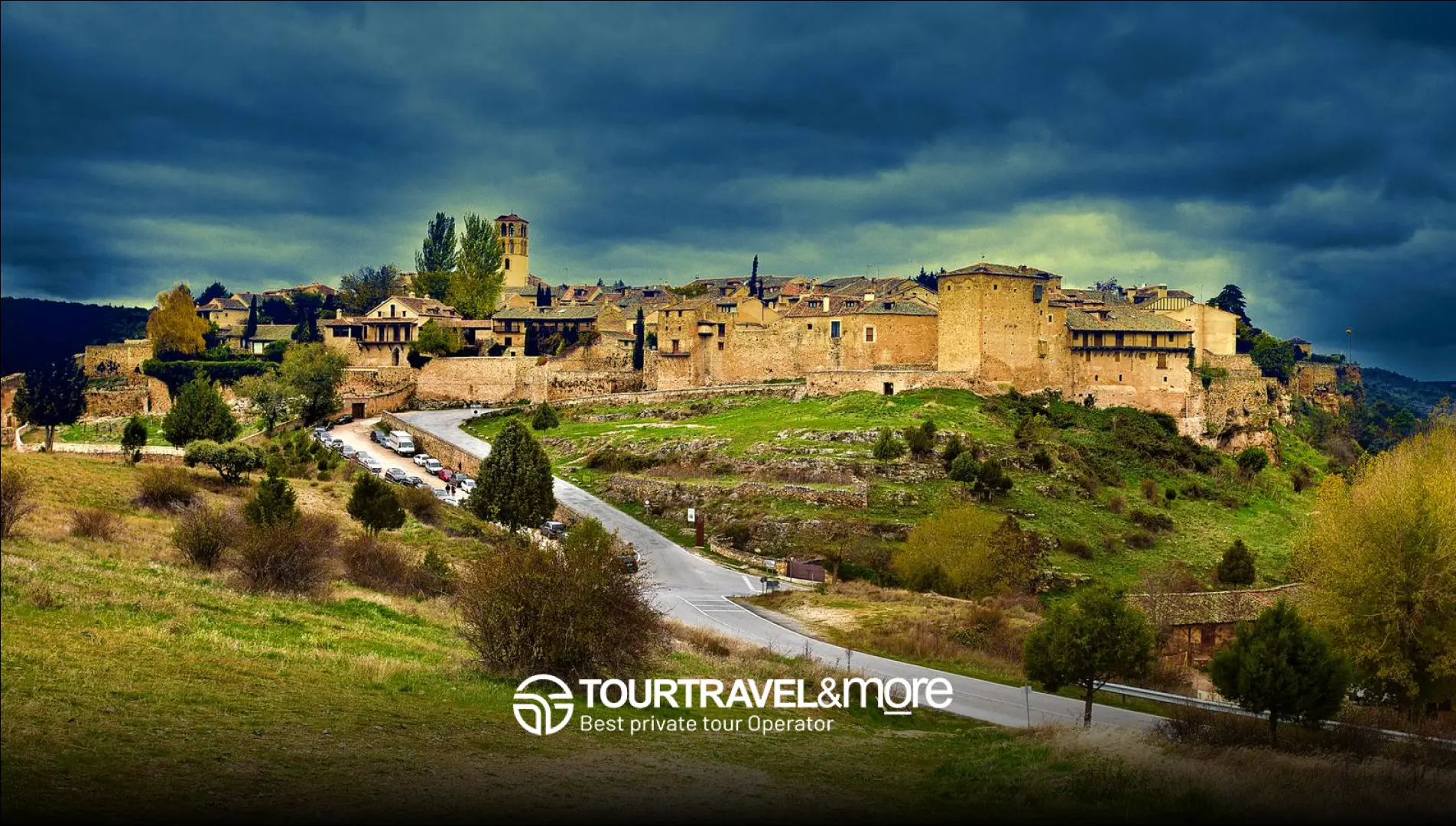
The whole place fits inside its wall and there is only one way in, the Puerta de la Villa, built in the 11th century and rebuilt in the 16th. Cross it and nothing breaks the scene: cobbled streets, stone houses with coats of arms carved above the doors, wooden balconies and an arcaded Plaza Mayor that looks like it stopped four centuries ago. At the far end, on the rock, stands the castle the painter Ignacio Zuloaga bought in 1926, with one tower now a museum of his work.
What sets it apart from other medieval villages is the scale. Pedraza is small, you can walk all of it in an hour without hurrying, and it has barely grown outside the wall, so the silhouette on the rock reads just as cleanly from the approach road as it does from inside. Then there is the other reason people drive up: lamb roasted in a wood-fired oven, the dish this corner of Segovia is known for.
There is one night a year when Pedraza is even more itself: the Noche de las Velas, the Night of the Candles, held on the first two Saturdays of July. The village switches off its street lighting and burns more than 45,000 candles, with a concert on the esplanade below the castle. Capacity is capped at 5,000 people and the ticket does not include parking, so it books up far in advance.
Pedraza’s problem is not the village, it is getting there. There is no train and no direct bus from Madrid. You have to reach Segovia first and pick up the Linecar line, which runs only on Tuesdays and Fridays: out of Segovia at 13:00, back from Pedraza at 9:30 in the morning. In other words, on public transport Pedraza cannot be done as a day trip at all. By car it is an hour and a half.
If it has to be inside the Madrid region: Chinchón
Chinchón is the answer when the question is “the most beautiful village in the Madrid region”, and it is one of the few cases where the internet lists and the association agree, since it was added in 2017.
Everything revolves around its Plaza Mayor, which is neither square nor regular: an irregular space ringed by three-story houses carrying 234 wooden balconies above ground-floor arcades, with the church of the Assumption watching from above. For centuries it worked as a bullring, a theater and a market, and cinema found it early: the bullfight in Around the World in 80 Days was shot here with Cantinflas, and in late 2021 Wes Anderson’s crew moved in to film Asteroid City.
Its advantage over Pedraza is access. It is one of the few candidates you can visit comfortably without a car: the 337 bus leaves the Conde de Casal interchange every hour and takes between 55 minutes and 1 hour 10, depending on traffic. Check the time of the last bus back before you go, though, because it shapes your whole afternoon.
Its weak spot is its own popularity. At lunchtime on a weekend the square belongs to the restaurant terraces, and what you see is the balconies, not the square. To catch it clear, with morning light on the wood, you need to arrive early or come on a weekday.
Patones de Arriba and Buitrago: the favorites without the seal
Not being listed takes nothing away from them. These are two of the most beautiful villages in the Madrid region, each for a completely different reason.
Patones de Arriba, the black village
Patones de Arriba is the best example of black architecture near Madrid: houses built from dark slate slabs, roofs of the same stone and cobbled lanes that blend into the hillside. It is small, a dozen streets on a slope, and you can walk it in an hour. Much of its charm comes from a decision taken more than twenty years ago: cars are not allowed in its streets, and the access is monitored by cameras that fine any non-resident who tries.
That same decision is what complicates the visit. On weekdays there is a small parking area at the entrance, three minutes’ walk away. On weekends and public holidays the road up from Patones de Abajo is closed: you park in the lower village and walk the path linking the two, about 800 meters and a gentle 20-minute climb, or take the municipal shuttle. The lower parking fills up too: on a weekend, if you are not there before 11:00 you will struggle to park, and the crowd peaks between 12:00 and 16:00.
Without a car, the 197 bus leaves Plaza de Castilla and reaches Patones de Abajo, though some services terminate in Torrelaguna and force a change.
Buitrago del Lozoya, the walled village
Buitrago keeps the most complete medieval wall in the Madrid region, declared a National Monument in 1931. What makes it special is the river: the Lozoya wraps almost entirely around the old town and works as a natural moat, so the best view of the village is not inside it but from the opposite bank.
Inside the walls, besides the castle and the church, there is the Picasso Museum–Eugenio Arias Collection, free to enter: around 60 works Picasso gave to his barber and friend Eugenio Arias, a native of Buitrago, during the painter’s exile in France. It is the kind of detail no other village on this list can offer.
The 191 bus from Plaza de Castilla takes between 1 hour 35 and 1 hour 45. The walled enclosure is closed to non-resident traffic.
Nuevo Baztán, Madrid’s other listed village
Nuevo Baztán is the candidate nobody expects, because it looks nothing like the others. It is not medieval and it did not grow slowly: it was founded by Juan de Goyeneche in the early 18th century as a settlement for the workers of his factories, one of them a glassworks, and named after his home valley in Navarre. The layout was drawn by José de Churriguera, the architect who gave the Churrigueresque style its name.
The result is a planned Baroque complex, with the Goyeneche Palace and its church built as a single structure, squares designed for festivals and markets, and a coherence you feel the moment you arrive. It joined the association in 2021, the second village in the Madrid region to do so. The 261 bus from Avenida de América takes around an hour, and the place is far quieter than Chinchón or Patones.
Sepúlveda and the other listed villages within two hours
Sepúlveda would be the answer if the question included the landscape. The village looks down from its ridge over the Hoces del Río Duratón, a natural park where the river cuts through vertical-walled meanders and griffon vultures nest. The hermitage of San Frutos, 17 kilometers from the village and 1.5 kilometers on foot from the parking area, sits above one of those meanders and has the most spectacular view in this entire article. On public transport it is even harder than Pedraza: one bus on Thursday at 7:30 and another on Friday at 16:30 from Avenida de América, both with a change, and the return is on Sunday.
The remaining listed villages around Madrid are worth the drive too, each for something specific:
- Ayllón and Maderuelo, in northeastern Segovia: Ayllón for its square and its palace-lined old town; Maderuelo for the way the village occupies a long ridge above the Linares reservoir.
- Valverde de los Arroyos, in Guadalajara: the most complete version of black architecture, with the Chorreras de Despeñalagua waterfalls a walk away.
- Atienza and Hita: two medieval villages on hilltops, each with the remains of its castle crowning the top.
- Pastrana: the village of the Princess of Éboli, whose collegiate church holds a set of 15th-century Flemish tapestries.
Getting there without a car: which ones fit in a day and which do not
Here is the paradox at the heart of this question: the most beautiful village near Madrid is also among the worst connected. Villages inside the Madrid region have a daily intercity bus; those in Segovia and Guadalajara depend on lines that run two or three times a week.
Timetables on these lines change often, and Pedraza’s own town hall advises calling the bus company before setting off. The conclusion holds either way: Chinchón and Nuevo Baztán work without a car; Pedraza and Sepúlveda do not.
What time of day each village looks its best
A beautiful village at the wrong hour can disappoint. For almost every name on this list, what makes the difference is not which day you pick but what time you arrive.
If all you have is one Saturday, the strategy that works best is to head out early to the village you care about most and leave the second one, if there is a second one, for the afternoon.
Where each village is, and which ones pair up
On the map, the listed villages appear in gold and the unlisted favorites in brown. What you see straight away is that they cluster in three directions: south and southeast of Madrid (Chinchón, Nuevo Baztán), the Sierra Norte (Buitrago, Patones) and north, already in Segovia and Guadalajara (Pedraza, Sepúlveda, Ayllón, Valverde).
That geography decides which combinations work in a single day with your own or a private vehicle:
- Segovia and Pedraza: around 35 kilometers apart. The city in the morning, the village and the roast lamb in the afternoon.
- Pedraza and Sepúlveda: around 25 kilometers. Segovia’s two most photogenic listed villages on the same day.
- Aranjuez and Chinchón: around 25 kilometers. Palace and gardens in the morning, Plaza Mayor in the afternoon.
- Buitrago and Patones de Arriba: both in the Sierra Norte, less than an hour apart.
The combination that does not work is the one that mixes directions: Chinchón and Pedraza sit on opposite sides of Madrid, and putting them together means spending more time on the road than in the villages.
The most beautiful village near Madrid with Tour Travel & More
The problem with the most beautiful villages near Madrid is almost never the village, it is the logistics: the Pedraza bus that runs two days a week, the Patones parking area that fills before eleven, the connection you need for Sepúlveda, the last 337 back from Chinchón.
With Tour Travel & More, those problems disappear:
- 100% private tour — The day is built around the villages you actually want to see, not around Linecar’s timetable or the city’s bus interchanges.
- Official licensed guide — Tells you what the signs do not, from why Pedraza has a single gate to who laid out Nuevo Baztán and which Goya hangs in the church at Chinchón.
- Luxury vehicle with a professional driver — Hotel pickup and arrival at the gate in the wall. Pedraza and Sepúlveda stop requiring an overnight stay and fit into one day.
- Tailor-made itinerary — Segovia and Pedraza, Aranjuez and Chinchón, or Buitrago and Patones de Arriba on the same day.
- Guardian Angel Service 24/7 — Human coordination before, during and after the trip, in case the plan changes along the way.
More beautiful, but at the right hour
Lists of beautiful villages near Madrid look so alike because the candidates are what they are. What separates a trip you remember from one that disappoints is not having picked the right name off the list.
Pedraza can be a stone village in complete silence or a street full of cars hunting for a parking space. Chinchón can be a square with 234 balconies or an open-air dining room. The useful question, before you choose, is not only which one is the most beautiful, but which one you can catch at its best with the day you have.
Cover image: Pedraza (Segovia), photo by Wikipedio — Wikimedia Commons, CC BY-SA 4.0