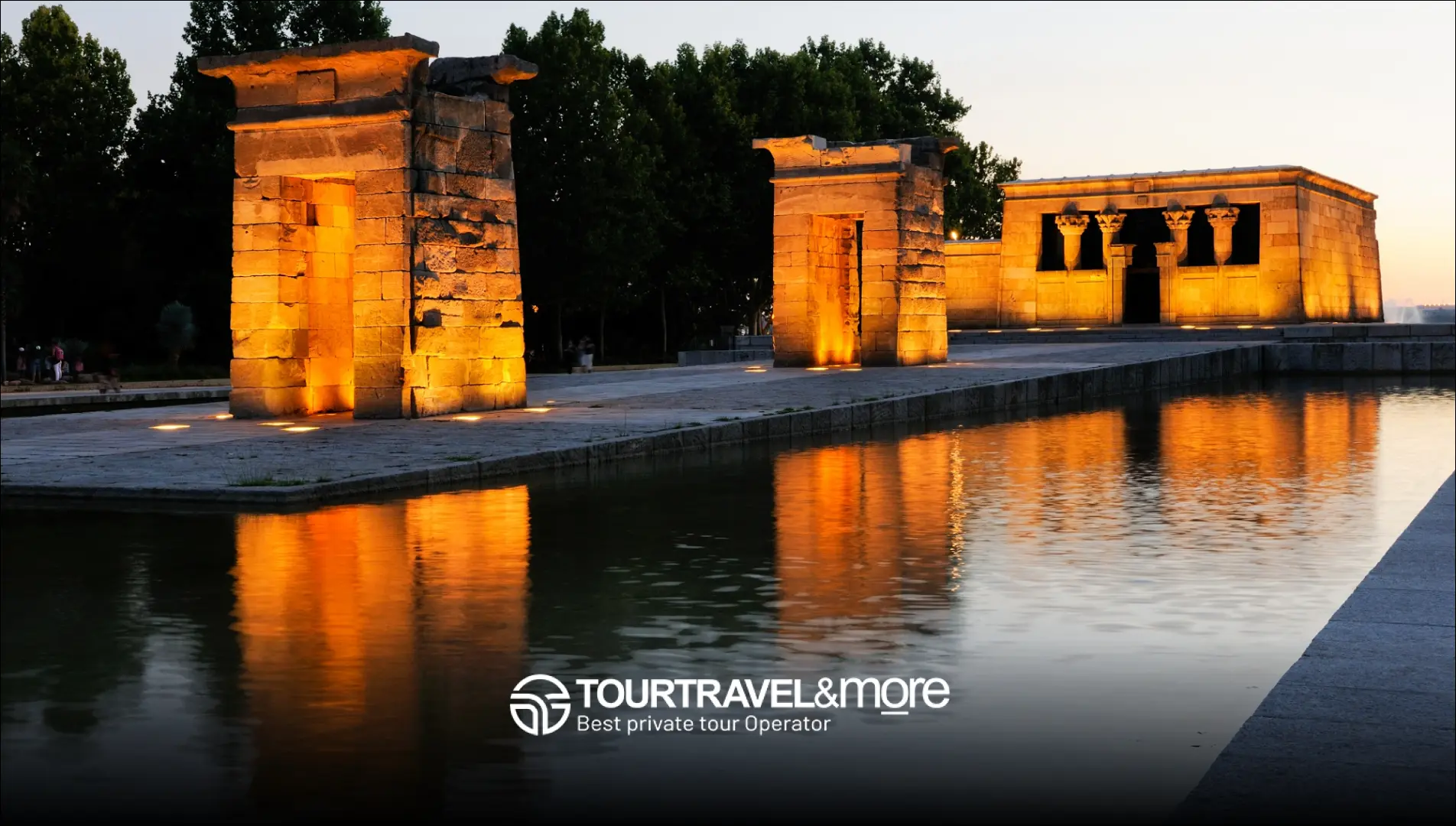
There are two kinds of free in Madrid, and mixing them up is what ruins the day. There is what is always free — the Temple of Debod, the chapel with Goya’s frescoes, the Retiro, half a dozen city museums — and there is what is free only inside a two-hour window, which usually falls at the very end of the day and draws the biggest crowd of the day with it.
The list of places is nearly identical in every guide. What changes the outcome is the calendar: what you can see on a Monday, what only opens free on Saturday afternoon, what asks for a passport at the door, and what is closed on the one day you had free. That is what this article is about.
Free things to do in Madrid, at a glance
The places that genuinely earn a slot in your day, with the condition that almost no list mentions.
| Place | When it is free | The small print |
|---|---|---|
| Temple of Debod | Always, Tuesday to Sunday | Only 10 people fit inside at a time and the visit is capped at 30 minutes |
| Ermita de San Antonio de la Florida | Always, Tuesday to Sunday | It is a small chapel: the real visit is 20 well-spent minutes |
| Museo del Prado | Monday to Saturday 18:00-20:00; Sundays and holidays 17:00-19:00 | You still need to collect a free pass, and the queue forms before the window opens |
| Museo Reina Sofía | Monday and Wednesday to Saturday 19:00-21:00; Sundays 12:30-14:30 | Closed on Tuesdays |
| Museo Thyssen-Bornemisza | Mondays 12:00-16:00 | Permanent collection only, not the temporary exhibitions |
| Royal Palace | Monday to Thursday, the last two opening hours | EU citizens, EU residents and Ibero-American nationals only, with ID, and no guided visit |
| Gallery of the Royal Collections | Monday to Thursday 18:00-20:00 | Same nationality requirement, same document in your hand |
| Changing of the Guard | Wednesdays and Saturdays | September to June, 11:00-14:00; July and August, 10:00-12:00 |
| State museums (Arqueológico, Cerralbo, Romanticismo, Traje, América) | Saturdays from 14:00 and Sunday mornings | They close at midday on Sunday, so the real window is short |
| El Retiro, Campo del Moro and the other gardens | Always | None |
What is always free, no clock involved
This is the part of the list that depends on nothing. It fits on a Tuesday morning or a Sunday at six in the afternoon and works exactly the same.
The Temple of Debod, and its small print
An Egyptian temple from the 2nd century BC, taken apart stone by stone in Aswan and given to Spain in 1968 in thanks for its help saving the temples of Nubia. It stands on the Príncipe Pío hill, ringed by a pool that reflects it, and sunset seen from there is the most famous free plan in Madrid.
What almost no list mentions is that you can also go inside, also free, and that the interior holds ten people at a time with a 30-minute cap, no groups. Which means: if you turn up at sunset, with the esplanade packed, forget the interior. To see it from inside you go on a weekday morning; for the sunset you go early and accept the crowd. They are two different visits to the same place.
The chapel with Goya’s frescoes
The Ermita de San Antonio de la Florida, down by the Manzanares river, holds the frescoes Goya painted in 1798 across its dome and vaults — and it holds Goya himself: his remains are buried under the altar. Entry is free, Tuesday to Sunday, and the scene on the dome — the saint raising a dead man before a crowd leaning over a painted railing — is read from below, with your head tipped back.
It is a short visit, twenty or thirty minutes, which is exactly why it chains so well with Debod and the Royal Palace: all three sit on the same side of the city.
The city museums, which never charge
This is the big gap in the usual free-things lists: Madrid runs a network of municipal museums with free entry every day they open — no window, no pass, no queue.
- Museo de Historia de Madrid — The city told from the Habsburgs onward, with León Gil de Palacio’s 1830 scale model of Madrid. Worth the stop for Pedro de Ribera’s baroque doorway alone.
- Museo de San Isidro — In the house where tradition places the city’s patron saint, with the well of the miracle and the archaeology of Islamic Madrid.
- Conde Duque — Contemporary art museum inside the old barracks.
- Museo Naval — On the Paseo del Prado, voluntary contribution. This is where Juan de la Cosa’s 1500 chart hangs, the first map ever to draw the Americas.
- Matadero Madrid — Exhibition and cinema complex in the old municipal slaughterhouse. The grounds and almost every hall cost nothing.
Add to that the Palacio de Cibeles: the building itself and the CentroCentro exhibition halls are free to walk into. The eighth-floor viewpoint is not — that one is paid separately.
The big museums: the hour matters more than the day
The Prado, the Reina Sofía and the Thyssen are free every day or close to it. The catch is that their free window is the last two opening hours, and two hours on the clock are not two hours of museum.
| Museum | Free window | What you can actually see |
|---|---|---|
| Museo del Prado | Monday to Saturday 18:00-20:00; Sundays and holidays 17:00-19:00 | Between the pass queue and the closing sweep you get 75-90 minutes: enough for Velázquez, Goya and Bosch, not for the whole museum |
| Museo Reina Sofía | Monday and Wednesday to Saturday 19:00-21:00; Sundays 12:30-14:30 | Two hours are plenty for the Guernica floor and the surrealists |
| Museo Thyssen-Bornemisza | Mondays 12:00-16:00 | Four hours: the most generous free window in Madrid and the only one at midday |
| Gallery of the Royal Collections | Monday to Thursday 18:00-20:00, with EU or Ibero-American ID | Two comfortable hours; the building is walked top to bottom |
Three things are worth knowing before you turn up at the door.
The Prado requires a pass, even a zero-euro one. You do not simply walk in: you collect the free ticket, online or at the box office, because capacity is controlled. The queue at the Jerónimos door starts building 30 to 45 minutes ahead, so arriving at 18:00 sharp means walking in at 18:25. On the first Saturday of each month the Prado also opens at night and the free window stretches to 23:30.
The Reina Sofía closes on Tuesdays. It is the most repeated mistake of anyone building their free-museum day around the Guernica. And on Sunday its window is not in the afternoon but from 12:30 to 14:30, because the museum does not open later that day.
The Thyssen is the exception that organises your Monday. Monday is the day almost every state museum closes; the Thyssen, instead, opens its permanent collection free from 12:00 to 16:00. A well-built Monday in Madrid starts there.
Free entry to the Royal Palace: who actually qualifies
The Royal Palace is the largest working royal palace in Western Europe, with 3,418 rooms, and it can be visited without paying. But this is the most conditional free entry in the city, and if you are reading this from outside the EU it probably does not apply to you.
It is free Monday to Thursday, excluding public holidays, during the last two opening hours: 16:00-18:00 in winter and 17:00-19:00 from April to September. The catch is who it is for: EU citizens, residents or workers in the EU, and Ibero-American nationals, proven with an ID card, passport or residence permit. A British, American, Canadian or Australian passport does not qualify — since Brexit, UK visitors pay like everyone else.
Two practical consequences for those who do qualify. First, only self-guided visits are allowed in that window, so there is no guide and no commentary: you walk the Throne Room, the Royal Armoury and Sabatini’s staircase on your own and with whatever you already know. Second, the queue. Being the last window of the day and being free, the Plaza de la Armería fills well before the hour, and the palace stops letting people in once it calculates there is no longer time to walk the route. Turning up twenty minutes late can mean not getting in at all.
The same rule and the same hours apply to the Gallery of the Royal Collections, the museum that steps down the hillside beside the Almudena cathedral, holding tapestries, carriages and paintings from the Crown collections. Its free window is Monday to Thursday, 18:00 to 20:00.
And the Almudena cathedral next door is entered on a voluntary contribution: what you pay for is the museum and the dome climb, not the church.
 Private
 Private
 Private
The Changing of the Guard: the best free show in Madrid
It costs nothing, needs no booking, and it is the one moment when the front of the Royal Palace fills with horses, period uniforms and a military band.
There are two different ceremonies and they are not the same thing:
- The ordinary Changing of the Guard takes place on Wednesdays and Saturdays, 11:00 to 14:00 from September to June, and 10:00 to 12:00 in July and August. Reliefs follow every half hour at the sentry boxes on the Puerta del Príncipe and Calle Bailén, so there is no exact time to hit: you arrive, you watch one, you move on.
- The Solemn Changing of the Guard is the big one: the first Wednesday of each month at 12:00, with hundreds of Royal Guard troops, cavalry, infantry and the Royal Guard Band. It runs about 50 minutes. It is not held in January, August or September.
If you can choose your day, the first Wednesday of the month at noon is the most spectacular free thing in the city. Be in the Plaza de la Armería half an hour early: the front row goes quickly and the ceremony reads badly from the back.
The museums that open themselves at the weekend
There is a second tier of museums, all state-run, sharing one rule: free on Saturdays from 14:00 and on Sunday mornings. They are smaller than the big three, which is exactly why they feel calm at the hour when the Prado is packed.
- Museo Arqueológico Nacional — The Lady of Elche, the Guarrazar treasure and the full-size replica of the Altamira cave in the garden.
- Museo Cerralbo — A late 19th-century mansion with the marquis’s furniture and collection left as they were. On top of the weekend window, it is also free on Thursday evenings.
- Museo del Romanticismo — The Madrid of Larra and Espronceda rebuilt room by room, with a garden and a café that are a plan in themselves.
- Museo del Traje, Museo de América, Museo Nacional de Antropología and Museo Nacional de Artes Decorativas round out the list.
Three warnings so you do not waste the trip. On Sundays these museums close at midday, so the good window is short and Saturday afternoon gives you far more. Most of them close on Mondays, precisely the day the Thyssen is free. And the Museo Sorolla, always the favourite on this list, has been shut for more than two years for extension works: it reopens in October 2026, so if you are reading this before then, do not count on it.
To all of that, add a handful of red-letter days when nearly every state museum opens free to everyone at any hour: 18 April, 18 May, 12 October and 6 December.
What is free on each day of the week
This is the table that decides the plan. The combination matters more than the list: a Monday and a Saturday in Madrid do not let you see the same things, even though the budget is identical at zero euros.
| Day | The best of what is free | What is closed or best avoided |
|---|---|---|
| Monday | Thyssen 12:00-16:00, Royal Palace and Royal Collections in the last two hours, Prado 18:00-20:00 | Almost every state museum is closed: Arqueológico, Cerralbo, Romanticismo, Traje |
| Tuesday | Royal Palace, Royal Collections and Prado in their windows; Debod and Goya’s chapel in the morning | The Reina Sofía is closed all day |
| Wednesday | Changing of the Guard in the morning and, on the first Wednesday of the month, the Solemn Change at 12:00 | The Prado window overlaps with the end of the working day: longer queue |
| Thursday | Museo Cerralbo in the evening, plus the Royal Palace and the Royal Collections | Last day of free palace entry: on Friday you pay |
| Friday | Prado and Reina Sofía in their evening windows | The Royal Palace and the Royal Collections are no longer free |
| Saturday | State museums from 14:00, Changing of the Guard in the morning, Prado until 20:00 and Reina Sofía until 21:00 | The busiest day in the free windows of the big three |
| Sunday | El Rastro flea market in the morning, Reina Sofía 12:30-14:30, Prado 17:00-19:00 | State museums close at midday and the Reina Sofía does not open in the afternoon |
If you only have one day and you get to choose it, Saturday opens the most doors: Changing of the Guard in the morning, state museums in the afternoon, and the two big ones at the end of the day. If the day is fixed and it happens to be Monday, the city still works — the plan is simply a different one.
A full free day in Madrid, hour by hour
A real Saturday, without paying for a single ticket and without crossing the city more than necessary.
- 10:00 — Ermita de San Antonio de la Florida. Half an hour with Goya’s frescoes, before anyone else arrives.
- 11:00 — Changing of the Guard at the Royal Palace. Twenty minutes on foot from the chapel. Reliefs continue until 14:00, so there is no exact time to meet.
- 12:00 — Temple of Debod. Ten minutes away, uphill. With a short queue you get inside; if not, the walk through the Parque del Oeste is worth it anyway.
- 13:30 — Plaza de Oriente, the Almudena and Habsburg Madrid. Free entry to the cathedral, then Plaza Mayor, Puerta del Sol and kilometre zero: a quarter of an hour on foot that costs nothing.
- 15:00 — Museo Cerralbo or Museo del Romanticismo. Free from 14:00 and, with the afternoon just started, half empty.
- 17:00 — Museo de Historia de Madrid or Conde Duque. No window, no pass: you walk in.
- 18:00 — Museo del Prado. Arriving at 17:40 for the pass queue gets you almost the full two hours. With that time: Velázquez, Goya and Bosch, and little else.
- 20:15 — El Retiro, or sunset at Debod. Depending on the light and your legs.
It adds up to about seven kilometres on foot, all of it in the centre. If you would rather see the classic route with no timing conditions attached, it is broken down in Madrid in one day, and if you have a spare day, in day trips from Madrid.
What looks free in Madrid and is not
The confusion gets expensive once you are already at the door, so it is worth knowing in advance.
- Free tours are not free. They run on tips, and the expected tip is around 10-15 euros per person. They are a decent option, but they are not a zero-euro plan.
- The Palacio de Cibeles viewpoint costs a few euros, even though the building and the exhibitions are free. The same goes for the Faro de Moncloa and the rooftop of the Círculo de Bellas Artes.
- The Royal Botanical Garden charges admission. The genuinely free gardens are the Retiro, the Campo del Moro, the Sabatini Gardens, the Quinta de los Molinos and El Capricho.
- Temporary exhibitions at the big museums rarely fall inside the free window: at the Thyssen, free Monday covers the permanent collection, not the temporary show.
- The Almudena cathedral is entered on a voluntary contribution, but the museum and the dome are paid.
Where every free place in Madrid is
On the map, gold is what is always free, brown is what is only free inside its window, and grey marks the museums that open at the weekend.
Free things to do in Madrid
Always freeFree only inside its windowFree at the weekendStarting point
Leaflet | © OpenStreetMap
What you see straight away is that nearly everything falls on two axes. The first is the Royal Palace axis: Debod, Goya’s chapel, the Cerralbo, the Almudena, the Royal Collections and the Campo del Moro, all within fifteen minutes of each other on foot. The second is the Paseo del Prado axis: Prado, Thyssen, Reina Sofía, Museo Naval, the tropical garden inside Atocha station and the Retiro, in a near-straight line.
A well-built free day stays on one axis in the morning and switches to the other in the afternoon. What does not work is hopping between them: it is twenty-five minutes on foot each time, and in a free window, arriving late means not getting in.
Seeing Madrid free, or seeing Madrid with someone who explains it
The one thing no free window includes is the explanation. At the Royal Palace, free entry is self-guided by rule; at the Prado, half of your two hours goes on finding the right rooms; and at the Changing of the Guard, what you see without context is a set of handsome uniforms.
With Tour Travel & More, that part changes:
- 100% private tour — The route is built around what interests you in Madrid, not around free windows or last-hour queues.
- Official licensed guide — Who is buried under Goya’s dome, why the Royal Palace has 3,418 rooms, and what exactly is being handed over in the Plaza de la Armería.
- Tickets and access handled — No capacity passes, no forty-minute queues, and no discovering at the door that this particular museum closes today.
- Luxury vehicle with a professional driver — Hotel pickup and both axes of the city in the same day, without the seven kilometres on foot.
- Guardian Angel Service 24/7 — Human coordination before, during and after the visit, in case the plan changes along the way.
Free, but at the right hour
Madrid is one of the few European capitals where you can stand in front of Velázquez, Goya, the Guernica and a working royal palace without paying for a ticket. What it costs is not money: it is planning.
Monday does not show you what Saturday does, the Reina Sofía is closed on Tuesdays, the palace asks for a specific document, and the free Prado starts in the queue rather than at the door. Anyone carrying that in their head leaves Madrid having seen three or four major places without spending a euro. Anyone who does not spends the day arriving late to windows.
- Just your group
- Licensed guides
- Free cancellation