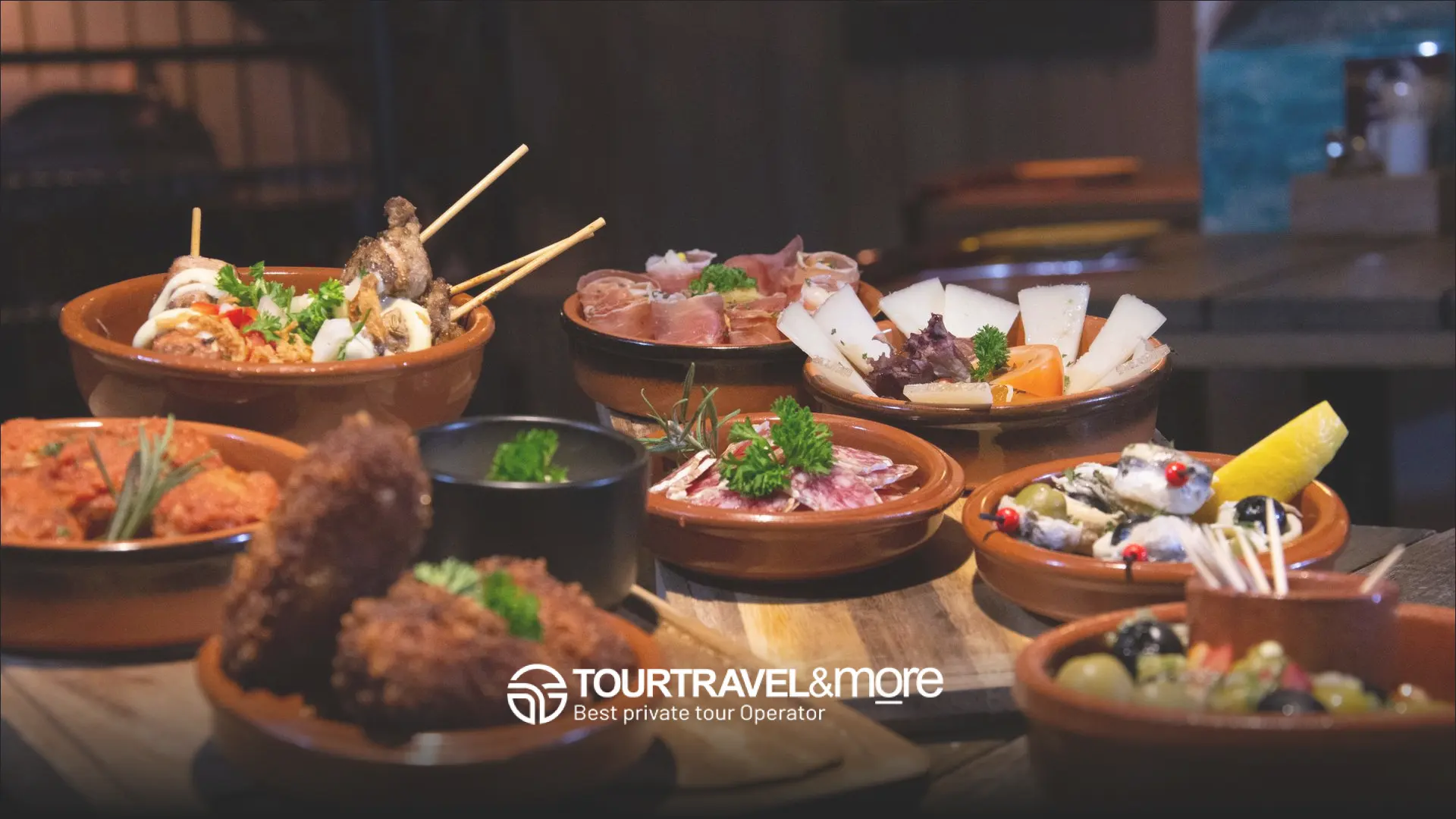
It is twenty past two on Calle de la Bola and a group is standing in front of a red façade. They read the menu in the window, one of them goes in to ask and comes out shaking his head: full until four. You walk past them, give your name at the door and are shown to a table by the window. An earthenware pot is already waiting on the tablecloth. You don’t know anyone in the house. You phoned yesterday, mid-afternoon, from the hotel.
What follows is that whole day, hour by hour: Madrid for foodies without a single wrong table. At every stop you get what is eaten, why it is eaten at that hour and what it costs. Because here the question is not only where to eat well, but when. Madrid keeps its own clock, and half of a hungry traveller’s disappointments come from reaching a good place at the wrong time.
The day before — One single booking
The whole day hangs on one phone call. You decide which meal is going to be the main one and you book it; everything else is eaten at the bar and is never booked.
Today it is cocido madrileño, and that shapes the rest. Cocido is served at midday, never at night, and the houses that do it best fill both sittings days ahead at weekends. You book for 14:30 at La Bola, a tavern open since 1870 where every cocido is cooked in its own earthenware pot, over holm-oak charcoal.
The second decision is less obvious: your stomach has a capacity limit too. Six stops fit into one day if the five small ones really are small. Sharing, ordering a half portion and leaving something on the plate is not bad manners. It is the only way to reach the evening still hungry.
9:30 — Churros or porras, the first decision
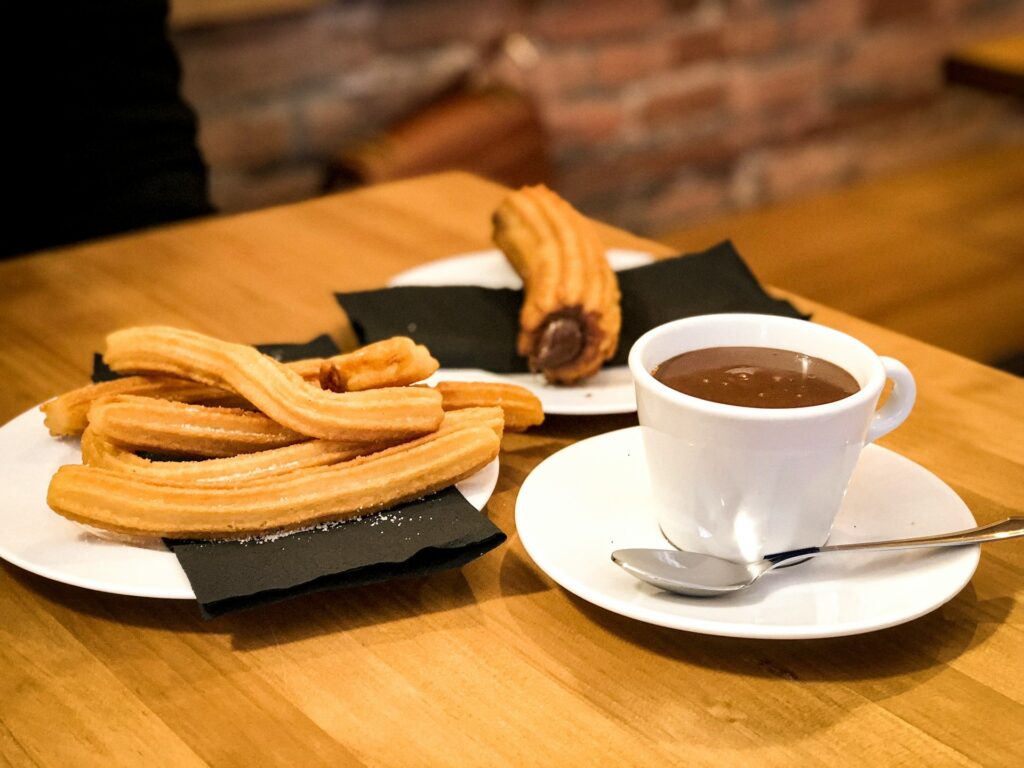
You turn into the Pasadizo de San Ginés, an alley behind Calle Arenal, and the smell of frying reaches you before the door does. The chocolatería has been there since 1894 and at this hour there are still free marble tables. In the afternoon, the queue spills out into the alley.
At the counter they ask you what nobody has explained: churros or porras. Churros are thin, crisp and looped. Porras are thicker and spongier, and they soak up more chocolate. The chocolate is thick, almost spoonable: here you don’t drink it, you dip.
A portion with its cup costs around 6 € and is enough for two. Share it. There are five stops to go.
11:00 — The pretty market and the real market
Three minutes away is the Mercado de San Miguel, an iron-and-glass structure from 1916 next to the Plaza Mayor. It opens at 10:00 and this is its good hour: you can walk between the stalls, look at the produce and take the photo without elbows.
It helps to know what it is. San Miguel is a market for nibbling on your feet, and one of the most expensive in the city: an oyster, a gilda, a glass of something. Nobody does their shopping there. You have one thing, look a lot and move on.
The markets where the neighbourhood shops are different ones, and several have bars inside: Antón Martín, between Huertas and Lavapiés; La Cebada, in La Latina; La Paz, in the Salamanca district, where the slice of tortilla at Casa Dani has its own queue. They close at midday on Saturdays and almost all are shut on Sundays, so the day of the week decides.
13:00 — Vermouth hour
Between one and two, Madrid doesn’t eat: it has the aperitivo. It is the custom most travellers skip, and the one that best explains the city.
You go to Casa Labra, a step away from the Puerta del Sol. The tavern dates from 1860 and the menu has barely changed: a piece of battered salt cod and a cod croquette. You order at a small window, pay, and eat standing up or out on the street, with a small beer or a vermut de grifo, vermouth on tap, drawn from the barrel, dark and slightly sweet.
Two pieces and a drink come to under 7 €. You are left hungry, and that is the idea: the cocido is an hour and a half away.
14:30 — Cocido and its vuelcos
You go back to Calle de la Bola. The group at the door is still there; you sit down.
The waiter lifts the pot and tips the broth over the noodles first. That is the soup. When you finish it, he comes back with the same pot and lets the rest fall onto the plate: the chickpeas, the potato, the cabbage, the chorizo, the pork belly, the meat. Those are the vuelcos: one single stew served in stages, and it is what sets cocido madrileño apart from any other pot dish.
Depending on the house, cocido costs between 25 and 40 € per person, without drinks. It is a meal for two long hours. Don’t order starters, however tempting the menu makes them.
If cocido is not your thing, the midday alternative is the menú del día: starter, main, bread, drink and dessert for between 12 and 18 €, Monday to Friday. It is where working Madrid eats.
17:00 — The hour when nobody eats
You leave after half past four and the city has changed. Between 16:00 and 20:30, almost every kitchen in Madrid is closed. The restaurants serving at six in the evening on the streets of the centre do exist, but they cook for people who don’t know the timetable.
A foodie doesn’t fight that. You walk to the Barrio de las Letras, have a coffee and let the cocido settle. If you need something sweet, the old pastry shops in the centre don’t close at midday.
20:30 — La Latina, one thing per bar
At half past eight the kitchens open and you are on Cava Baja, a curved street in La Latina with a tavern every other doorway.
The rule here is one round per bar and back out to the street. A small beer and one portion to share: huevos rotos in one, grilled pig’s ear in another, a slice of tortilla, some croquettes. Three or four bars make a dinner. Sitting down at the first one and ordering five dishes is what visitors do.
In most bars you pay for the portion. Sometimes the beer arrives with a few olives or crisps, but the free tapa is not the rule in Madrid the way it is in Granada. Four stops come to around 30 € per person.
Two streets away is Botín, open since 1725 and recognised by Guinness World Records as the oldest restaurant in the world. Its roast suckling pig is another main meal, for another day and with another booking.
23:30 — The last bar
In half of Europe everything would be closed. Here the bars are still full and one last decision is left: a slow drink, or back to the Pasadizo de San Ginés, which on several days of the week doesn’t close all night.
If you choose the drink, the breakdown by neighbourhood is in the best bars and cocktail bars in Madrid.
The day, stop by stop
| Time | What you eat | What it costs per person |
|---|---|---|
| 9:30 | Hot chocolate with churros or porras, to share | Around 3 € |
| 11:00 | One bite at the Mercado de San Miguel | Between 4 and 8 € |
| 13:00 | Battered cod and a cod croquette with vermouth on tap | Around 7 € |
| 14:30 | Full cocido madrileño, with a booking | Between 25 and 40 €, without drinks |
| 17:00 | Coffee, and nothing else | Around 3 € |
| 20:30 | Three or four bars in La Latina | Around 30 € |
The whole day comes to between 80 and 100 € per person. Prices are a guide and change from one season to the next.
What to order, dish by dish
| Dish | What it is | When to order it |
|---|---|---|
| Cocido madrileño | Chickpeas, vegetables and meats cooked together and served in stages | At midday and with a booking; best from October to April |
| Callos a la madrileña | Tripe stew with chorizo and paprika | At midday, as a portion to share |
| Bocadillo de calamares | Battered squid in a bread roll, nothing else | At any time, in the bars next to the Plaza Mayor |
| Tortilla de patatas | With or without onion, set or runny: ask first | A slice mid-morning |
| Huevos rotos | Fried eggs broken over fried potatoes, sometimes with ham | As a portion, in the evening |
| Soldaditos de Pavía | Battered and fried salt cod | At aperitivo time, standing up |
| Oreja a la plancha | Grilled pig’s ear with garlic or spicy brava sauce | On a bar crawl, in the evening |
| Vermut de grifo | Vermouth from the barrel, served with ice and an olive | Between 13:00 and 14:00 |
If you want to place these dishes on the map of the rest of the country, the overview is in Spanish gastronomy: top 10 dishes.
What can throw your day off
There are four things no restaurant list warns you about.
- On Mondays half the city is shut. Many taverns and traditional restaurants close on Mondays, and some on Sunday evenings as well. Check the closing day before crossing Madrid for one dish.
- On Sundays La Latina runs backwards. The Rastro flea market is on in the morning, and when it ends the whole neighbourhood has its aperitivo at once, between one and four. It is the best atmosphere of the week and the worst moment to find a spot at the bar.
- Cocido has a season. Some houses serve it all year and others only in the cold months or on certain days of the week. In August, on top of that, some kitchens close for holidays.
- Fine dining needs booking well before the flight. Madrid has a long list of Michelin-starred restaurants, and the most sought-after tables fill up weeks or months ahead. If a dinner like that is the reason for the trip, book it first and fit the rest around it.
If your trip doesn’t look like this one
| If this is your case | What to change | Why |
|---|---|---|
| You only have one afternoon | Vermouth at 13:00 and a bar crawl in La Latina at 20:30 | Those are the two hours when the city eats standing up |
| You are travelling on a Sunday | The Rastro in the morning and aperitivo in La Latina before 13:00 | After that hour nobody else fits at the bars |
| You are travelling in summer | Swap the cocido for a menú del día and stretch the evening | The stew is heavy in the heat and many houses don’t serve it |
| You don’t eat meat | Neighbourhood markets, tortilla, salt cod and seasonal vegetables | Traditional Madrid cooking is built on meat and offal |
| You are travelling with children | Churros, a bocadillo de calamares and dinner at 20:30 sharp | It is the first hour of kitchen service and the only one with free tables |
| You are after fine dining | One single big table per day, booked well in advance | A tasting menu takes three hours and leaves no room for more |
If you also want to fit the sights in between one dish and the next, the route is in Madrid in one day.
A day like this with Tour Travel & More
Finding good places in Madrid is easy. The hard part is knowing what to order at each bar, at what time it is at its best, and which of the five taverns on the same street is the one worth the stop.
With Tour Travel & More, these problems disappear:
- Private tapas tour in Madrid — 2 hours around the Plaza Mayor or the Plaza de Santa Ana, with 3 bars, 3 tapas and 3 drinks per person included.
- 100% private tour — No groups, no strangers: the starting time and the pace adapt to you.
- Official licensed guide — Who, as well as what to order, tells you the history of each house and of the streets between one bar and the next.
- Tailor-made itinerary — Allergies, dishes you would rather not try and dishes you don’t want to miss, flagged in advance.
- Guardian Angel Service 24/7 — Human coordination before, during and after your trip.
The group at the door
Go back to the beginning, to the red façade on Calle de la Bola. The group reading the menu in the window didn’t pick the wrong place: they had chosen well. They arrived, as almost everyone does, at lunchtime and without calling ahead. They probably ended up on some terrace or other, one of those with photos on the menu.
They knew as much as you did about where to eat in Madrid. The difference was one phone call the afternoon before, and knowing that here hunger keeps a timetable too.