You have been standing in front of Las Meninas for four minutes and, for the first time on this trip, you are in no hurry at all. You know who every person in that room is, why Velázquez painted himself into it, and what they are all actually looking at. A couple stops beside you for ten seconds, takes the obligatory photo and moves on. Three hours ago, that was you.
What follows is that whole day, hour by hour: a morning with a private guide and an afternoon without one. At every stop you get what actually changes, what it costs, and what would have happened if you had skipped it. Because the question was never guide or no guide. It is which hours of the day a guide is worth paying for.
9:45 — The queue you don’t join
You arrive at the Royal Palace from Plaza de Oriente and there is a solid line at the ticket window. Your guide is waiting outside with the tickets already issued, and you walk straight to the entrance. That, oddly enough, is the first moment you feel what you paid for, and nothing has been explained yet.
Admission to the Royal Palace is 18 € per person at the official ticket office, and it is almost never included in the guide’s fee. Worth knowing before you compare quotes: what you are hiring is the person, not the ticket.
Here is a detail nobody discovers until they try. If there were twelve of you instead of four, none of this could be improvised: group visits with your own guide have to be booked through Patrimonio Nacional between 3 months and 1 week in advance, in groups of 9 to 24 people. The freedom to decide the night before exists only below that number.
10:15 — The Royal Armoury, or the room nobody knows how to read
You walk into the Royal Armoury and, objectively, it is stunning: full suits of armour for men and horses, lined up in half-light. It is also, objectively, incomprehensible without someone to put it in order.
Your guide doesn’t start with the flashiest one. She starts with a single suit, explains whose it was and what it was actually used for — parade, tournament or battle, which are not the same thing — and from that point on the rest stop being repeated metal. This is precisely what a wall label cannot do.
The Royal Palace has 3,418 rooms, of which the visit covers a fraction. Whether you leave knowing what you saw or with a vague memory of gilded rooms doesn’t depend on how many you walk through, but on the order in which they are explained to you.
11:30 — The Prado: what you are not going to see
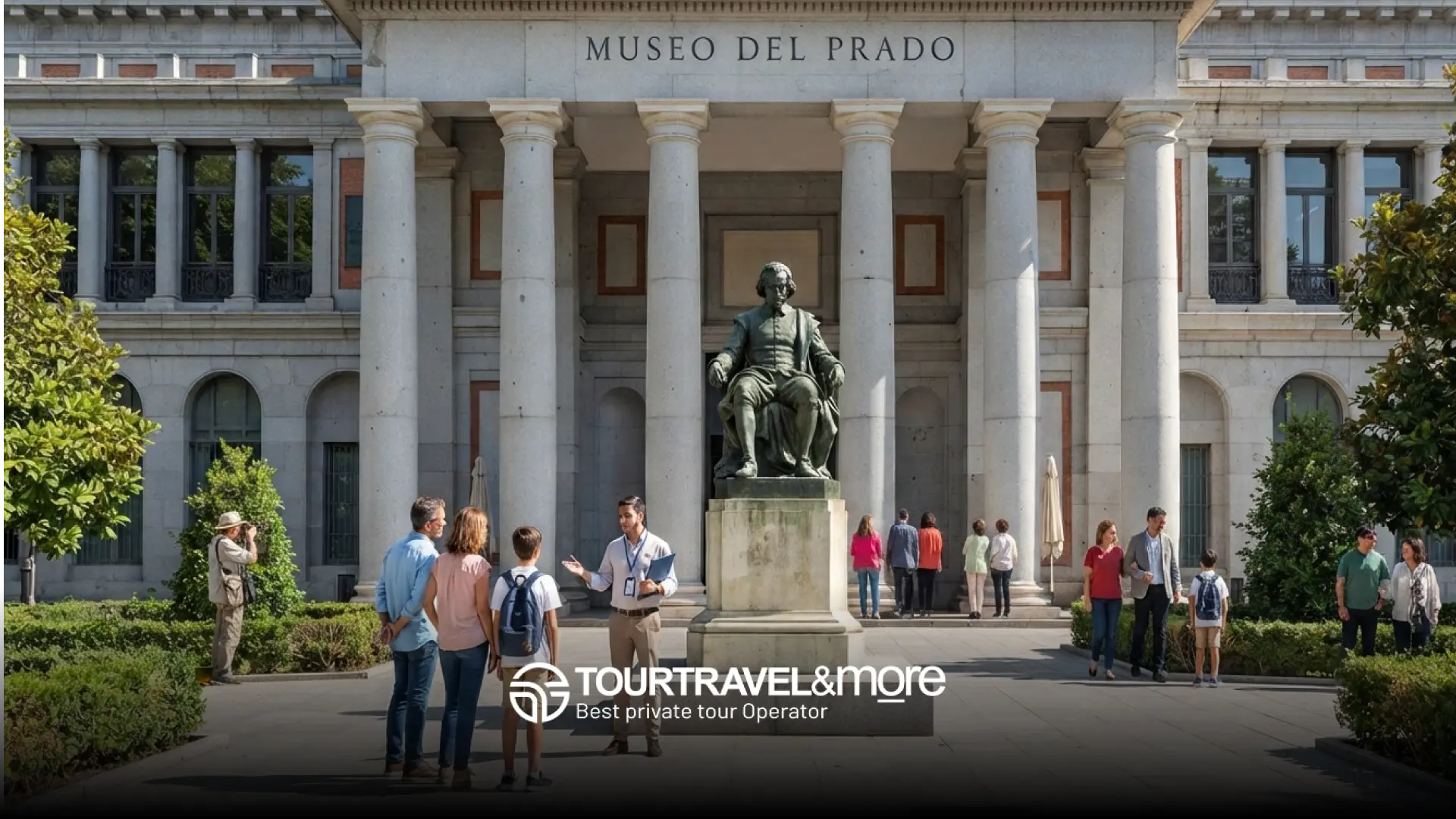
You cross to the Paseo del Arte and, before going in, your guide does something that sounds counterintuitive: she tells you what you are not going to see.
The Museo del Prado has more than 1,700 works on display, out of a collection of over 27,000 pieces. Nobody sees that in a morning, or in three. The route she proposes has about fifteen stops, with entire corridors walked straight through because today they are not the point.
That editing is the job. Museum fatigue arrives sooner than anyone expects — an hour and a half of galleries and your ability to look shuts down exactly when you reach what you came for — and visitors on their own tend to follow the order the corridors impose, which is not the order your energy follows.
General admission is 15 €, and it is free from 6 pm to 8 pm Monday to Saturday and from 5 pm to 7 pm on Sundays and holidays. That free slot is the busiest of the day and the worst possible one for a first visit. If budget is the priority, the full breakdown is in free things to do in Madrid.
12:10 — Four minutes in front of Las Meninas
This is where the story started.
Your guide explains the painting before you reach the room, not in front of it. It is a craft detail: standing in front of the canvas you are already looking, and looking and listening at the same time is done badly. By the time you are standing there, you know where to look. And you stay.
Nobody is wearing headsets and nobody is rushing, because there are fewer than nine of you. That number is not arbitrary, and it is the single detail that changes the experience inside the museum most: for the Prado, a group means 9 to 20 participants including the guide. Since June 2026 that maximum dropped from 30 to 20 with no exceptions, a guided group visit lasts 1 hour and 30 minutes from the moment you pass the turnstiles, and a radio-guide system is mandatory to keep gallery noise down.
Translated into real experience: in a group you listen through an earpiece, you move at the clock’s pace and you ask questions when there is a slot. Below that number — a family, two couples — you talk quietly, you stop where it interests you and you ask as you go. It is the difference between a lecture and a tutorial.
13:20 — The guide says goodbye, and that’s where the paying ends
You come out of the Prado, your guide writes down two places to eat nearby and leaves. It has been a long three and a half hours. And that is where the part of the day worth paying for ends.
This is the part almost no tour company admits, because it doesn’t sell. Hiring a guide from morning to night spends your budget on the hours where it shows least. What comes next is just as good, or better, with nobody explaining it.
14:30 — Eating on Madrid time
Madrid eats lunch at 2:30 pm and dinner at 9 pm, so at the hour when half of Europe has already cleared the tables, the taverns here are filling up. You don’t need a guide for that. You need to know it, and not find yourself standing in an empty restaurant in the centre at half past one wondering whether they are open.
This is the real reason the morning is the slot worth paying for: it is the only one that gives you a long, uninterrupted block before the city stops to eat.
17:00 — La Latina, where nobody needs to explain anything
You head down to La Latina with no plan. Narrow streets, terraces, people standing outside on Cava Baja, a beer on your feet because there is nowhere to sit. Nobody is explaining the history of the neighbourhood to you and you don’t miss it for a second.
The same goes for Malasaña in the late afternoon, for the Barrio de las Letras between terraces, and for the markets. These are places to be in, and being somewhere cannot be guided. A guide there adds anecdotes; he doesn’t change the experience. In the Prado or the Armoury, taking him away changes it completely. Pushing both halves of Madrid into the same question is exactly why some people swear it was the best part of their trip and others call it money thrown away.
20:45 — Debod, and the final sum
You walk up to the Temple of Debod for sunset, the most photographed plan in Madrid and one of the few that costs nothing. You sit on the grass with half the city around you.
And that is where you do the day’s arithmetic: you paid for three and a half hours and enjoyed fourteen. The other ten and a half sorted themselves out.
What would have happened without a guide
| Moment of the day | Without a guide | With a private guide |
|---|---|---|
| Royal Palace and Royal Armoury | Impressive rooms with no idea what sets them apart | Every room tied to who lived there and what it was for |
| Museo del Prado | Two hours of corridors with no criteria for what to look at | Fifteen stops in order, with your energy rationed |
| Las Meninas | Ten seconds, a photo and on to the next thing | Four minutes knowing where to look |
| La Latina and Barrio de las Letras | Exactly what you should be doing: walking | Anecdotes that add, but change nothing |
| Debod at sunset | A lovely evening, full stop | Very little. It is a place to be in |
The line is reasonably clear: it runs through the doors of the Prado and the Royal Palace, and stops the moment you step back onto the street.
Who is actually allowed to guide you inside each site
This is the point that explains most of the bad experiences, and almost nobody knows it is regulated.
The Community of Madrid distinguishes between a tourism guide and an officially accredited tourism guide. Guiding out on the street can be done by practically anyone with a higher education degree; what changes is that several institutions require official accreditation to work inside their buildings and monuments. That accreditation is earned by passing the exams the regional government sets, covering history, heritage and languages.
That is why most negative reviews of private guides in Madrid don’t say “it wasn’t worth it”. They say the guide recited a generic script, or that the private tour turned out to be a small group with fixed stops. That is a different problem, and paying less doesn’t fix it.
What that morning costs
| Service | Price for the whole group | Duration |
|---|---|---|
| Museum visit (Prado, Reina Sofía, Thyssen) | 170-195 € | 1.5-2 h |
| Monument visit | 150-195 € | 2 h |
| Monument plus a walk through the centre | 250-320 € | 3-4 h |
| Full day | 420-700 € | 8 h |
The morning in this story is the third row: a monument and a museum back to back, between 250 and 320 € for the whole group, not per person. Tickets are separate, and that is where a 250 € budget turns into 350 €: for four people, the Prado and the Royal Palace add 132 € that were not in the guide’s quote. The full breakdown is in how much a tour guide costs in Madrid.
| If there are | Private half day (250 €) | Group tour (25 €/person) |
|---|---|---|
| 2 of you | 125 € each | 50 € |
| 4 of you | 62.50 € each | 100 € |
| 6 of you | 41.70 € each | 150 € |
| 8 of you | 31.25 € each | 200 € |
The tipping point is four people. Beyond that, a private guide costs less per head than a shared tour, with the difference that the guide is only yours.
If your trip doesn’t look like this one
| If you travel like this | Private guide | Why |
|---|---|---|
| Solo or as a couple, 4 or 5 days | Probably not | This is when it costs most per person and when you have the most room to go at your own pace |
| Family or group of 4 to 8 | Yes, half a morning | The fee is per group: from 4 people it lands near the price of a shared tour |
| First time in Madrid, 2 days only | Yes, concentrated on museums | This is where you lose the most context, and where getting the order wrong hurts most |
| You already know Madrid | Only for something specific | What you have left is usually neighbourhoods and streets |
If you are travelling with children the shape of the day changes considerably, and we break it down in Madrid with kids.
A morning like this with Tour Travel & More
Getting the order of the rooms right, the tickets sorted and the timing of each stop is exactly what cannot be improvised from your hotel the night before.
With Tour Travel & More, these problems disappear:
- 100% private tour — No groups, no strangers: the pace and the route adapt to you, not the other way round.
- Official licensed guide — Accredited to work inside the Prado, the Royal Palace and the Royal Collections Gallery.
- Tickets arranged in advance, with a timed slot, skipping both the ticket window and the free-admission queue.
- Luxury vehicle with a private driver to link monument and museum without losing the morning in transit.
- Guardian Angel Service 24/7 — Human coordination before, during and after your trip.
The couple with the ten-second photo
Go back to the beginning, to the room with Las Meninas. The couple who walked past did nothing wrong: they saw the most famous painting in Spain, got their photo and carried on with their trip. They probably slept in a better hotel than yours with what they saved.
The difference is in what each of you remembers three months later. And in Madrid that difference is bought by the hour, not by the day: three or four well-placed ones in the morning, and the whole city to yourself for the rest of the afternoon.