
Marta booked four days in Madrid at the end of November and, a week before flying, the forecast put a rain icon on three of them. She reacted by buying the Paseo del Arte pass all at once and stacking the Prado, the Reina Sofía and the Thyssen into the same afternoon, so the “museum day” would be sorted in case it rained non-stop. It did rain: two half-hour showers across four days. The rest was clear skies. And El Retiro, the thing she wanted most, she left for the last day — the same one the park woke up closed under a wind warning. She went home having seen three museums back to back with her head full, and without getting anywhere near the lake.
The mistake wasn’t preparing for rain. It was assuming Madrid rains the way northern Europe does, when here the norm is the exact opposite.
Why rain in Madrid almost never lasts all day
Madrid gets around 435 mm of rain a year, spread over some 85 rainy days. That leaves roughly 280 days without a drop, and the figure sits well below what London or Amsterdam pile up, both in rainfall and in number of days.
The distribution matters more than the total. The peak is in autumn — October and November — and, to a lesser extent, in April and May; July and August have a very pronounced minimum, with almost no rain at all. When it does rain in summer it is usually a short, intense mid-afternoon storm, with clear skies before and after. In autumn and winter showers are more frequent, but they alternate with clear spells within the same day instead of keeping up a steady drizzle from dawn to dusk.
That changes the question worth asking. It isn’t “what do I do if it rains all day?”, but “what do I do during the hour or two of the shower, and how do I use the other ten?”.
Which plans the rain ruins
El Retiro is the clearest case, and not only for comfort. The city council has its own protocol for the park with four levels — green, yellow, orange and red — triggered by the wind forecast, the soil moisture and the temperature: at orange, evacuating and cordoning off the risk areas is recommended, and at red the park closes completely. This isn’t theory: in February 2026, with an AEMET yellow warning for gusts of up to 70 km/h, El Retiro and eight more of the city’s landmark parks were shut. The protocol was revised that same year to raise the wind threshold and cut down on closures, but the possibility is still there — and autumn storms bring rain and wind together.
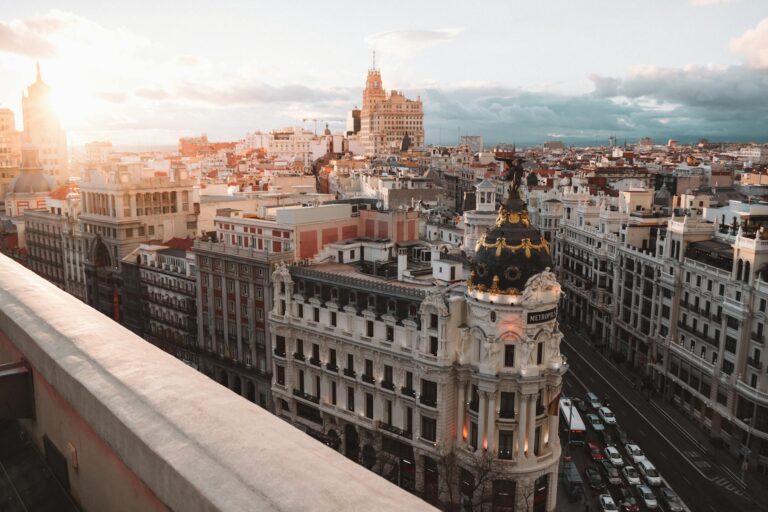
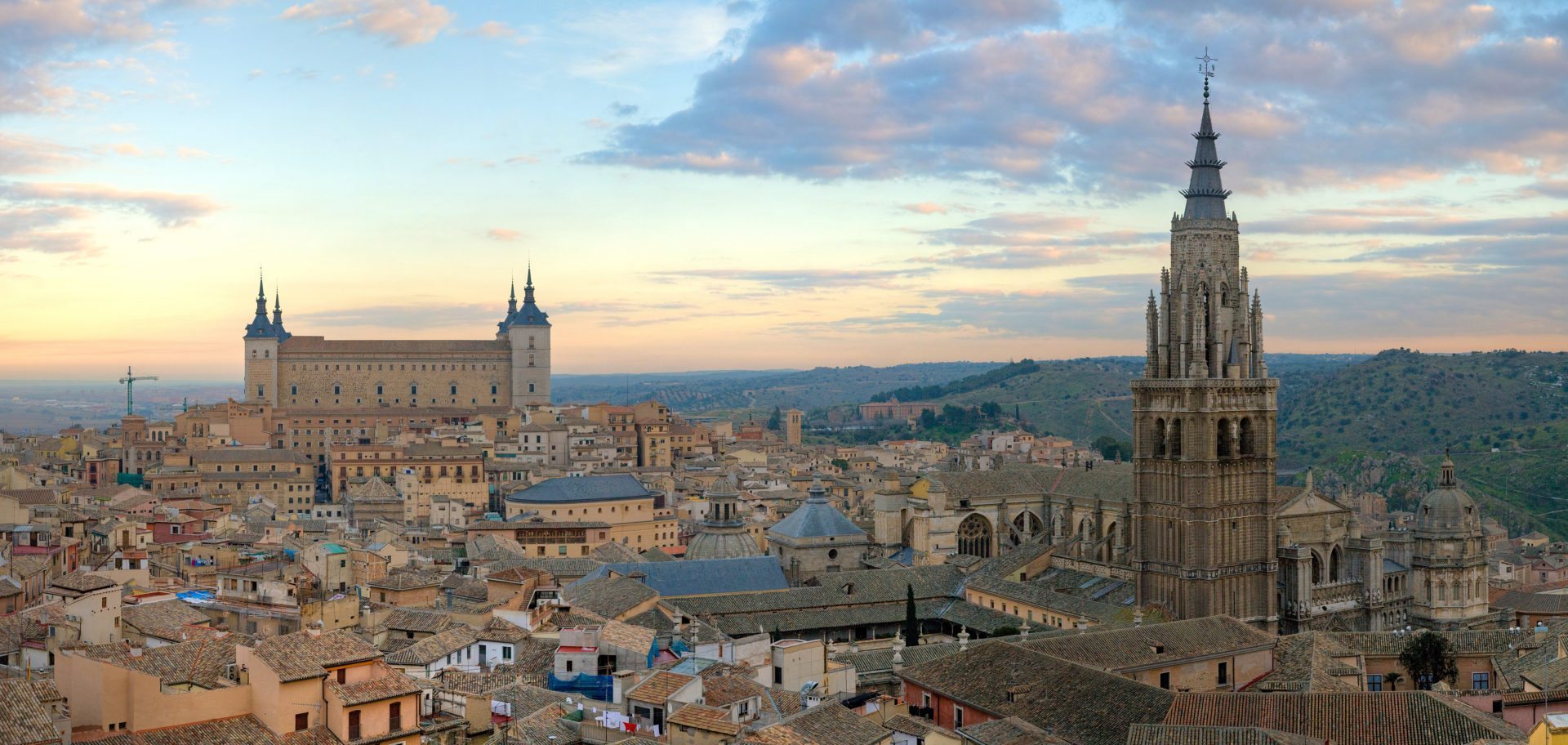
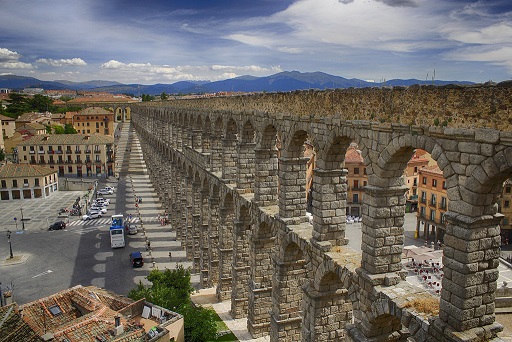
Then there are the rooftops and viewpoints: the one at the Círculo de Bellas Artes, the Gran Vía terraces, the Temple of Debod at sunset. With no cover and low cloud, there are no views to see. Long walking routes through the centre — Sol, Mayor, Ópera, Gran Vía — turn uncomfortable and the photos suffer. And day trips to Toledo or Segovia are, above all, steep streets and cobblestones.
| Plan | How rain affects it | Alternative if it pours |
|---|---|---|
| El Retiro and the rowing boats | With a wind warning the park can close completely | Move it to the clear window and don’t leave it for the last day |
| Rooftops and viewpoints (Círculo de Bellas Artes, Debod) | No cover and no visibility under low cloud | Save it for another afternoon of the trip |
| Walking route through the historic centre | Uncomfortable going and worse photos without sun | Shorten it and finish it once it clears |
| Day trip to Toledo or Segovia | Steep streets and slippery cobblestones | Switch it to the day with the better forecast |
 Private
 Private
 Private
Where to take shelter without wasting the day
The key isn’t ducking into any museum, but picking an indoor plan that is worth it in its own right and not only as a shelter.
The Paseo del Arte is the obvious answer, and it works: the Prado opens from 10:00 to 20:00 Monday to Saturday and its permanent collection absorbs a whole morning without repeating a room. With one practical warning: free entry runs from 18:00 to 20:00 Monday to Saturday and from 17:00 to 19:00 on Sundays and public holidays, and that slot is exactly the one that fills up on days washed out by rain. If it’s raining, the free-entry queue is the worst place to be; a paid timed ticket avoids precisely that.
The Reina Sofía and the Thyssen are good rain plans too: Marta’s mistake wasn’t choosing them, it was stacking them. Each one holds up on its own for the length of a shower, and each has its own scheduling trap. The Reina Sofía closes on Tuesdays — a rainy Tuesday drops it from the plan — and opens free from 19:00 to 21:00 Monday to Saturday and on Sundays from 12:30 to 14:30. The Thyssen opens Tuesday to Sunday from 10:00 to 19:00, and on Mondays only from 12:00 to 16:00, with the permanent collection free in that exact slot. If the budget is tight, the full breakdown of free time slots is in free things to do in Madrid.
A few metres from the Royal Palace, the Royal Collections Gallery covers another part of the day without stepping outside: the route descends by ramps across three underground levels, with the Royal Armoury, the royal tapestries and works by Bosch, Titian, El Greco, Velázquez and Caravaggio. General admission costs €14 and it’s free from 18:00 to 20:00 Monday to Thursday.
For a shorter gap, CaixaForum is the cheapest indoor plan in the Paseo del Arte area: €6 general admission, open every day from 10:00 to 20:00, without the weekly closing day the big museums have. Its vertical garden, 24 metres tall and 250 species, is on the façade, so in fairness that one looks just as good from the street with an umbrella.
And then there’s an advantage Madrid has that Rome and Lisbon don’t: the centre is stitched together by Metro. The stretch between Atocha, Sol, Ópera and Banco de España takes minutes without setting foot outside beyond going in and coming out. That turns the covered markets — San Miguel, next to the Plaza Mayor, or San Antón, in Chueca — and the San Ginés chocolate shop into plans you decide on once it’s already raining, not weeks ahead. If you’re travelling as a family, the running order of the day changes quite a bit, and we break it down in Madrid with kids.
| Indoor plan | Needs booking in advance | Why it works in the rain |
|---|---|---|
| Museo del Prado | Advisable, with a timed slot | Permanent collection for a whole morning, skipping the free-entry queue |
| Royal Collections Gallery | No, but check the opening hours | Three underground levels, entirely unaffected by the weather |
| Museo Reina Sofía | Advisable | Covers a whole afternoon, but closes on Tuesdays: watch out if the shower lands then |
| Museo Thyssen-Bornemisza | Advisable | Permanent collection free on Mondays, from 12:00 to 16:00 |
| Royal Palace | Advisable in high season | A full indoor visit |
| CaixaForum Madrid | No | €6 and open every day from 10:00 to 20:00, with no weekly closing day |
| Mercado de San Miguel or San Antón | No | Covered markets, a last-minute plan |
| Chocolatería San Ginés | No | Churros under cover and very long opening hours |
How to reorganize the day instead of cancelling it
A forecast a week out is only good for a general idea. The figure that decides is AEMET’s real-time rain radar, checked that same morning: it’s what tells a twenty-minute shower apart from a two-hour front. Deciding the night before off the cloud icon on your phone is what leads to cancelling plans that in practice only get interrupted for a while.
If El Retiro or the gardens are in the day’s plan, it’s worth also checking the park’s alert level that morning. A wind warning doesn’t show up in the rain icon, and it’s the one thing that can leave the plan closed outright.
Then comes the running order, and Madrid puts two things in your favour. One is the Metro, which lets you swap a block of street for a block of indoors without getting soaked in the attempt. The other is its own timetable: lunch here is at 14:30 and dinner at 21:00, so the meal is already a long stretch under a roof in the middle of the day — exactly the window the summer storms land in. What works is leaving the outdoor walk for the hours with the lowest probability and placing the museum in the window when it actually rains, rather than fixing the itinerary in advance with no room to swap the two blocks.
What to do when it rains in Madrid with Tour Travel & More
Reordering an itinerary on the fly — knowing whether El Retiro will be open, which booking is worth moving and which one is still worth keeping even under an overcast sky — is exactly what a traveler on their own can’t improvise in the middle of a downpour.
With Tour Travel & More, these problems disappear:
- 100% private tour — The itinerary gets reordered on the spot if the weather changes, with no fixed group schedule to work around.
- Official licensed guide — Knows what can be visited in the rain regardless and what is better moved to another slot of the day.
- Bookings sorted in advance for the Prado, the Royal Palace or the Royal Collections Gallery, with no dependence on last-minute availability or on the free-entry queue.
- Luxury vehicle with driver, for moving between one indoor plan and the next without waiting for a taxi in the rain.
- Guardian Angel Service 24/7 — Human coordination if the weather forces a change of plans with no advance warning.
The day Marta made it to the Retiro lake
On her next trip, Marta saw the rain icon in the forecast again and cancelled nothing. She checked the radar that same morning, saw a clear window of four hours and headed straight for El Retiro: a rowing boat, the Crystal Palace and a long, unhurried loop. The shower arrived mid-afternoon, exactly as the radar had suggested, and she spent it inside the Prado with a timed ticket bought two days earlier, with no queue.
There was no need for an indoor plan for all four days. Just understanding that a cloud icon in the forecast doesn’t mean a wasted day — only an hour or two that has to be placed in the right spot in the itinerary.
- Just your group
- Licensed guides
- Free cancellation