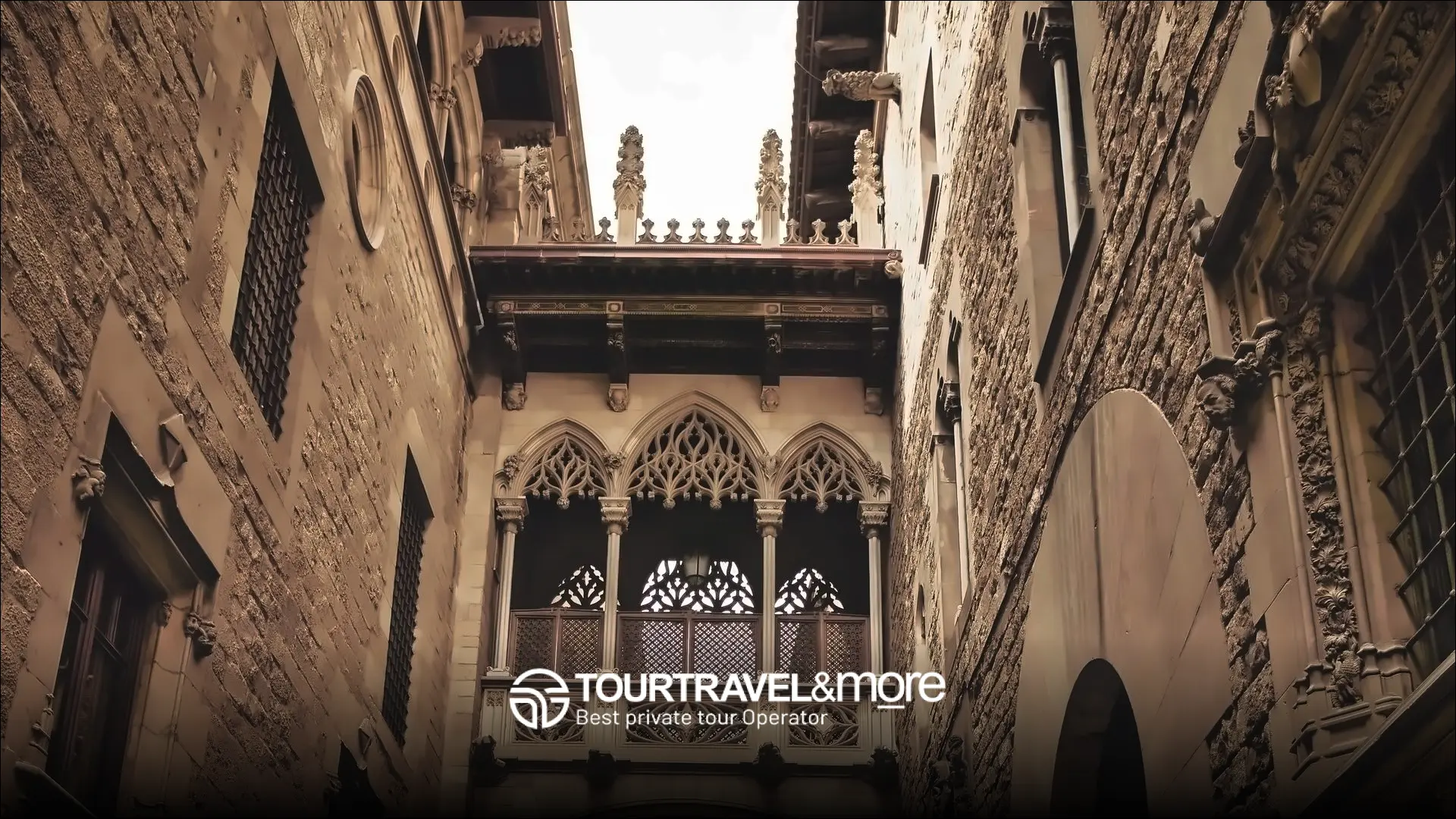
At 10:30, under the bridge on Carrer del Bisbe, there’s a queue. It isn’t to get in anywhere: it’s for the photo. A couple with a selfie stick wait their turn, and when it comes he tells her the bridge is “about six hundred years old”. He read it somewhere. You walked under it at 08:50, when the street was empty and still smelled of the water from the cleaning trucks. And you know the bridge was built in 1928.
What follows is one morning in Barcelona’s Gothic Quarter, hour by hour, from 08:30 to lunchtime. It’s a walking route of about 2.5 km, with ten stops you can cover without the metro or a taxi, and it’s designed to show you the Gothic Quarter in two ways at once: the postcard version, best seen early, and the one almost nobody notices, two streets away. Along the way you’ll find out something few guides mention: a good part of what looks medieval in this neighbourhood was built, or moved here, in the 20th century.
| Time | Stop | Don’t miss |
|---|---|---|
| 08:30 | Plaça Nova | The Roman towers, the “Barcino” letters and the Picasso frieze |
| 08:45 | Casa de l’Ardiaca | The letterbox with the swallows and the tortoise |
| 09:00 | The Cathedral | The cloister with its 13 geese, and the rooftop |
| 10:15 | Carrer del Bisbe | The 1928 bridge and the skull with the dagger |
| 10:30 | Plaça de Sant Felip Neri | The shrapnel marks from 1938 |
| 11:00 | El Call | The Sinagoga Major and the Hebrew stone from 1314 |
| 11:30 | Plaça de Sant Jaume and the Temple of Augustus | Four Roman columns, free, in a courtyard |
| 12:00 | Plaça del Rei | The Roman city beneath the museum |
| 13:00 | Santa Maria del Pi and Petritxol | The rose window and a hot chocolate in a granja |
| 13:30 | Plaça Reial | Gaudí’s lampposts, and lunch away from them |
08:30 — Plaça Nova: where the city began
You come out of Jaume I metro station, or walk down from Plaça de Catalunya, and reach Plaça Nova before the groups do. In front of you is the gate in the Roman wall of Barcino, the city founded under Augustus around 15 BC: two semicircular towers still standing, with stones almost two thousand years old at the base and medieval additions on top. Beside them, a few stone arches recall the aqueduct that brought water into the city; they’re a reconstruction, but they mark where it ran.
Look out for two things almost everyone walks past without seeing:
- The “Barcino” letters, large bronze letters placed around the square like a visual poem. They’re by the Catalan poet and artist Joan Brossa, from 1994.
- The Picasso frieze on the front of the Architects’ Association building (Col·legi d’Arquitectes), right opposite the cathedral. Picasso drew it in the early 1960s and a Norwegian artist sandblasted it into the concrete. It shows children, festival giants and local people in simple lines, and it’s the only Picasso work in Barcelona that’s out on the street.
If it’s a Thursday, the square in front of the cathedral fills with the stalls of the Mercat Gòtic, the antiques market: china, old postcards, iron keys and clocks. If it’s a Sunday morning, you may find people dancing the sardana, Catalonia’s traditional circle dance, in front of the cathedral, with a live band (a cobla) playing.
08:45 — Casa de l’Ardiaca: the letterbox nobody reads
To the left of the cathedral, along Carrer de Santa Llúcia, is the Casa de l’Ardiaca, the former residence of the archdeacon. Today it houses the city’s historical archive, and in the morning you can step into the courtyard: a fountain, a palm tree and a small Gothic cloister where there’s usually no one at this hour.
By the door there’s a stone letterbox with three swallows and a tortoise. It was designed by the architect Lluís Domènech i Montaner in 1895, when the building was the Bar Association. The popular reading is that the swallows stand for how fast justice should arrive, and the tortoise for how slowly it actually does. Stand next to it for a minute and you’ll see that hardly anyone stops.
09:00 — The Cathedral: go in early, look slowly
The Cathedral of the Holy Cross and Saint Eulalia opens in the morning for worship and, from 09:30, for tourist visits. The general ticket costs about €16 and gives access to the nave, the choir, the museum and the rooftop, which you reach by lift and from where you see the roofs of the Gothic Quarter almost at gargoyle level. On weekdays visiting hours run until mid-afternoon; on Sundays they’re shorter and start after lunch. Prices and opening times change often, so check the cathedral’s official website the day before. Shoulders and knees must be covered.
The first thing that catches your eye is the main façade, and this is where the route’s surprise begins: that very Gothic façade, with its spire and pinnacles, was finished in 1890, and the dome over the crossing in 1913. The cathedral was begun at the end of the 13th century, but the façade was left unfinished for centuries and completed, following a medieval drawing, when Barcelona had the money to pay for it. It’s neo-Gothic, like many of the things you’ll see this morning.
What is genuinely medieval is the cloister, with its fountain, orange trees and palms. It’s home to 13 white geese, one for each year of Saint Eulalia’s life when she was martyred, according to tradition; she’s the city’s patron saint. Geese have been kept here for centuries; it’s said they once served as an alarm, because they honk at any noise. Nearby, the crypt of Saint Eulalia, beneath the high altar, holds her alabaster tomb.
Allow an hour inside, or a little more if you go up to the rooftop. When you come out, there still won’t be a queue at the bridge.
10:15 — Carrer del Bisbe: the most photographed bridge is 98 years old
You leave by the side door and walk into Carrer del Bisbe, the narrowest and stoniest street in the neighbourhood. On one side is the Palau de la Generalitat, the seat of the Catalan government, with a Gothic Saint George carved above the door in the early 15th century. And a few metres further on is the Pont del Bisbe (Bishop’s Bridge), the lace-like Gothic bridge linking the palace with the Casa dels Canonges, and the one you’ll find in every photo of the area.
The bridge dates from 1928. It was designed by the architect Joan Rubió i Bellver, a pupil of Gaudí, for the 1929 International Exhibition, when Barcelona wanted to give its old quarter a more medieval look than it actually had. The very name “Barri Gòtic” caught on in those years. It isn’t a fraud: it’s a restoration typical of its time, like those in many European cities, and the bridge is just as beautiful. But it changes the way you look at the neighbourhood.
Look under the bridge, in the middle of the arch, for a skull pierced by a dagger. There are several legends about it; the most common says the architect put it there as an answer to those who criticised the project, and another that if anyone pulls out the dagger, the city will collapse. None of them is documented. By 10:15 the photo queue is starting. You already have yours.
10:30 — Plaça de Sant Felip Neri: the holes in the wall
A turn to the right and a narrow passage take you into Plaça de Sant Felip Neri, a small square with an octagonal fountain, a few trees and a Baroque church. It’s the quietest place in the Gothic Quarter, and there’s a reason for that.
The church façade is covered in holes and chips. They’re the marks of shrapnel from a bombing raid by the Italian air force, Franco’s ally, on 30 January 1938, during the Spanish Civil War. One bomb fell on the square and another as people were running to shelter in the church basement. Forty-two people died, most of them children who were sheltering there. Today there’s a school on the square, and at break time you can hear the children playing. Keep your voice down and don’t photograph the pupils.
There’s another detail almost nobody knows: two of the buildings on the square, the former guild houses of the coppersmiths and the shoemakers, weren’t originally here. They were moved stone by stone from other streets in the neighbourhood in the mid-20th century, when the city cut new roads through and decided to save their façades by rebuilding them in this square. It’s the same reconstructed Gothic as the bridge, only less obvious.
 Private
 Private
 Private
11:00 — El Call: the Jewish quarter in three streets
Leaving by Carrer de Sant Felip Neri you reach El Call, Barcelona’s medieval Jewish quarter, a handful of narrow streets between Carrer del Call, Carrer de Sant Domènec del Call and Carrer de Marlet. The Jewish community lived here until the attack of 1391, in which much of the quarter was destroyed and hundreds of people were killed. A few years later, the Call had ceased to exist.
There are three things to see in ten minutes:
- The Sinagoga Major, on Carrer de Marlet. It was identified in the late 20th century in the ground floor of a residential building, and today you can visit it for a few euros: a small room, below street level, with remains of the original walls.
- The Hebrew stone on the corner of Carrer de Marlet and Carrer de l’Arc de Sant Ramon del Call. It records a charitable foundation by Rabbi Samuel ha-Sardi and is dated 1314. The one you see is a copy; the original is kept in the city’s history museum.
- The El Call Interpretation Centre, on Placeta de Manuel Ribé, if you want to understand how the community lived. It’s a small branch of the city’s history museum.
The Call has no grand monuments. What it has are streets at odd angles, balconies that almost touch across the way, and a light that at 11:00 only reaches in from above.
11:30 — Plaça de Sant Jaume and the Temple of Augustus
Two more minutes and you come out into Plaça de Sant Jaume, open and bright after the alleyways. The forum of the Roman city stood here, and today the City Hall and the Palau de la Generalitat, the city government and the Catalan government, face each other across the square. It’s also where the big festivals happen, the human towers (castells) of La Mercè, and almost every demonstration.
From the corner of the square, walk up Carrer del Paradís. At number 10 there’s a doorway that looks like the entrance to a block of flats, with a courtyard at the back. Go in. Inside, with no ticket desk and no queue, stand the four columns of the Temple of Augustus, the Roman temple dedicated to the emperor: Corinthian, about nine metres high, wedged between the walls of a medieval building. Entry is free, though opening hours are short and it’s best to go in the morning.
As you leave, look at the ground in front of the doorway. There’s a millstone set into the paving that marks the highest point of Mont Tàber, the small hill, under 17 metres high, on which the Romans built Barcino. It’s the city’s lowest “mountain”, and almost everyone steps on it without knowing.
12:00 — Plaça del Rei: the Roman city beneath your feet
Heading down Carrer de la Llibreteria, or walking round the back of the cathedral, you reach Plaça del Rei, the most medieval square in the neighbourhood and, this time, the real thing. On one side is the Saló del Tinell, the great hall of the 14th-century royal palace, with its huge stone arches. At the far end are the Chapel of Santa Àgata and the tower of the Mirador del Rei Martí, five storeys of open galleries. Legend has it that Ferdinand and Isabella received Columbus on the steps of this square when he returned from his first voyage; there’s no proof it happened here, but the story keeps being told.
The building at the museum entrance, the Casa Padellàs, wasn’t originally on this square either: it’s a Gothic palace that was taken apart and reassembled here stone by stone in the 1930s, when the opening of Via Laietana swept away its street. Today it’s the entrance to the MUHBA, the Barcelona History Museum.
If you’re only paying for one ticket on the whole route, make it this one. The museum lift takes you under the square, into about 4,000 m² of excavated Roman city: streets, walls, a laundry, a factory for salted fish and garum (Roman fish sauce) and the tanks where wine was made. You walk on raised walkways above the ruins, literally beneath the streets you’ve just walked along. The general ticket costs around €7, it’s closed on Mondays, and entry is free on Sunday afternoons from 15:00 and all day on the first Sunday of the month. Allow an hour.
13:00 — Santa Maria del Pi and Carrer de Petritxol
From the museum you cross the neighbourhood towards La Rambla and reach Plaça del Pi, with its basilica of Santa Maria del Pi, pure Catalan Gothic: a single, very wide nave with no columns in the middle, and one of the largest rose windows in Europe above the door. Entry is around €8, and the guided climb up the bell tower is extra. At weekends there’s a painters’ market in the square next door, Plaça de Sant Josep Oriol.
Off the square runs Carrer de Petritxol, a narrow street with tiled façades, the Sala Parés, the city’s oldest art gallery, and several granjas: that’s what Barcelona calls its old-fashioned cafés serving chocolate and dairy. Order a suizo, thick hot chocolate topped with whipped cream, or a xocolata desfeta with melindros, soft sponge fingers for dipping. People have been having this here in the afternoon for over a century, and it’s the best way to round off a morning of stone.
13:30 — Plaça Reial: Gaudí’s lampposts, and lunch away from them
The route ends in Plaça Reial, a 19th-century arcaded square with palm trees and a fountain in the middle. Look at the two six-armed lampposts topped with a winged helmet: they’re by Gaudí, from 1879, one of his first public commissions, before he was Gaudí.
What you shouldn’t do is eat in the square. The terraces under the arcades have waiters at the door, menus with photos and La Rambla prices, and La Rambla is twenty metres away. To eat well, leave the Gothic Quarter: cross Via Laietana into El Born, or head into El Raval or the Eixample, and look for a restaurant with a menú del día on the board outside: a set lunch with a starter, a main course, dessert, bread and a drink at a fixed price, served on weekdays.
While you’re choosing, you see the couple from the bridge sitting on a terrace in the square. They’ve taken the photo of the bridge, the one of the cathedral from outside and the one of the lampposts. They show you the bridge on their phone: with the queue and the stick, it’s come out really well. He repeats the bit about six hundred years. You don’t correct him. But you’ve spent the morning in another neighbourhood: the one with the shrapnel of Sant Felip Neri, the columns hidden in a courtyard, the rabbi’s stone and the Roman city under the square. It’s the same Gothic Quarter. You’ve just looked at it upwards, and downwards.
The tickets on the route at a glance
Most of the Gothic Quarter is free, out on the street. These are the paid visits and the times when they aren’t. Prices are a guide as of November 2026.
| Visit | Approximate price | When it’s free or cheaper |
|---|---|---|
| Cathedral (full visit with rooftop) | About €16 | During worship hours you can go in to pray, without the tourist visit |
| MUHBA Plaça del Rei | About €7 | Sundays from 15:00 and all day on the first Sunday of the month; closed on Mondays |
| Sinagoga Major | A few euros | Short visit; reduced hours in winter |
| Santa Maria del Pi | About €8 | The bell tower, with a guided visit, is extra |
| Temple of Augustus | Free | Short opening hours; best in the morning |
| Casa de l’Ardiaca (courtyard) | Free | Only during the archive’s opening hours |
| Plaça Nova, Sant Felip Neri, the Call and Plaça del Rei | Free | Always, at any time |
When to walk the route and how long it takes
Walking without stopping, the route takes you less than an hour. With the cathedral, the MUHBA and a stop on Petritxol, allow about four and a half hours, from 08:30 to 13:00. A few tips that make a real difference:
- Start early. Before 10:00, Carrer del Bisbe, Sant Felip Neri and the Call are almost empty. From 11:00 the groups and free tours arrive, and in summer the streets stay crowded until sunset.
- Avoid Monday if you want to go into the MUHBA, and Sunday morning if you want to see the cathedral as a visitor: that day the tourist visit starts in the afternoon.
- Wear comfortable shoes. The paving stones have been polished by centuries of footsteps and get slippery in the rain. Rain, by the way, suits the Gothic Quarter: the stones shine and the streets empty. There are more ideas for those days in things to do in Barcelona when it rains.
- Wear your backpack on your front. The Gothic Quarter isn’t dangerous, but its narrow streets, Plaça Reial and La Rambla, which runs along one side, are pickpocket areas. Keep your phone in your pocket when you’re not taking pictures.
- The best light is early morning and late afternoon. At midday the sun doesn’t reach down into the narrow streets. If you’re taking photos, come back to Carrer del Bisbe after 17:00: the bridge lights up and the morning groups have gone.
What almost every Gothic Quarter route leaves out
If you still have the energy, or come back another day, there are stops that few routes include and that are five minutes from this one:
- Plaça de Sant Just, behind City Hall, with one of the oldest churches in the city and a Gothic fountain. It’s a neighbourhood square, with no terraces aimed at visitors.
- The Roman wall on Plaça de Ramon Berenguer el Gran, next to Via Laietana, the longest stretch still standing, with the Chapel of Santa Àgata on top.
- Carrer de la Pietat, behind the cathedral, the street that runs along the cloister. From it you can see a Gothic doorway with a carving of the Pietà, and first thing in the morning it’s probably the quietest street in the neighbourhood.
- Santa Maria del Mar, in El Born, across Via Laietana. Strictly speaking it isn’t in the Gothic Quarter, but it’s the most beautiful Gothic church in Barcelona and it’s ten minutes away.
For more places like these across the whole city, see secret places in Barcelona.
If your visit doesn’t look like this one
| If this is you | What to change on the route | What to prioritise |
|---|---|---|
| You only have an hour | Skip the inside of the cathedral and the MUHBA | Plaça Nova, Carrer del Bisbe, Sant Felip Neri and the Temple of Augustus |
| You’re going in the afternoon | Start at Plaça Reial and walk the route in reverse | The cathedral before it closes and Carrer del Bisbe in the 17:00 light |
| You’re travelling with children | Shorten the Call and spend longer at the MUHBA | The geese in the cloister, the Roman ruins underground and the chocolate on Petritxol |
| It’s a Sunday | Change the order: MUHBA in the afternoon | Sardana dancing outside the cathedral in the morning and the museum free from 15:00 |
| It’s a Monday | Swap the MUHBA for the cathedral cloister | The cathedral rooftop and the Temple of Augustus |
| You have a whole day in Barcelona | Do the route in the morning and carry on into El Born | The rest of the day in Barcelona in one day |
If it’s your first time in the city, you’ll also find Barcelona in 3 days useful, with the Gothic Quarter as its first morning, and the most beautiful places in Barcelona for the rest of the city.
The Gothic Quarter with Tour Travel & More
You can walk the Gothic Quarter on your own, but what makes it interesting isn’t on the signs: that the bridge dates from 1928, that two buildings on a square came from another street, that the Roman columns stand in an unsignposted courtyard, or that the holes in a façade come from a bombing raid. Without someone to tell you, it’s easy to end up taking the usual photo at the usual time, among groups of forty following a raised umbrella.
With Tour Travel & More, these problems disappear:
- 100% private tour — Just you and yours, first thing in the morning or whenever you prefer, through the Gothic Quarter streets the groups never reach.
- Official licensed guide — Who tells you about Roman, medieval and rebuilt Barcelona, and shows you how to tell them apart.
- Tickets handled for you — The cathedral, the MUHBA or any visit you want to add, with a set time slot and no queues.
- Luxury vehicle with a professional driver — If you want to combine the Gothic Quarter with the Sagrada Família or Montjuïc on the same day, without hunting for a taxi between visits.
- Guardian Angel Service 24/7 — Real people coordinating everything before, during and after your trip, including last-minute changes.
We’re from Barcelona: the company was founded here in 2014, and today we hold a rating of 4.9 out of 5 from more than 500 reviews by verified travelers.
- Just your group
- Licensed guides
- Free cancellation