Marta had spent forty minutes in the Sagrada Família queue on a Tuesday in October. Ahead of her, three groups with headsets. Behind her, a cruise ship that had just docked. When she finally got in, the nave was so crowded she couldn’t take a single photo without a head in it.
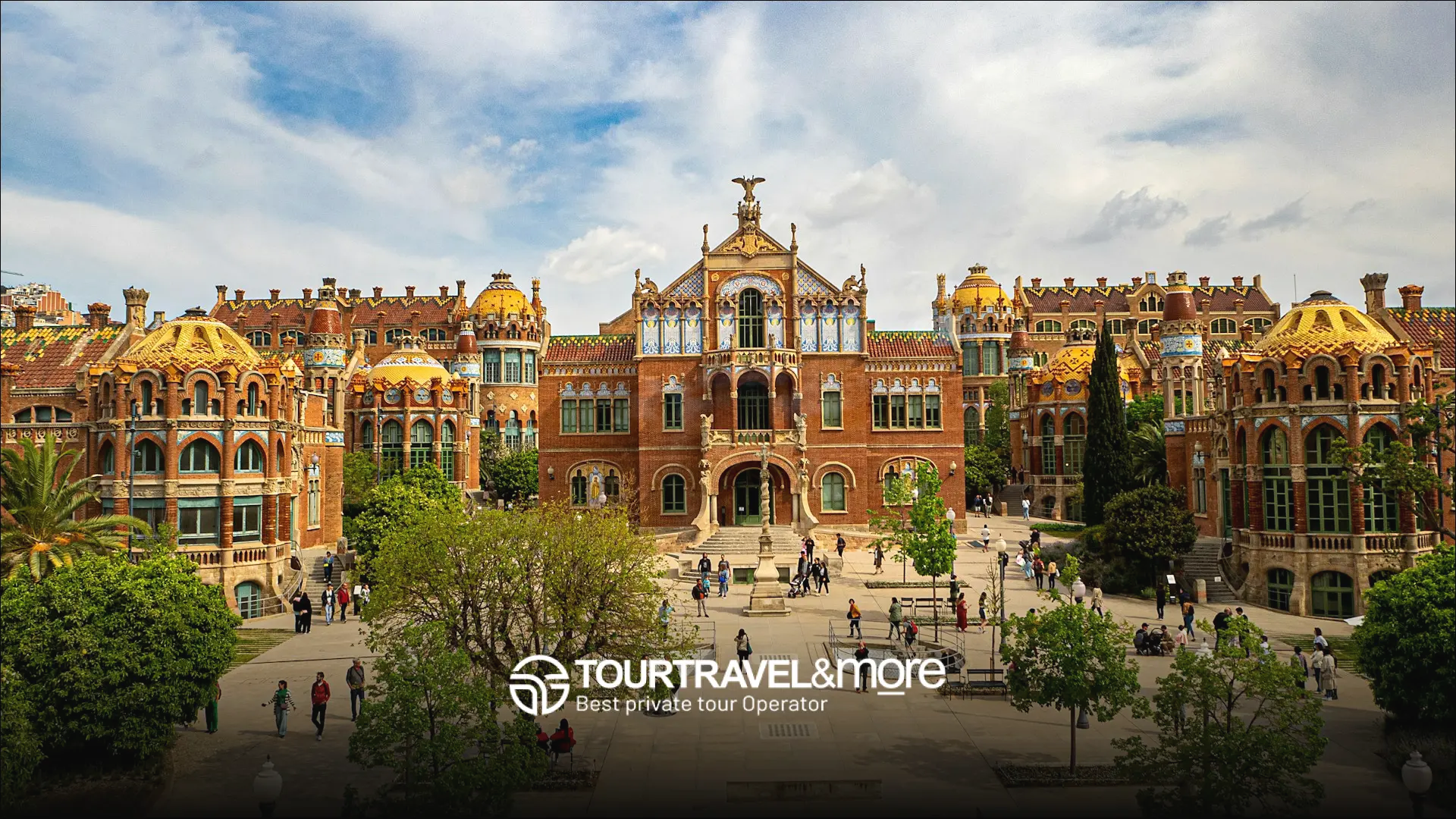
On the way out she walked ten minutes along Avinguda de Gaudí and went into the Recinte Modernista de Sant Pau. Ceramic domes, gardens, columns covered in pink tiles. There were eight people.
The most beautiful places in Barcelona aren’t always the most famous ones, and they rarely look their best at just any time of day. The city has a dozen places that genuinely take your breath away: some are two streets from the monuments on every list and have no queues, and others depend on arriving with the right light.
The most beautiful places in Barcelona at a glance
This is the short list, with what makes each place beautiful and when it looks its best.
| Place | Why it’s beautiful | Best time |
|---|---|---|
| Recinte Modernista de Sant Pau | Pavilions of ceramic and mosaic set among gardens | First thing, at opening time |
| Casa Vicens | Gaudí’s first house, covered in green and white tiles | In the morning, with sun on the façade |
| Palau Güell | A hall with a perforated dome like a starry sky | First thing, before the groups |
| MNAC steps | The city lined up from Montjuïc to Collserola | At sunset |
| Tibidabo | The highest view in Barcelona, at 512 metres | In the morning, while the air is clear |
| Jardins de Mossèn Costa i Llobera | Giant cacti with the port behind them | Mid-afternoon |
| Cascada of the Parc de la Ciutadella | The monumental fountain a young Gaudí worked on | In the morning, with the water backlit |
| Gràcia’s squares | Small squares with terraces and neighbourhood life | At vermouth time |
| Inside the Sagrada Família | Stained glass that floods the nave with colour | Between 4 pm and 6 pm |
The famous places that are also the most beautiful
Four places appear on every list and are also genuinely among the most beautiful in Barcelona. There’s no need to repeat everything we’ve already said about them, but here’s the detail that makes them beautiful.
- Sagrada Família. The beauty is inside: cool-toned stained glass on the Nativity façade, which faces east, and warm tones on the Passion façade, which faces west. Between four and six in the afternoon, the nave turns orange and red. We explain the light month by month in Sagrada Familia month by month.
- Palau de la Música Catalana. The inverted glass skylight above the hall only makes full sense during a concert, not on the tour.
- Santa Maria del Mar. Bare Catalan Gothic, with almost no ornament, and morning sun pouring through the rose window.
- Casa Batlló or La Pedrera. Both are stunning; one is enough.
We cover all four, with what you need to know before going, in what not to miss in Barcelona. Here we focus on what those lists usually leave out.
The most beautiful modernist interiors, without the queues
Barcelona’s modernism doesn’t end on Passeig de Gràcia. Three of its most beautiful interiors get a fraction of the Sagrada Família’s visitors and can be seen without rushing.
Recinte Modernista de Sant Pau, the forgotten one
Ten minutes on foot from the Sagrada Família is one of the most beautiful modernist complexes in Europe. Lluís Domènech i Montaner designed it as a hospital, it was built between 1902 and 1930, and it has been a UNESCO World Heritage Site since 1997.
It’s a set of brick, ceramic and mosaic pavilions linked by gardens and by underground tunnels once used to move patients. Inside the Administration Pavilion, the columns and vaults covered in pink tiles are a match for any Gaudí house.
- Opening hours: 9:30 am to 6:30 pm from April to October, and until 5 pm from November to March.
- Tickets: €18 general admission, dropping to €17 from 2 pm. Free on 23 April and 24 September.
- Best time: at opening. Empty gardens and low light on the ceramics are the photo.
Casa Vicens, Gaudí’s first house
Before the Sagrada Família, before Park Güell, Gaudí built this summer house in Gràcia between 1883 and 1885. He was 31, and it shows: the façade is covered in green and white tiles with French marigold flowers, the plant that grew on the plot before it was built on.
Inside, the smoking room has a muqarnas ceiling that looks straight out of the Alhambra, and the iron gate at the entrance reproduces palmetto leaves. It has been a UNESCO World Heritage Site since 2005 and only opened as a museum in 2017, so it’s still missing from most lists.
- Opening hours: 9:30 am to 8 pm from April to October and 9:30 am to 6 pm from November to March. Closed on 25 December and from 7 to 14 January.
- Tickets: €22 general admission and €20 reduced.
- Best time: in the morning, when the sun hits the main façade.
Palau Güell, Gaudí at his darkest
Fifty metres from La Rambla, on Carrer Nou de la Rambla, stands a palace Gaudí built for his patron, Eusebi Güell, between 1886 and 1890. From the outside it’s severe, almost a fortress. Inside, the central hall rises three floors and ends in a dome pierced by small openings that let daylight through like a starry sky.
Then you climb to the roof: a forest of chimneys covered in trencadís, the broken-tile mosaic Gaudí would later use in Park Güell.
- Opening hours: 10 am to 8 pm from April to October and 10 am to 5:30 pm from November to March. Closed on Mondays that aren’t public holidays and in the last week of January.
- Tickets: €15 general admission and €12 reduced. Free on the first Sunday of every month.
- Best time: first thing, to have the roof almost to yourself.
 Private
 Private
 Private
What is the most beautiful neighbourhood in Barcelona?
It depends on what you’re after. The Gothic Quarter has the monuments, but if you want the most beautiful side of Barcelona with real neighbourhood life, these three are worth the trip.
Gràcia is the most complete. It was an independent town until 1897 and keeps its small squares, narrow streets and long-standing family shops. In August, during the Festa Major de Gràcia, residents decorate entire streets with recycled materials and compete for the most beautiful one.
Eixample is beautiful at block scale. Ildefons Cerdà’s grid, with its cut-off corners, is best seen from above, but at street level it holds Puig i Cadafalch’s Casa de les Punxes, with its six pointed towers, and dozens of modernist doorways you can admire from the pavement.
Sarrià was a town in its own right until 1921, and it still feels like one. You get there on the Ferrocarrils from Plaça de Catalunya, and Carrer Major de Sarrià still has old-school pastry shops such as Foix de Sarrià, open since 1886.
The most beautiful viewpoints in Barcelona, by time of day
You understand the city from above: Eixample as a perfect grid, the Sagrada Família rising out of it, the sea on one side and Collserola on the other. What hardly anyone mentions is that every viewpoint has its moment.
| Viewpoint | What you see | Best time |
|---|---|---|
| MNAC steps | Avinguda Maria Cristina down to Plaça d’Espanya and Collserola | At sunset, especially in summer |
| Tibidabo | The whole city and the sea from 512 metres | In the morning, before the haze builds |
| Montjuïc Castle | The port, the cruise ships and the coast to the south | Mid-afternoon |
| Carretera de les Aigües | The entire city from Collserola, on foot or by bike | At sunset, with the sun behind you |
The MNAC steps at sunset
From the steps of the Palau Nacional, Avinguda Maria Cristina runs straight down to Plaça d’Espanya, with its two Venetian towers, and behind it the whole city stretches up to Collserola. At sunset the sun goes down behind you and turns the city in front of you orange. It’s free from outside and ten minutes on foot from Plaça d’Espanya metro, or you can take the escalators up the hill.
Tibidabo, better in the morning
It’s the highest point in the city. At the top are the Sagrat Cor church and an amusement park that opened in 1901 and still keeps some period rides. The view is easily spoiled: from midday onwards, especially in summer, a layer of haze wipes out the horizon. Go up in the morning on a windy day, which is when you can even see Montserrat.
The Bunkers del Carmel are the other great viewpoint, and in summer the enclosure closes before sunset. We explain it in detail in what not to miss in Barcelona.
The most beautiful gardens in Barcelona
The Cascada in the Parc de la Ciutadella
The monumental fountain in the Ciutadella, with Aurora’s chariot on top and its winged griffins, was designed by Josep Fontserè for the 1888 Universal Exhibition. Among his assistants was an architecture student called Antoni Gaudí. It’s free and five minutes from El Born.
Go in the morning: the sun comes in from the side, the water sparkles against the light and the rowing boats on the lake are still moored.
Jardins de Mossèn Costa i Llobera, cacti facing the port
On the side of Montjuïc that drops down to the sea there’s a garden devoted to succulents and cacti, with specimens taller than a person. The beauty is in the contrast: desert cacti and, behind them, the port with its cruise ships. It’s free and pairs well with the cable car or Montjuïc Castle.
A route to see the most beautiful places in Barcelona in the best light
If you have one day and want to see the most beautiful places rather than the most famous, this is the order that makes the most of the light:
| Time | Stop | Why at that time |
|---|---|---|
| 9:30 am | Recinte Modernista de Sant Pau | It opens and the gardens are empty |
| 11:30 am | Casa Vicens | Sun on the tiled façade |
| 1:30 pm | Lunch in Gràcia | Plaça de la Virreina or Plaça del Sol, at local prices |
| 4 pm | Inside the Sagrada Família | The warm light of the west-facing windows |
| Sunset | MNAC steps | The sun sets over the city |
If you can’t get an afternoon slot for the Sagrada Família, swap it for Palau Güell and then walk down the Paral·lel to Montjuïc. In July and August, add a long break after lunch: at three in the afternoon, the Eixample asphalt has nothing beautiful about it.


The most beautiful places in Barcelona with Tour Travel & More
Seeing all this on your own is possible. But beauty in Barcelona depends on timing, and fitting the Sagrada Família’s afternoon slot, Sant Pau’s opening and sunset on Montjuïc into one day is easy to get wrong.
With Tour Travel & More, these problems disappear:
- 100% private tour — It’s your pace, not that of a group following a raised flag. If you want to spend half an hour in the Sant Pau gardens, you do.
- Official licensed guide — Explains why the Sagrada Família changes colour and why Casa Vicens is covered in marigolds, and orders the route around that day’s light.
- Tickets handled for you for the Sagrada Família’s afternoon slot, even when it shows as sold out on the official website.
- Luxury vehicle with a private driver to reach Tibidabo or Montjuïc without the uphill walk or changing lines, with pickup at your hotel or the cruise terminal.
- Guardian Angel Service 24/7 — Human coordination before, during and after the tour, in case anything goes wrong.
We’re from Barcelona: the company was founded here in 2014, and today we hold a rating of 4.9 out of 5 from more than 500 reviews by verified travelers.
The difference between seeing Barcelona and seeing it at its most beautiful
Marta went back two days later. She walked into Sant Pau at half past nine, with the gardens to herself. At half past four she was sitting in the Sagrada Família watching the nave shift from yellow to red, and she watched the sunset from the MNAC steps.
She didn’t see more places than on the first day. She saw different ones, at the right time. That’s the most beautiful thing about Barcelona: not a longer list, but knowing where to look and when to arrive.
- Just your group
- Licensed guides
- Free cancellation