On the plane you end up next to a couple flying to Barcelona for the first time, just like you. She has a handwritten list on the last page of her guidebook: “La Rambla, paella and sangria, Sagrada Família, beach, mojito at sunset”. He bought their Sagrada Família tickets the night before, on the first website that came up in the search, and shows you the email: €52 each. You paid €26. You say nothing. He hasn’t checked the price on the official website yet.
What follows is your first day in Barcelona, hour by hour, from the airport to midnight. At every stop you get the tourist trap waiting there, why so many people fall for it and what to do instead. This is not a list of things to be afraid of. Barcelona is a safe city, and what usually happens to visitors is not a violent robbery but paying double for something worth half, or losing a phone left on a café table. Almost all of it can be avoided once you know where it is.
The day before — Tickets, on the website you type yourself
The first trap in Barcelona isn’t in Barcelona. It’s in your search engine. Type “Sagrada Família tickets” and the top results are often ads for websites that copy the official one: same colours, same photos, the word “official” in the title. They sell a real ticket, but with a mark-up that can double the price. The Catalan police (the Mossos d’Esquadra) and Catalonia’s cybersecurity agency have warned about these sites more than once, and they exist for Park Güell and Montserrat too.
You did three things:
- Typed the address yourself, without clicking on ads: sagradafamilia.org for the basilica and parkguell.barcelona for the park.
- Compared the price. A basic adult ticket to the Sagrada Família costs from €26 on the official website. If you’re asked for €50 or €60 for the same ticket without a guide, you’re on a resale site.
- Bought with days to spare. In high season the best time slots sell out one or two weeks ahead, and that’s exactly when people end up on whichever site still has availability.
Agencies and guided tours also sell tickets, and there’s nothing wrong with that: what you pay extra for is the guide, the small group or the transfer. The trap is paying tour prices for a standard ticket. If you’d like to know when the light inside is at its best, it’s all in Sagrada Familia month by month.
9:30 — El Prat: the metered taxi and the man offering a price
You walk out into the T1 arrivals hall and, before you even see the taxi sign, a man with a clipboard asks if you need a ride into town. He offers a fixed price and tells you a taxi costs more. It doesn’t. No transport offered to you in the arrivals hall is worth trusting unless you booked it yourself. Official taxis, black and yellow, wait at the signposted rank outside the terminal.
Airport taxis always run on the meter. There’s no fixed fare into the city centre: there’s an airport supplement of €4.60, already included on the meter, and a minimum fare of €21. To Plaça de Catalunya or the Eixample, expect around €30-40 depending on traffic and time of day. The only fixed fare from the airport is to the cruise terminal. If anyone offers you “€35 to anywhere”, that isn’t the official rate.
If you’d rather not take a taxi, you have three options:
| Getting into the city | Approximate price | Good to know |
|---|---|---|
| Official taxi | Around €30-40 | Metered; the €4.60 supplement is included; €21 minimum fare |
| Aerobús | Around €7.75 one way | Leaves from T1 and T2 and reaches Plaça de Catalunya in about 35 minutes |
| Metro, line 9 Sud | Airport ticket, €5.90 | The T-casual travelcard and single tickets don’t work at the airport stations |
| Rodalies train, R2 Nord | One T-casual journey | Only leaves from T2; from T1 take the free shuttle bus first |
At the hotel, the day’s other surprise is waiting for you. It isn’t a trap, but it feels like one: the tourist tax. Since April 2026 it combines a Catalan tax with a Barcelona surcharge of €5 per person per night, and in a five-star hotel it reaches €12 per person per night. You pay it at the hotel, on top of your booking, and it’s perfectly legal for it not to be included in the price you saw online.
11:00 — La Rambla: phone in your pocket, backpack on your front
You drop your suitcase at the hotel and walk down La Rambla, as everyone does on their first day. The boulevard isn’t dangerous, but it is the place in Barcelona with the most pickpockets per square metre, for a very simple reason: everyone walks along looking up at the balconies and the living statues, phone in hand and backpack on their back.
Pickpockets on La Rambla work in teams. One distracts you, another takes your wallet and a third steps in the way so you can’t follow. The distractions are always the same: someone who spills something on your jacket and offers to clean it, someone asking you to sign a petition with a clipboard held against your chest, someone who bumps into you and apologises a little too much. On top of that, the boulevard is under works until 2027, with fences and narrow walkways that suit anyone looking for a crowd to push through.
What you did:
- Backpack on your front, wallet in an inside pocket, never in your back trouser pocket.
- Phone away when you’re not using it. Not in your hand while you check the map, not on a terrace table. On La Rambla and along the seafront there are phone snatches from scooters and bikes, without the thief even slowing down.
- Walked straight past the shell game. There are groups with three cups and a ball on a cardboard box, and someone is always winning. That someone is part of the group. While you watch, someone else is watching your bag.
There’s a fourth trap worth knowing about, even though it’s rare: the fake police officer. Two plain-clothes men show you a badge and ask for your wallet to check for counterfeit notes. No real police officer asks for your wallet in the street. If they ask for ID, say you’ll show it at the police station; a real officer will have no problem going with you.
12:00 — La Boqueria: the juices at the front and the market at the back
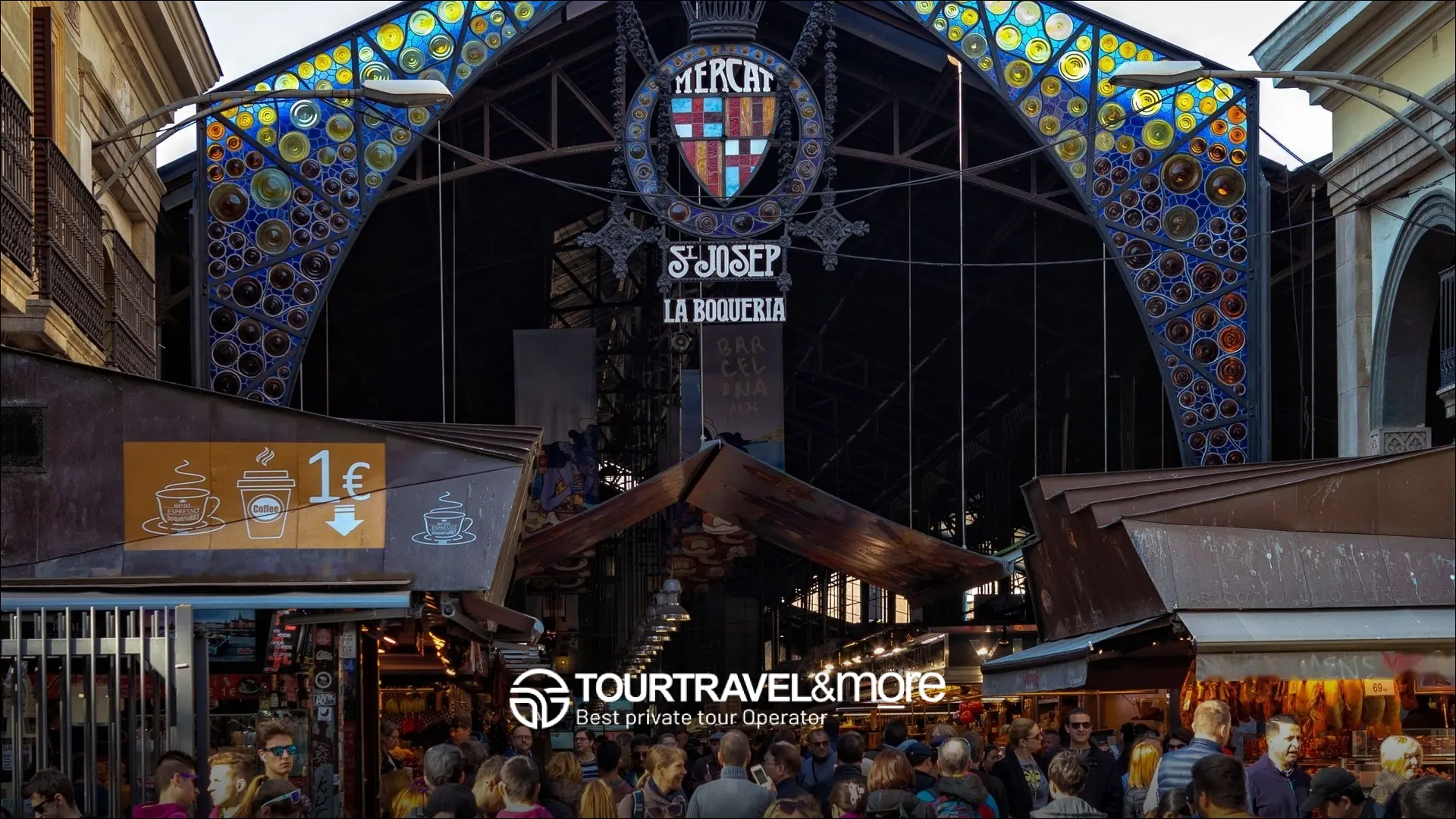
Halfway down La Rambla you walk into La Boqueria, the city’s most famous market. The first stalls, the ones you can see from the street, are designed for visitors: cups of brightly coloured juice, cones of ham, fruit skewers and trays of seafood ready for the photo. None of it is a scam, but it isn’t what people from Barcelona buy.
The real Boqueria starts a few metres further in. The stalls at the back and along the sides are the old-school ones selling fruit, fish, mushrooms and meat, and that’s where you’ll find the little counters where locals have breakfast standing up. You take a stool at one, order chickpeas with botifarra sausage and a small beer, and check the menu before ordering: at the market counters, seafood is charged by weight, and a plate of prawns with no price in sight can cost far more than you expected.
If you want a market without tour groups, there are two close by: the Mercat de Santa Caterina, in the Born, with its colourful wavy roof, and the Mercat de Sant Antoni, which on Sunday mornings also has a market for books and trading cards. Nobody at either will try to sell you a six-euro juice.
 Private
 Private
 Private
13:30 — The paella in the photo, and why you don’t eat it on La Rambla
At half past one, the couple from the plane messages you: they’ve sat down at a terrace on La Rambla, next to a sign with a huge photo of paella and a jug of sangria. It’s the best-known tourist trap in Barcelona, and that’s exactly why it still works. Terraces on the boulevard charge more than €20 for a single-portion paella, which often arrives pre-cooked, plus bread, drinks and sangria that can cost as much as a bottle of good wine. The City Council itself wants to remove the paella photo boards and standing signs from La Rambla once the works finish in 2027.
You can spot this kind of place from the pavement:
- A waiter at the door inviting you in with the menu in hand.
- Photos of the dishes and a menu in six languages, without a word of Catalan or Spanish.
- “Paella and sangria” as a set deal, at any time of day and for one person.
You leave La Rambla, cross into the Raval or the Eixample and sit down at a restaurant serving a menú del día: a set lunch with a starter, main course, dessert, bread and a drink for a fixed price, Monday to Friday, at midday. It’s what people who work in the area eat, and it’s written on a board by the door, usually only in Catalan and Spanish. If you fancy rice, good paella is eaten at lunchtime and in a restaurant that specialises in rice dishes, in Barceloneta or by the Port Vell, where it’s made to order and takes about twenty minutes. If it arrives in five, it wasn’t made for you.
16:00 — Sagrada Família: the queue that doesn’t exist
Your slot at the Sagrada Família is at four. As you come out of the metro, two or three people in the square with a badge round their neck are offering “skip-the-line tickets” or a guided tour starting right now. Some are genuine guides with groups that haven’t filled up. Others sell tickets for a different time, or tours at three times the price on the official website.
The explanation is simple: you can’t buy tickets at the door of the Sagrada Família. Every ticket has a date and time, is bought online, and the only queue is the security check, the same for everyone. Nobody can help you “skip” a queue that doesn’t exist. If you arrive without a ticket and the day is sold out, what you buy in the street doesn’t get you in sooner; it gets you in for more money.
You show the code on your phone, go through security and you’re inside ten minutes before your time. The couple from the plane get in too, with their €52 tickets, which were exactly the same as yours. More tips on choosing the day and time are in how to avoid the queues at the Sagrada Família.
On the way out, you sit for a moment on Avinguda de Gaudí, the pedestrian avenue that runs from the Sagrada Família to the Sant Pau hospital. The terraces looking straight at the basilica charge for the view. The ones on the avenue, five minutes away, don’t.
18:30 — Barceloneta: beach mojitos and the empty towel
You reach the beach as the sun goes down. It’s the scene the couple from the plane were looking for, and Barceloneta has three traps of its own.
The first is the beach mojito. Sellers walk past with a cool box and coloured plastic cups offering mojitos, cans of beer and “fresh sangria”. Selling drinks on the beach without a licence isn’t allowed, the cans are often stashed in the sand or in drains so they won’t be confiscated, and nobody knows what goes into the mojito. The beach bars and the bars on the seafront will serve you the same thing in a proper glass.
The second is the massage on your towel. It’s offered for a few euros and the bill, at the end, is something else. A “no, thanks” from the start is all it takes.
The third is the most common: the empty towel. You go into the sea, leave your backpack on the sand and, when you come back, the towel is still there but the backpack isn’t. Take the bare minimum to the beach, keep your phone in a waterproof pouch on you, and always leave someone from the group out of the water. If you’d like somewhere quieter, keep walking along the seafront to Nova Icària or Bogatell, which are wider and have fewer sellers. And one local rule: in Barcelona you can’t walk around town in swimwear or without a top, only on the beach and the seafront promenade, and there are fines for it.
21:00 — Dinner, and the waiter waiting at the door
At nine, which in Barcelona is dinner time, the city fills up with people looking for a table. The areas where it’s easiest to end up in a trap are the ones with the most visitors: Plaça Reial, the streets running off La Rambla and the Port Olímpic. The signs are the same as at lunchtime. If someone in the street invites you in, keep walking.
You have tapas at a bar counter in Gràcia, Poble-sec or the Born, well away from La Rambla. You order what the people next to you are having: pa amb tomàquet (bread rubbed with tomato and olive oil), patatas bravas, croquettes, a Barceloneta bomba and a vermouth. Before ordering, you check the menu for two things:
- Bread and nibbles. If they bring bread, olives or a little plate of something you didn’t order, ask whether it’s charged. It’s legal to charge for it if it’s on the menu, but you’re entitled to say you don’t want it.
- Price by weight. Fish, seafood and grilled meat are often priced per kilo. Ask how much the piece weighs before it’s cooked.
Tipping in Barcelona is neither compulsory nor included, and it works very differently from the United States. If the service was good, people round up or leave around 5-10%, and nobody will think twice if you don’t. If the bill has a “service” line that wasn’t on the menu, you can ask for it to be removed.
22:30 — The cash machine that offers to charge you in your own currency
On the way back to the hotel, you stop at a cash machine to take out some money. It’s the last trap of the day, and the quietest. A question appears on the screen: would you like to be charged in your own currency or in euros? If you choose your own currency, the machine applies its own exchange rate, much worse than your bank’s, and presents it as a service. The same thing happens in shops and restaurants when you pay with a foreign card.
The answer is always the same: in euros. Two more tips about money:
- Avoid standalone cash machines in tourist areas, the ones that don’t belong to any bank, because they usually charge a high fixed fee on every withdrawal. Use one attached to a bank branch.
- Almost everything can be paid by card. In Barcelona you can go days without cash, even in small bars and taxis. Carry a little change for the markets and not much more.
23:30 — The couple from the plane
At the hotel door you bump into the couple from the plane. He’s holding a brand-new phone, bought at seven o’clock in a shop on Passeig de Gràcia, because the old one was taken on La Rambla while he was photographing a living statue. She tells you the rest without being asked: the €23 paella that arrived in eight minutes, the €28 jug of sangria, the two beach mojitos that tasted of water and the five-euro massage that ended up costing twenty.
They haven’t had a bad day. They’ve seen the same things as you. But you’ve paid half as much, you still have your phone, and tomorrow you’re going back to the bar in Gràcia where you had dinner.
The day’s traps, one by one
| The trap | Where | What you did instead |
|---|---|---|
| Websites that copy the official one | In your search engine, before the trip | Typed sagradafamilia.org and parkguell.barcelona yourself |
| Transport offered as you walk out | El Prat arrivals hall | Metered official taxi, Aerobús or the metro with the Airport ticket |
| Pickpockets and the shell game | La Rambla, the metro and the busiest areas | Backpack on your front, phone away and walking past the cups |
| Fake police officer | Side streets off La Rambla | Not showing your wallet; offering to go to the police station |
| Stalls for visitors | The entrance to La Boqueria | The counters at the back, Santa Caterina or Sant Antoni |
| Paella and sangria on a terrace | La Rambla and Plaça Reial | Menú del día in the Raval or the Eixample; paella at a rice restaurant |
| “Skip-the-line” tickets in the street | Outside the Sagrada Família | A timed ticket bought on the official website |
| Mojitos and massages on the sand | Barceloneta | A beach bar on the seafront and a timely “no, thanks” |
| The backpack on the towel | Every beach in the centre | The bare minimum on the beach and always someone out of the water |
| Being charged in your own currency | Cash machines and card readers | Always choosing euros and using bank cash machines |
What can still go wrong
Some traps didn’t catch you that day, but they turn up on almost every first trip to Barcelona.
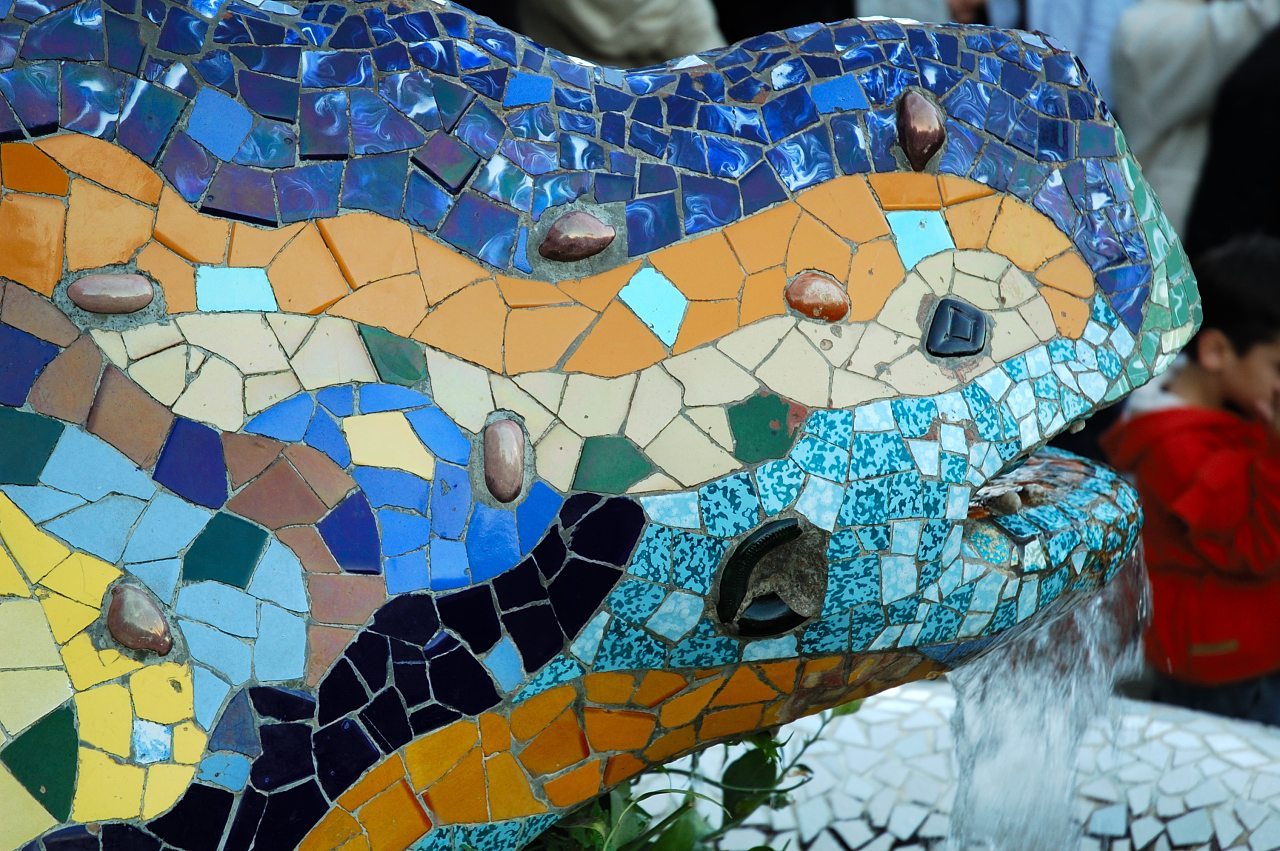
- “Free” Park Güell. The Monumental Zone, the one with the mosaic bench and the dragon, requires a timed ticket, and an adult ticket costs €18 on the official website. Copycat websites sell it with mark-ups of up to 40%. Some parts of the park are free to enter, but they’re not the ones in the photos. If you’d like to know what you can genuinely see without paying, it’s in free things to do in Barcelona.
- The unlicensed holiday flat. Every legal tourist rental in Barcelona has a registration number starting with HUTB, and the listing has to show it. If it doesn’t, your booking may be cancelled at the last minute or you could be left on the street after an inspection.
- The friendship bracelet and the sprig of rosemary. Someone ties a bracelet round your wrist or puts a sprig in your hand “as a gift” and then asks for money. Simply don’t let them put it on you.
- Living statues and costumed characters. Photos with them cost money, and sometimes they ask for the fee after the photo. If you don’t want to pay, take the picture from a distance.
- Currency exchange on La Rambla and at the airport. Bureaux de change in tourist areas advertise “0% commission” and make it back with a very poor exchange rate. You’re better off arriving with a card and withdrawing from a bank cash machine.
- Club promoters at the Port Olímpic. At night they offer free entry or cheap drinks at the clubs by the marina. Entry may be free; the first drink won’t be.
If your trip doesn’t look like this one
| If this is you | Which trap to watch most | What to do |
|---|---|---|
| Arriving by cruise ship | Taxis and tours waiting as you come ashore | Check your all-aboard time before booking anything; La Rambla is a walk from the port |
| Only one day in the city | Trying to see everything and eating at the first terrace | A walking route by neighbourhood and a single timed visit; see Barcelona in one day |
| Travelling in summer | The beach, the beach mojitos and thefts from towels | Poblenou beaches, early or late in the day, with the bare minimum |
| Travelling in high season | Sold-out tickets and resale websites | Buy Sagrada Família and Park Güell two weeks ahead on the official websites |
| Travelling with children | The terraces in the centre at dinner time | Tapas at a bar counter around 20:00 |
| Going out at night | Club promoters and phones on the dance floor | Bars in Gràcia or the Born, and your phone in a front pocket |
If you have more days, Barcelona in 3 days gives you the full route, neighbourhood by neighbourhood.
Your first trip to Barcelona with Tour Travel & More
Barcelona isn’t a difficult city, but on a first trip everything is in the easiest place to find: the ticket website that comes up first, the transport offered as you leave the plane, the terrace with the paella photo. Avoiding the traps takes time to compare, knowing where the locals eat and keeping an eye on your phone and bag in every crowded street.
With Tour Travel & More, these problems disappear:
- 100% private tour — Just you and yours, at your own pace and through the neighbourhoods that never make the lists.
- Official licensed guide — Who brings the city to life and knows where to eat well two streets from La Rambla.
- Tickets handled for you — Bought through official channels, with a set time slot and no resale mark-ups.
- Luxury vehicle with a professional driver — From the airport or the port to your hotel, without hunting for a taxi or haggling with anyone.
- Guardian Angel Service 24/7 — Real people coordinating everything before, during and after your trip, including if something goes wrong.
We’re from Barcelona: the company was founded here in 2014, and today we hold a rating of 4.9 out of 5 from more than 500 reviews by verified travelers.
- Just your group
- Licensed guides
- Free cancellation