Laura had saved a list of “secret places in Barcelona” before her trip. The first one was the Bunkers del Carmel. She got there on a Saturday at sunset and found three hundred people holding up their phones, a speaker blasting music and the gate to the site locked.
The next day, in the Raval, she pushed open a door on Carrer de l’Hospital looking for a toilet. She came out into a Gothic courtyard with orange trees, benches and a well. Four people were reading. It was the garden of the old hospital where Gaudí died, and it wasn’t on any of her lists.
Almost every “secret place in Barcelona” doing the rounds online stopped being secret years ago. These ten still get a fraction of the Sagrada Família’s visitors, they’re spread across the whole city and half of them are free or cost less than €6.
The 10 secret places in Barcelona at a glance
| Place | Neighbourhood | Price |
|---|---|---|
| Temple of Augustus | Barri Gòtic | Free |
| Santa Anna cloister | Ciutat Vella, next to Plaça de Catalunya | Free |
| Gardens of the Old Hospital de la Santa Creu | El Raval | Free |
| Sant Pau del Camp | El Raval | €6 |
| Refugi 307 | Poble-sec | €3.50, booking required |
| Passatge Permanyer | Eixample | Free |
| Torre Bellesguard | Sant Gervasi | €12 with audio guide, €20 guided |
| Pedralbes Monastery | Pedralbes | €5.20 |
| Poblenou Cemetery | Poblenou | Free |
| Plaça Prim | Poblenou | Free |
The secrets that aren’t secret any more
Before the list, it helps to know which places are no longer secret, so you don’t go looking for peace and quiet where there isn’t any.
- Bunkers del Carmel. They’re the city’s most famous viewpoint and they fill up at sunset. We explain how to enjoy them without the crowds in must-see in Barcelona.
- Pont del Bisbe and Plaça de Sant Felip Neri. They’re still beautiful, but at midday there’s a queue for the photo. They only work before nine in the morning.
- Recinte Modernista de Sant Pau, Casa Vicens and Palau Güell. Short queues and an unhurried visit, but they’re already in every guide to Modernisme. You’ll find them, with opening hours and prices, in the most beautiful places in Barcelona.
And two genuine secrets can’t be visited right now. The cypress maze at the Laberint d’Horta has been closed for works since March 2025, and it’s expected to reopen in early 2027. The Güell Pavilions, in Pedralbes, are also under works, although their dragon gate can be seen from the pavement. Further down we tell you when it’s worth stopping by.
Ciutat Vella: four secrets ten minutes from La Rambla
The old town is where the crowds are and, even so, where the most secrets are left. They hide behind doors that look private.
1. Temple of Augustus, four Roman columns inside a courtyard
At number 10 Carrer del Paradís, two minutes from the cathedral, there’s a doorway that looks like the entrance to a block of flats. Inside, in the courtyard of the Centre Excursionista de Catalunya, stand four Corinthian columns from the Roman temple of Barcino, almost 9 metres tall and more than 2,000 years old.
Before you go in, look at the street: a millstone set into the paving marks Mont Tàber, the highest point of the Roman city.
- Entry: free. It’s part of the Barcelona History Museum (MUHBA).
- Opening hours: Monday 10:00 to 14:00, Tuesday to Saturday 10:00 to 19:00 and Sunday 10:00 to 20:00.
- Time needed: ten minutes is enough.
2. Santa Anna cloister, Gothic next to Plaça de Catalunya
A hundred metres from Portal de l’Àngel, the city’s busiest shopping street, the church of Santa Anna is tucked away. You go in through a narrow passage off Carrer de Santa Anna and, suddenly, the noise disappears.
Its 15th-century Gothic cloister, with a small garden in the middle, is one of the quietest corners in the centre. It’s free and open on weekdays, roughly from 11:00 to 19:00. On Sundays there’s Mass, so it’s best not to go then.
3. Gardens of the Old Hospital de la Santa Creu, where Gaudí died
This is the courtyard from Laura’s story. The Hospital de la Santa Creu was founded in 1401 and worked as a hospital until 1926. That same year, on 10 June, Antoni Gaudí died here, three days after being hit by a tram on the Gran Via. 2026 marks a hundred years.
Today the Gothic building houses the Library of Catalonia, and the courtyard is a public garden, the Jardins de Rubió i Lluch, with orange trees and stone benches.
- Entry: free, from Carrer de l’Hospital, 56.
- Opening hours: 8:00 to 21:00 in summer and 8:00 to 19:00 in winter. In winter it closes at dusk.
- The extra: peek into the library’s entrance hall to see the stone arches of the old patients’ ward.
4. Sant Pau del Camp, the oldest monastery in the city
In a corner of the Raval that few travellers set foot in stands the oldest church in Barcelona. Inside is the tombstone of Guifré II Borrell, Count of Barcelona, buried here in 911.
What you really need to see is the Romanesque cloister: small, with lobed arches of Arab influence that you won’t find in any other building in the city.
- Entry: €6 since August 2026. Older guides still say €3.
- Opening hours: Monday to Saturday 10:00 to 18:00, last entry 17:40. They may change if there are services.
- Getting there: Carrer de Sant Pau, 101, five minutes from Paral·lel metro (L2 and L3).
 Private
 Private
 Private
Underground and between the blocks: Poble-sec and the Eixample
5. Refugi 307, the tunnel dug by the neighbours
Between 1937 and 1939, during the bombings of the Civil War, the residents of Poble-sec dug an air-raid shelter by hand under Montjuïc hill. It has around 400 metres of tunnels and was designed for some 2,000 people. It had an infirmary, a water fountain and even a space for children.
The visit is guided and, when you come out, you see the city differently.
- Entry: €3.50, with advance booking on the MUHBA website.
- Opening hours: Saturdays and Sundays. Tours start at 10:30 in English, 11:30 in Spanish and 12:30 in Catalan.
- Getting there: Carrer Nou de la Rambla, 175, ten minutes from Paral·lel metro.
Places are limited and they sell out. Book before you arrive in Barcelona.
6. Passatge Permanyer, a London street in the Eixample
The Eixample is a grid of huge blocks, but some of them hide inner passageways. The most beautiful is Passatge Permanyer, a cobbled pedestrian street that cuts through the block between Consell de Cent and Diputació, and between Pau Claris and Roger de Llúria.
It was opened in the 19th century, inspired by English terraced houses: white façades, columns, small front gardens and wrought-iron street lamps. Five minutes from Passeig de Gràcia, it’s another city. People live here, so keep your voice down.
Uptown: two secrets with gardens
To reach these two you have to leave the centre. In return, it’s almost impossible to find them crowded.
7. Torre Bellesguard, the Gaudí almost nobody visits
On the slopes of Tibidabo, between 1900 and 1909, Gaudí built a medieval-looking house on the ruins of the palace of Martin the Humane, the last king of the House of Barcelona. It’s a stone tower with battlements, trencadís benches at the entrance and a view over the city that very few people know.
The house still belongs to a family, and it opened to the public in 2013.
- Entry: €12 with audio guide and €20 with a guided tour.
- Opening hours: Tuesday to Sunday, 10:00 to 15:00. Closed on Mondays.
- Heads up: the routes through Collserola run by Bellesguard are suspended because of the African swine fever outbreak. The house is still open, but check the opening hours on its website before heading up.
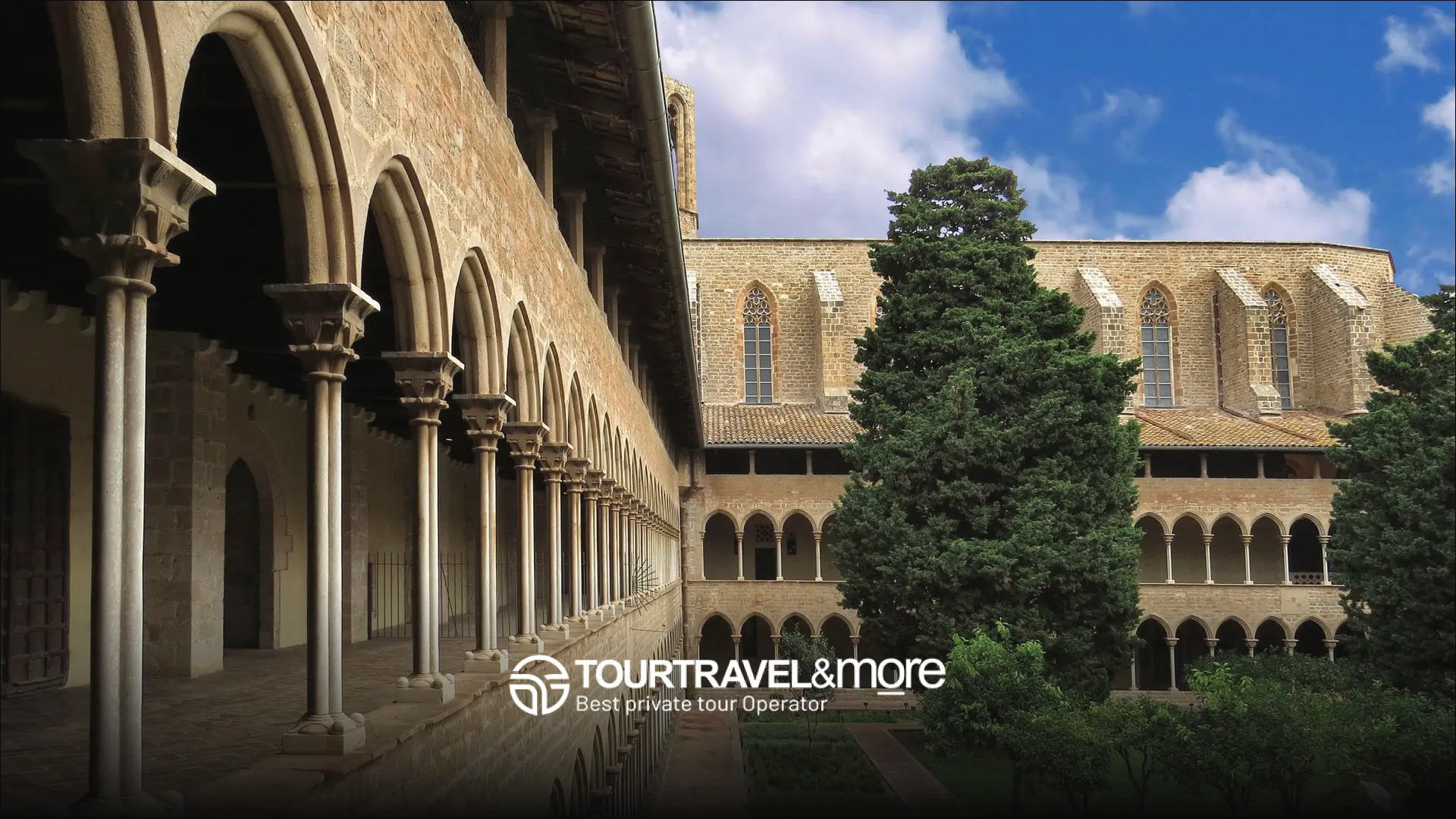
8. Pedralbes Monastery, the largest Gothic cloister
It was founded by Queen Elisenda de Montcada in 1327, and its three-storey cloister is one of the largest in Gothic architecture. Few travellers make it out here, so mid-morning you can have it almost to yourself.
Don’t leave without seeing the Chapel of Sant Miquel, with murals by Ferrer Bassa from 1346, among the oldest in Catalonia.
- Entry: €5.20 general and €3.70 reduced. Free on Sundays from 15:00 and all day on the first Sunday of every month.
- Winter opening hours (October to March): Tuesday to Friday 10:00 to 14:00 and weekends 10:00 to 17:00. In summer it stays open later.
- Getting there: Ferrocarrils to Reina Elisenda and a five-minute walk.
A kilometre away, at Avinguda de Pedralbes, 7, is the dragon gate of the Güell Pavilions, a wrought-iron gate designed by Gaudí. The site is closed for works, but the gate can be seen from the street, for free.
Poblenou: the neighbourhood that was a fishing village
9. Poblenou Cemetery and the Kiss of Death
It was Barcelona’s first cemetery outside the city walls, opened in 1775. It’s an open-air museum of funerary sculpture, with Neoclassical streets of niches and the mausoleums of 19th-century bourgeois families.
The best-known piece is El Petó de la Mort, the Kiss of Death, from 1930: a winged skeleton kissing a young man on the forehead. Few sculptures in Barcelona are as striking.
- Entry: free.
- Opening hours: every day from 8:00 to 18:00.
- Getting there: Avinguda d’Icària, ten minutes from Llacuna metro (L4).
It’s a working cemetery. Respect funerals and don’t take photos of families.
10. Plaça Prim, the square that stayed in the 19th century
Ten minutes’ walk from the cemetery, at the end of the Rambla del Poblenou, a square from 1851 appears, surrounded by low white houses that once belonged to fishermen. In the middle stand three huge ombú trees, with roots that look like sculptures.
It’s the best way to end the day. In one corner is Els Pescadors, in an old tavern from 1848, known for its rice dishes and fish. If you’d rather keep it simple, the Rambla del Poblenou has terraces at neighbourhood prices.
How to fit Barcelona’s secret places into your trip
They’re spread across the whole city, so the practical thing is to group them by area. That gives you four half-days:
| Area | Places | When to go |
|---|---|---|
| Ciutat Vella | Temple of Augustus, Santa Anna, Santa Creu and Sant Pau del Camp | A weekday morning |
| Poble-sec and Eixample | Refugi 307 and Passatge Permanyer | Saturday or Sunday morning |
| Uptown | Bellesguard, Pedralbes and the dragon gate | Tuesday to Friday, before 14:00 |
| Poblenou | Cemetery and Plaça Prim | In the afternoon, before 18:00 |
Opening hours rule. Santa Anna and Sant Pau del Camp are hard to visit on a Sunday, Refugi 307 only opens at weekends and Pedralbes closes at 14:00 on weekdays in winter.


Barcelona’s secret places with Tour Travel & More
Finding these places on your own is possible. But they’re in four different neighbourhoods, with opening hours that don’t line up and doors that look shut, and it’s easy to end up in front of a locked gate on a Monday.
With Tour Travel & More, these problems disappear:
- 100% private tour — No group and at your own pace. If you want to spend half an hour in the Pedralbes cloister, you do.
- Official licensed guide — Knows which doorway on Carrer del Paradís to push and tells you the story of every place, from Count Guifré to the neighbours who dug Refugi 307.
- A route planned around opening hours — The shelter at the weekend, Pedralbes before it closes and the cemetery in daylight.
- Luxury vehicle with a private driver — Up to Bellesguard and Pedralbes without the uphill walk or changing lines, with pickup at your hotel or the cruise terminal.
- Guardian Angel Service 24/7 — Human coordination before, during and after the tour, in case anything goes wrong.
We’re from Barcelona: the company was founded here in 2014, and today we hold a rating of 4.9 out of 5 from more than 500 reviews by verified travelers.
The Barcelona behind the doors
Laura came back to Barcelona a year later. She didn’t go up to the bunkers. She pushed open the doorway on Carrer del Paradís, went down into Refugi 307 on a Sunday at half past eleven and ended the afternoon under the ombú trees in Plaça Prim.
Barcelona’s secret places aren’t hidden. They’re in plain sight, behind a door that looks private or in a neighbourhood nobody sends you to. You just need to know which one to push.
- Just your group
- Licensed guides
- Free cancellation