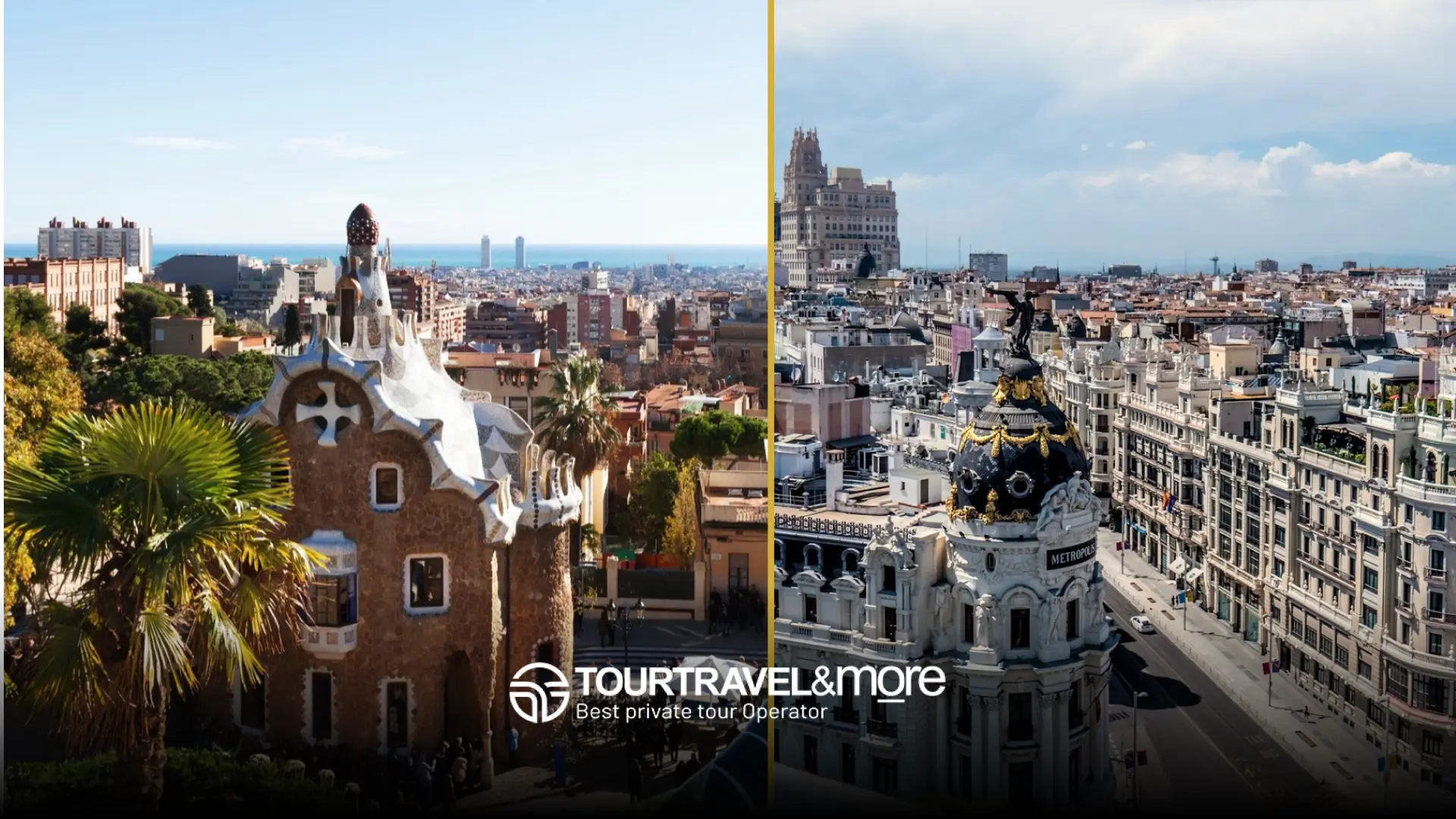
It is 8:40 on a Tuesday morning in October and you are having breakfast. In one version of this story you can smell the sea from the terrace and the Sagrada Família is nine metro stops away. In the other you are dipping a churro in chocolate at 667 metres above sea level, in the highest capital in Europe, and the October air bites a little more than you expected.
Same traveller, same budget, same free day. The only thing that changes is the city.
What follows is those two days running in parallel, hour by hour: what you are doing at each moment in Barcelona, what you would be doing at that exact hour in Madrid, what each thing costs, and the precise point in the day where one city pulls away from the other. Because “Madrid or Barcelona” is almost never decided with a list of monuments. It is decided with a clock.
8:40 — Two breakfasts that already tell you where you are
In Barcelona you have breakfast near the sea whether you plan to or not: the city is built against the coast and almost every route ends up heading down towards it. In October that means a mild morning, clean light and short sleeves by midday.
In Madrid you have breakfast in an inland city and your skin notices. Madrid sits 667 metres above sea level, which gives it cooler mornings, drier afternoons and an October that feels far more like a real autumn.
It sounds like a minor detail. It is not: it decides what you pack, what time you go out and, above all, what you do at five in the afternoon. That is where these two cities stop resembling each other.
10:00 — The queue that exists and the one that does not
In Barcelona you bought your ticket days ago, and not out of foresight: out of obligation. Park Güell admits only 1,400 visitors per hour into the monumental zone and every ticket carries an assigned time slot, sold online and routinely sold out days in advance. The Sagrada Família works the same way: a time window, that door, that hour.
Barcelona is a city of reservations. The icons are concentrated, there are few of them, and everyone wants the same ones. Improvising here costs money, or costs you the whole plan.
In Madrid, at ten on a Tuesday morning, you walk into the Prado Museum with a reasonable queue and, on many days, none at all. General admission is €15 and getting in does not depend on having booked ahead. The Royal Palace works much the same: €18 at the official box office, and the worst that happens is a twenty-minute line.
That is the first real difference of the day, and almost no comparison mentions it: Barcelona has to be planned, Madrid can be improvised.
11:20 — What you are actually looking at
In Barcelona you look up. The Sagrada Família lands in a single glance: you walk in, raise your head, and the light through the stained glass does the work for you. You do not need to know anything for it to move you. Basic admission is €26, or €36 if you want to go up the towers.
In Madrid you look closely. The Prado displays more than 1,700 works from a collection of over 27,000 pieces, and nothing there hits you all at once: you have to step in, stop, and above all know what you are looking at. The Royal Palace has 3,418 rooms, and the Royal Armoury is spectacular precisely for whoever knows how to read it.
Which gives you the sentence that sums up the whole trip: Barcelona impresses on day one, Madrid gets better on day four. One is enjoyed by looking; the other, by understanding. That is why a guide changes the experience so much in Madrid and adds considerably less in Barcelona, something we break down in how much a tour guide costs in Madrid.
14:30 — Lunch, which here is not just any hour
Both cities eat late, but not equally late. In Barcelona, by half past one, kitchens are open and places have people in them, partly because 90% of its visitors are foreign and the city has spent years bending its hours towards people arriving from abroad.
In Madrid lunch is at 14:30 and dinner at 21:00, and that is not up for negotiation. Turning up in the centre at half past one leaves you staring at empty dining rooms wondering whether they are open. It is a practical fact worth more than half a list of monuments: in Madrid the morning is one long uninterrupted block, and the afternoon starts late.
If budget is the deciding factor, it is worth knowing Madrid has an unusual number of plans that cost nothing at all, from the Temple of Debod to El Retiro; the full list is in free things to do in Madrid.
17:00 — The afternoon only one of them has
This is where the tie ends.
At five in the afternoon on a Tuesday in October, in Barcelona you can be on the beach. Sea temperature averages around 21.9 °C in October, and Barceloneta is a walk from the old town. It is not an excursion: it is a last-minute decision you make on foot.
Madrid simply does not have that. It has El Retiro at golden hour, the terraces of the Barrio de las Letras and sunset at Debod, which is one of the most photographed plans in Spain and costs nothing. It is a wonderful afternoon. But it is not the sea, and pretending otherwise helps nobody choose.
If you are travelling with children this moment of the day matters more than any other, and we go into it in Madrid with kids.
19:30 — The street, where the two are alike
At half past seven both cities do the same thing, and both do it well.
In Barcelona you drop into the Gòtic or the Born, wander with no plan and end up in Gràcia without having decided to. In Madrid you head down to La Latina, up to Malasaña, or stay among the terraces of the Barrio de las Letras with a beer standing up because there is nowhere to sit.
Neither one needs anybody explaining anything at this hour. These are places to be in, and being is not something you guide. If somebody swears one is far better than the other for a night out, they are probably just describing where their friends live.
22:00 — Adding up the day
The day ends, and the two versions of this story have not cost the same.
The Prado is also free from 18:00 to 20:00 Monday to Saturday and 17:00 to 19:00 on Sundays and holidays, which is the busiest slot of the day and the worst possible one for a first visit. Better to know that than to discover it at the door.
One note on the stadium, because it changes in 2026: the Spotify Camp Nou is still under construction, and what you visit is the immersive experience with the museum, not the classic walk through a finished stadium. The Bernabéu, by contrast, is open and renovated. If football is part of the reason for the trip, this year the scales tip clearly towards Madrid.
What sleeping costs, which no comparison mentions
And here is the figure that decides more trips than you would think.
Since 1 April 2026, Barcelona charges a tourist tax that can reach around €12 per person per night. It comes in two parts: the Catalan regional tax and a municipal surcharge from the city council of between €4 and €5.
Madrid has no tourist tax. None at city level, none at regional level, and the Community of Madrid has ruled out introducing one. Zero euros per person per night.
Run the numbers on your own trip: a couple, five nights, four-star hotel. In Barcelona that is €74 to €84 in tax alone, before you have seen anything. In Madrid, nothing. And Barcelona’s municipal surcharge is scheduled to keep climbing to €8 by 2029, which would push the total close to €15 per person per night in upper-tier accommodation.
This is not an argument for writing Barcelona off. It is an argument for putting it in the budget before you book, which is exactly where almost nobody puts it.
The next day: what each city has half an hour away
If the trip runs longer than three days, the question stops being what is in the city and becomes what is around it. And here the two play different games.
Madrid has two World Heritage cities less than half an hour away by train, and that is hard to match anywhere in Europe. Barcelona offers more variety of plan — mountain, sea and medieval town — but no single destination that strong that close. If day trips are part of the plan, the breakdown is in day trips from Madrid.
So, which one?
The 2025 numbers say something interesting about how each traveller behaves: Madrid registered 10.4 million visitors while Barcelona held its lead in overnight stays with 21.7 million against 21.4. Average length of stay, on the other hand, is 2.4 days in Barcelona and 2.1 in Madrid. More people go to Madrid; they stay slightly longer in Barcelona.
Translated into an actual decision:
If it had to fit in one line: Barcelona is the better first trip to Spain; Madrid is the better trip to Spain.
And if the trip has room for both
Worth saying, because the question is often framed wrong. Madrid and Barcelona are 621 kilometres apart and the AVE covers it from 2 hours 30 minutes, with more than 20 daily departures and fares starting at €17 if you book ahead.
With seven days there is nothing to choose: three nights in one, three in the other, and the journey takes a morning. The split that works best is to start in Barcelona, which goes straight to the eye and wakes the trip up, and finish in Madrid, which you enjoy once you have a few days in the country behind you and have caught the rhythm. If you only have three or four days, then yes: pick one and do it properly. Splitting a short trip between two cities is the most reliable way to see neither of them well.
To get the most out of a single day in the capital, the route is in Madrid in one day.
Both cities, without the part that wears you down
What drains a trip like this is not the places: it is the timed tickets that sell out, the opening hours that do not line up, the journey between two cities with suitcases, and discovering the tourist tax at check-out.
With Tour Travel & More, that part disappears:
- 100% private tour — No groups, no strangers: the pace and the route are yours, in Madrid and in Barcelona.
- Official licensed guide — Accredited to work inside the Prado, the Royal Palace, the Sagrada Família and Park Güell.
- Tickets sorted in advance, with assigned time slots where they are compulsory and no risk of them selling out.
- Luxury vehicle with a professional chauffeur to link visits without losing the morning to transfers.
- Guardian Angel Service 24/7 — Human coordination before, during and after the trip, including between the two cities.
The same Tuesday, three months later
Go back to the breakfast at the beginning, 8:40 on a Tuesday in October.
Both versions of that day are good. Nobody who has spent an afternoon in Barceloneta, or an afternoon at Debod, goes home thinking they picked the wrong city. The difference is not which one is better, but which one looks more like the trip you had in your head before you bought the flight.
If you wanted Spain to impress you, it was Barcelona. If you wanted to understand it, it was Madrid. And if the calendar had room for both, the right answer to “Madrid or Barcelona” was always two and a half hours on the AVE.