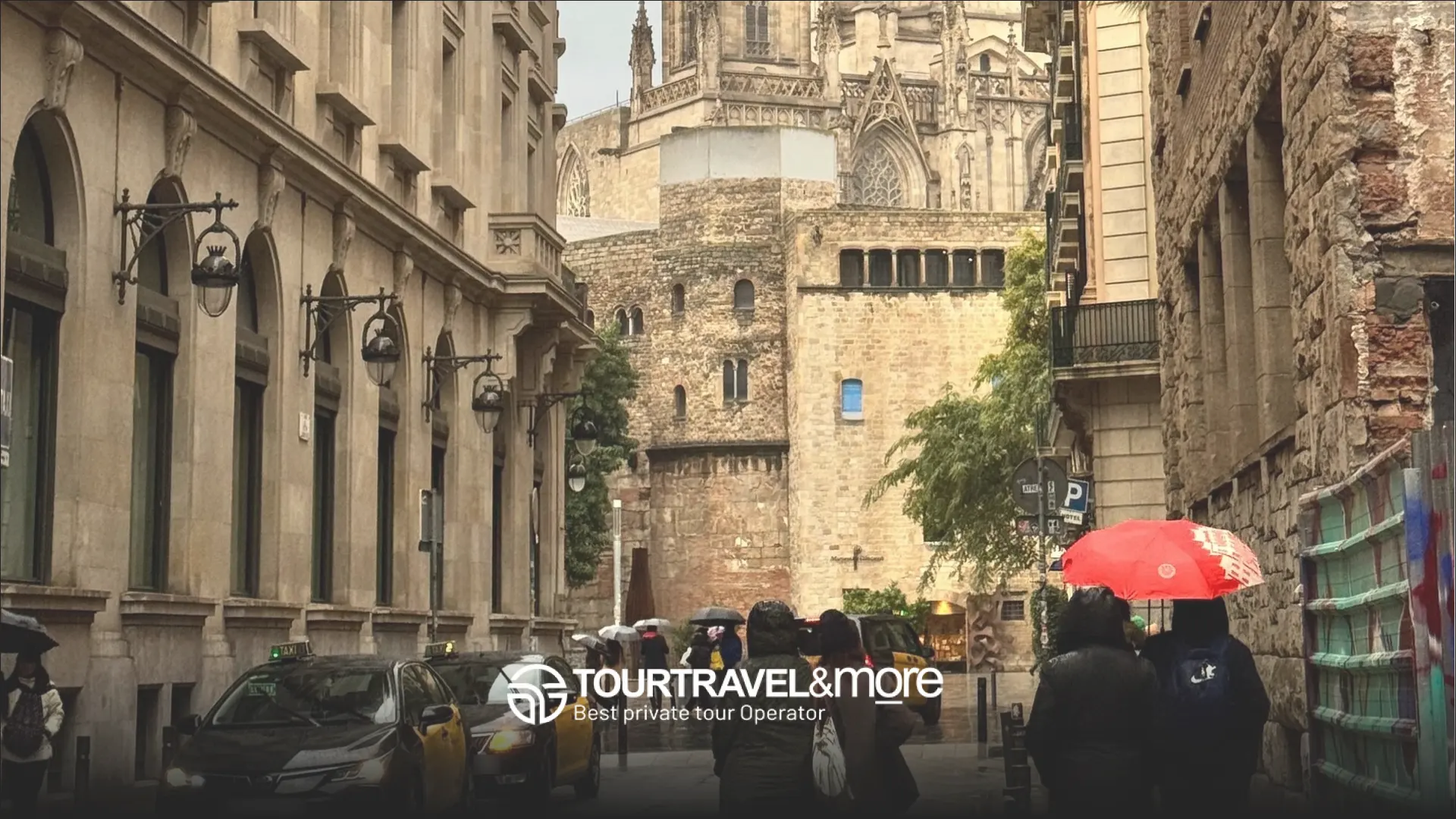
It is eight in the morning and the hotel window is covered in raindrops. Down in the street, the café awnings are still rolled up and people walk fast, close to the buildings. At breakfast, the couple at the next table pull on two plastic ponchos and go over their plan out loud: Park Güell at ten, the Bunkers del Carmel after that, the beach in the afternoon “if it clears up”. You had almost the same plan for today. You change it in ten minutes, before your coffee has gone cold.
What follows is that whole day, hour by hour: things to do in Barcelona when it rains, in the order you did them. Each stop explains why it works in the rain, what it costs and what to know before you go. This is not a consolation day. Some of Barcelona looks just as good in the rain, or better, and almost all of it is indoors.
8:00 am — The radar, not the icon on your phone
The first thing you do is not look for plans. You check how it is going to rain. The little cloud with drops in your weather app tells you very little. In Barcelona, rain is hardly ever a grey drizzle that lasts all day: it comes in showers, sometimes very heavy ones, that last one, two or three hours and then move on. Especially in autumn.
October is the wettest month of the year. At the airport weather station the average is around 75 mm, but it falls on just six or seven days. The rest of the month is sunny. Barcelona gets about 600 mm of rain a year, less than many cities in northern Europe, and it comes on very few days.
So you open the radar of the Catalan weather service (Meteocat) and look at the patch of colour: heavy rain all morning and a lighter band from six in the evening. That settles three things:
- Anything outdoors moves to another day, it doesn’t get cancelled. Park Güell, the Bunkers del Carmel, the Montjuïc cable car and the beach have no rainy-day version.
- Anything with an inside moves to today. If you had a Sagrada Família ticket for later in the week, you check whether there is a slot this morning.
- The day is planned by neighbourhood, not as a list. In the rain, every transfer counts. Three well-chosen areas beat seven points scattered across the map.
9:00 am — Sagrada Família: light that doesn’t need the sun
You find a 9:15 slot on the basilica’s official website. You are lucky: timed tickets sell out days or weeks ahead and there is no ticket office on site. The basic ticket starts at 26 €; with a tower climb it costs quite a bit more.
You come out of Sagrada Família metro station, on lines 2 and 5, and get wet for exactly the hundred metres to the door. Inside, the rain disappears. And here is what hardly anyone tells you: under a cloudy sky, the stained glass doesn’t throw the pools of colour across the floor that you see in photos, but the light is far more even. You see the whole forest of columns, with no blown-out backlight, and the greens and blues on the Nativity side fill the nave with a cool, calm tone. It is a different Sagrada Família, not a worse one.
Two things are worth knowing on a rainy day. First, the towers can close in rain or strong wind, so on a day like this the basic ticket is a better bet than the tower ticket. Second, the security queue is outdoors: if your ticket is for a set time, wait under the trees in the square opposite, not in the line. For the time of year and time of day when the sun works best on the windows, see Sagrada Familia month by month.
11:00 am — The metro, and the taxi that never comes
You come out at a quarter to eleven and the taxi rank on the square is empty. It always happens in the rain: demand for taxis shoots up, ride-hailing apps raise their prices and traffic in the Eixample grinds to a halt. On a dry day, the Sagrada Família to Passeig de Gràcia is a twenty-minute walk. Not today.
You go back down into the metro. Line 5 takes you to Diagonal in two stops, and from there you walk down Passeig de Gràcia to Casa Batlló in about eight minutes. The metro is the best tool for a rainy day in Barcelona: almost everything you will see has a station less than ten minutes away. If you are going to use it a lot, the T-casual card gives you ten journeys and works out much cheaper than single tickets.
One detail that saves you an umbrella: the Eixample has no arcades. Its streets are wide and straight, and the rain falls straight down on them. The old town is different: the narrow streets of the Gothic Quarter and the Born give you a fair amount of cover, and Plaça Reial is surrounded by arcades on all four sides.
11:30 am — Casa Batlló, the Gaudí you see from the inside
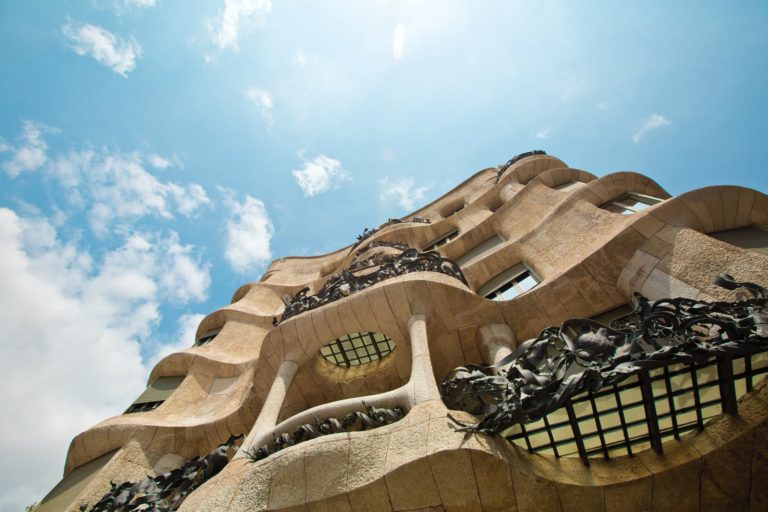
On Passeig de Gràcia there are two Gaudí houses five minutes apart, and in the rain the choice is easy. La Pedrera is famous for its rooftop, the one with the warrior-shaped chimneys, and in heavy rain it can close or become half a visit. Casa Batlló is almost entirely indoors: the main salon with its wavy windows, the light well that goes from deep blue to white, and the loft with its white arches.
The basic ticket is around 29 € online and the price changes with the day and time. It costs more at the door. On a rainy day it is busier than usual, because everyone has had the same idea as you, but tickets are sold by time slot and inside you don’t feel it as much.
There is one thing a grey day does better here: the light well. Gaudí designed it so that the little light coming in from above would spread evenly across every floor, with darker tiles at the top and lighter ones further down. On a cloudy day, you suddenly understand what it was for.
 Private
 Private
 Private
1:30 pm — Mercat de Santa Caterina, not La Boqueria
You are hungry, and the temptation is La Boqueria, the market on La Rambla. It is the most common rainy-day mistake: half the city’s visitors end up there at the same time, the aisles fill with wet umbrellas and eating at the counters becomes a race for a stool. On top of that, La Boqueria is closed on Sundays and is being renovated in phases until 2027, although it stays open.
You take the metro to Jaume I and walk five minutes to the Mercat de Santa Caterina, in the Ribera neighbourhood. It has a wavy roof of coloured ceramic tiles that looks better in aerial photos than from below, and inside it feels like a real neighbourhood market. You eat at one of its counters: whatever is fresh that day, a la plancha.
By local standards, you are eating early. In Barcelona lunch is between 1:30 and 3:30 pm, and many restaurants offer a set menú del día on weekdays. On a rainy day, book: indoor tables fill up first, because nobody wants the terrace.
3:00 pm — MUHBA: four metres down, to Roman Barcino
This is the best rainy-day plan in the whole city, and hardly anyone does it. Five minutes’ walk from Santa Caterina is Plaça del Rei, and underneath it, the Barcelona History Museum (MUHBA).
You go in through Casa Padellàs, take the lift down and come out about four metres below the street, in the Roman city of Barcino. You walk on walkways above the original streets, past a laundry, a garum factory and a winery with its storage jars still in place, all the way to the remains of seventh-century Visigothic Barcelona. Upstairs it is still raining. Down here you can’t hear it.
A ticket costs about 7 € and also gets you into the museum’s other sites. It opens Tuesday to Sunday: 10 am to 7 pm Tuesday to Saturday and until 8 pm on Sundays. It is closed on Mondays, like many of the city’s museums. On Sunday afternoons, from 3 pm, entry is free if you book ahead; that slot, and the other museums’ free hours, are in free things to do in Barcelona.
4:45 pm — Petritxol: the afternoon treat the rain asks for
You leave the museum and it is still raining, but more gently. You cross the cathedral square and turn into Carrer de Petritxol, a narrow street between Plaça del Pi and Carrer Portaferrissa. It became Barcelona’s first pedestrian street in 1959, and in barely two hundred metres it has several granjas, the old-style cafés where people go for thick hot chocolate.
Granja Dulcinea, at number 2, has been serving chocolate since the 1940s. La Pallaresa, at number 11, is known for its suizo: thick chocolate topped with unsweetened whipped cream. You order hot chocolate with churros, which here are dipped into a cup so thick the spoon almost stands up on its own.
Worth knowing: on rainy days there is a queue at both at this time. It is the treat half of Barcelona wants as soon as the temperature drops. If the queue reaches the street, give it ten minutes: it moves fast, because nobody lingers once the cup is finished. And some granjas close at midday, so it is best not to go before five.
6:00 pm — It clears: the Gothic Quarter, freshly rained on
Just as the radar said, the rain stops at six. You don’t put the umbrella away yet, but you go out for a walk, and you find the best hour of the day.
The Gothic Quarter after the rain is a different place. The paving stones shine, the street lamps come on over the wet ground and the tour groups have vanished. You walk from Plaça del Pi to Plaça Sant Felip Neri, the square with shrapnel marks on its church façade, without meeting anyone. Then Carrer del Bisbe, with its neo-Gothic bridge, and the floodlit front of the cathedral.
If the rain hadn’t stopped, plan B was ready: the Museu Picasso, in five medieval palaces on Carrer Montcada, or a long afternoon at CosmoCaixa, the science museum, open every day until 8 pm, with a flooded Amazon forest under a glass roof and general admission at 8 €.
8:30 pm — Palau de la Música, the evening that wasn’t in the plan
That morning, between metro rides, you saw there was a concert tonight at the Palau de la Música Catalana, five minutes from the cathedral, and bought the cheapest ticket left. It is the best way to see the hall: full, with the lights on beneath the coloured glass skylight in the ceiling and the music playing.
If no concert suits you, the hall can also be visited by day: a guided tour of about 50 minutes from around 22 €, every day from the morning until mid-afternoon. On a rainy day, it fits well first thing, before it fills up.
You come out of the concert after ten, and now it really is dinner time. In Barcelona dinner starts at 9 pm, and in the Born, five minutes away, the tapas bars are packed, their windows steamed up. You sit at one, order patatas bravas, pa amb tomàquet (bread rubbed with tomato) and some croquettes, and go back over the day.
11:00 pm — The couple in the ponchos
Back at the hotel, in the lift, you run into the couple from breakfast. They still have their ponchos on and their trainers are soaked. They tell you about their day without you asking: Park Güell wrapped in fog, no view over the city and the mosaic bench slippery underfoot; an hour in a café waiting for the rain to stop; the beach, they never even saw it.
They weren’t unlucky. They had the same day as you, with the same rain. The difference was those ten minutes at breakfast.
The rainy day, stop by stop
| Stop | Approximate price | Why it works in the rain | Worth knowing |
|---|---|---|---|
| Sagrada Família | From 26 € | Everything is indoors, and cloudy light is more even | Timed tickets sell out days ahead; the towers can close |
| Casa Batlló | From about 29 € online | Almost the whole visit is under cover | Dynamic pricing; more expensive at the door |
| Mercat de Santa Caterina | Whatever you eat | Covered market with counters to eat at | Less crowded than La Boqueria, which is closed on Sundays |
| MUHBA Plaça del Rei | About 7 € | Literally underground: the Roman city | Closed on Mondays; free on Sundays from 3 pm with booking |
| Petritxol granjas | A few euros | Hot chocolate, indoors | Queues on rainy days; best after 5 pm |
| Palau de la Música | Tours from about 22 € | The hall looks the same rain or shine | Tours in the morning; in the evening, only with a concert |
More indoor plans, depending on your trip
The day above is one of many possible. Barcelona has enough indoor sights to fill three rainy days without repeating, and each kind of traveller fits some better than others.
| If this is you | Where to go | Why |
|---|---|---|
| Travelling with children | CosmoCaixa or L’Aquàrium | CosmoCaixa is free for under-16s and has a tropical forest indoors; the aquarium is in Port Vell, a short walk from Drassanes metro |
| Into Modernisme | Sant Pau Recinte Modernista or Palau Güell | Sant Pau, Domènech i Montaner’s former hospital, links its pavilions with tunnels; Palau Güell is Gaudí from the inside, and closes on Mondays |
| Into art | MNAC or Museu Picasso | The MNAC holds the Romanesque frescoes from the Pyrenees; the Picasso, his formative years in Barcelona |
| On a tight budget | Sunday afternoon museums | Many city museums are free on Sundays from 3 pm, with booking |
| Arriving on a Monday | Sagrada Família, Casa Batlló, La Pedrera or CosmoCaixa | Public museums such as MUHBA, the Picasso or the MNAC close on Mondays; these open |
| It only rains for an hour | A Petritxol granja or Mercat de Sant Antoni | Just enough to wait out the shower under cover and carry on with the plan |
What not to do in the rain
Some plans in Barcelona have no covered version, and in the rain they turn out worse than you expect.
- Park Güell. The Monumental Zone is outdoors, with a fixed entry time. In the rain the mosaic bench is slippery, the dirt paths turn to mud and the views over the city vanish into the fog. Better to move your ticket to another day, if you can.
- The Bunkers del Carmel and other viewpoints. From the top, with low cloud, you can’t see the sea. The climb is also up slopes and steps with no shelter.
- The Montjuïc and harbour cable cars. They run depending on the wind, and in a storm they can stop.
- The hop-on hop-off bus. The top deck is open. In the rain everyone crowds downstairs and you see the city through steamed-up windows.
- La Pedrera’s rooftop. In heavy rain it can close. For a day like this, Casa Batlló is the safer bet.
- Relying on taxis for everything. In the rain they are scarce, apps raise their fares and traffic jams up. The metro gets you almost everywhere.
If the sun comes out tomorrow, whatever you left for later is in the most beautiful places in Barcelona, with the best time of day to see each one.
A rainy day in Barcelona with Tour Travel & More
A rainy day doesn’t ruin a trip to Barcelona. What makes it hard is everything you have to sort out at once at eight in the morning: finding timed tickets for today, reordering your visits by neighbourhood, knowing what is closed that day and getting from stop to stop without ending up soaked or stuck at an empty taxi rank.
With Tour Travel & More, these problems disappear:
- 100% private tour — The route is redrawn that same morning according to the radar, without depending on a group’s plan.
- Official licensed guide — Who knows which indoor sights are worth it in the rain and which are not.
- Tickets handled — Sagrada Família, Casa Batlló or Palau de la Música, with a set entry time and no queuing in the open.
- Luxury vehicle with a professional driver — Door to door, with no hunting for a taxi in the rain.
- Guardian Angel Service 24/7 — Human coordination before, during and after your trip.
We’re from Barcelona: the company was founded here in 2014, and today we hold a rating of 4.9 out of 5 from more than 500 reviews by verified travelers.
- Just your group
- Licensed guides
- Free cancellation