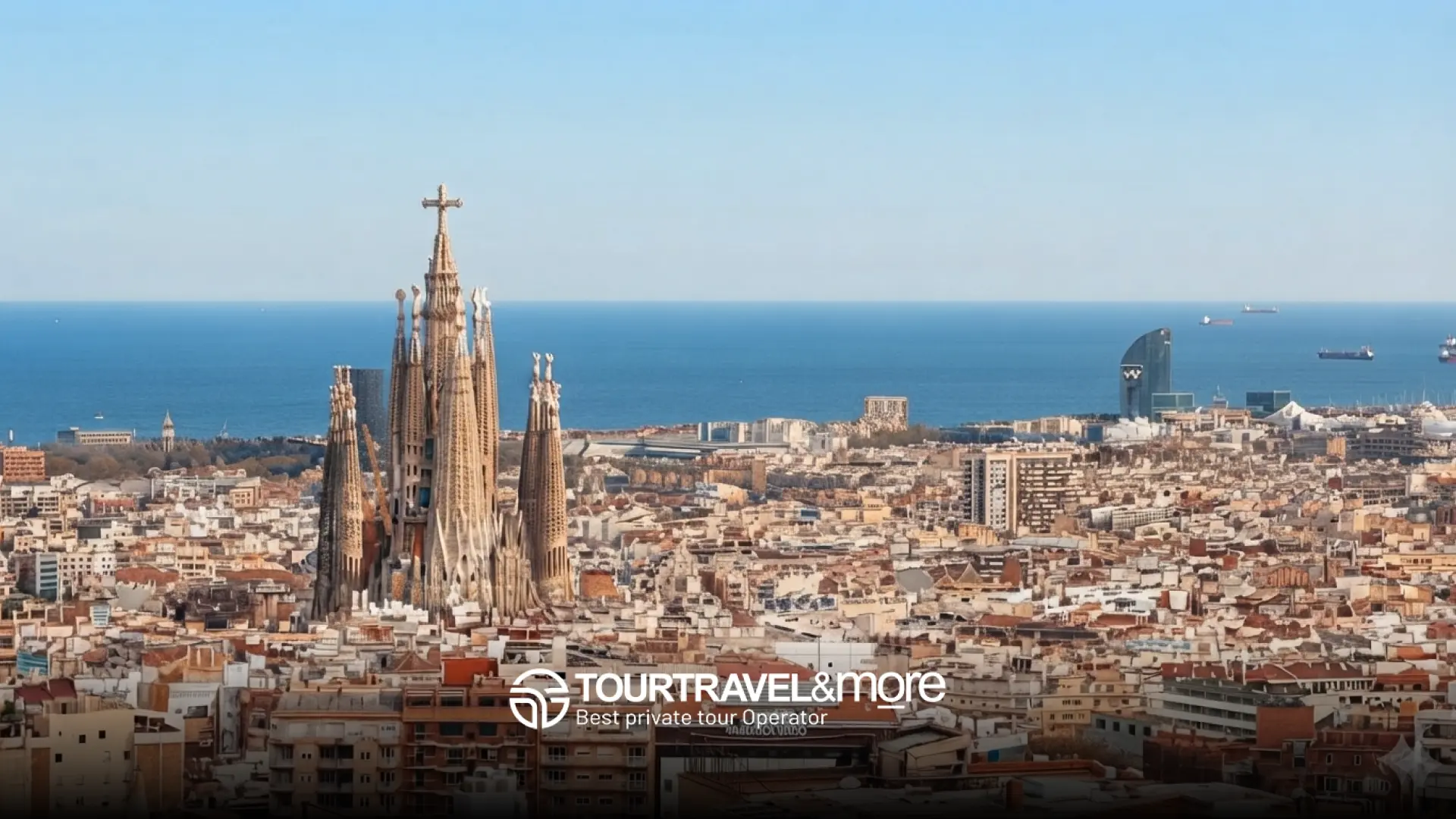
Marc searched “Sagrada Familia construction finish date” a few weeks before booking his trip to Barcelona, and what he found were articles from 2019, from 2023, even from barely a year ago, all describing a central tower still under construction. The Tower of Jesus Christ was completed on February 20, 2026, and inaugurated on June 10, coinciding with the centenary of Gaudí’s death. What Marc actually struggled to find wasn’t that piece of news, but a clear answer to the question that really mattered to him: which month should he go, at what time, and which ticket is actually worth it?
What you’ll find at the Sagrada Familia in 2026
The exterior structure is now finished. The Tower of Jesus Christ reached its final height of 172.5 meters, making the basilica the tallest building in Barcelona and the tallest church in the world, crowned by a luminous cross visible from much of the city. This is the first time in over a century that the temple’s exterior silhouette can be seen complete, exactly as Gaudí designed it.
That doesn’t mean the works are entirely finished: the interior of the tower will keep being completed through 2027 and 2028, and the Glory Facade, the most complex of all, still has no fixed completion date. In practice, for anyone traveling this translates into something simple: today you can photograph and visit the complete temple from the outside, with scaffolding only in very specific spots that don’t affect the regular visitor route.
Sagrada Familia month by month: the complete guide
Before going into detail by season, here’s the quick snapshot of all twelve months: average temperature, how crowd levels behave, and which opening hours apply depending on the time of year.
| Month | Average temperature | Crowd levels | Opening hours |
|---|---|---|---|
| January | 13°/5°C | Low (except Epiphany) | 9:00 AM-6:00 PM (Sun. 10:30 AM-6:00 PM) |
| February | 14°/5°C | Low | 9:00 AM-6:00 PM (Sun. 10:30 AM-6:00 PM) |
| March | 16°/7°C | Medium, rises during Holy Week | 9:00 AM-7:00 PM (Mon-Fri) |
| April | 18°/10°C | Medium-high, peaks during Holy Week | 9:00 AM-8:00 PM (Sun. 10:30 AM-8:00 PM) |
| May | 21°/13°C | Medium-high | 9:00 AM-8:00 PM (Sun. 10:30 AM-8:00 PM) |
| June | 25°/17°C | High | 9:00 AM-8:00 PM (Sun. 10:30 AM-8:00 PM) |
| July | 28°/20°C | Very high, driest month of the year | 9:00 AM-8:00 PM (Sun. 10:30 AM-8:00 PM) |
| August | 28°/20°C | Very high | 9:00 AM-8:00 PM (Sun. 10:30 AM-8:00 PM) |
| September | 25°/17°C | High, brief spike on the 24th (La Mercè) | 9:00 AM-8:00 PM (Sun. 10:30 AM-8:00 PM) |
| October | 21°/13°C | Medium, rainiest month | 9:00 AM-7:00 PM (Mon-Fri) |
| November | 17°/9°C | Low | 9:00 AM-6:00 PM (Sun. 10:30 AM-6:00 PM) |
| December | 14°/5°C | Low, except the last week | 9:00 AM-6:00 PM (Dec 25-26: 9:00 AM-2:00 PM) |
With this table alone you can already rule out the obvious: if the goal is avoiding both heat and queues, July and August are out. But the rest of the decision depends on finer priorities, which is what follows below.
Winter (December-February): the Sagrada Familia with fewer crowds
Winter is the temple’s true low season. Temperatures hover around 13-14°C for highs and 5°C for lows, with short days and some rain spread throughout, though never as heavy as in autumn. The upside for travelers is twofold: tickets can be secured just a few days ahead even on popular dates, and access queues — except during Christmas and Epiphany — are the shortest of the year.
The opening hours work against you: from November to February the basilica opens 9:00 AM to 6:00 PM Monday through Saturday, and 10:30 AM to 6:00 PM on Sundays, so the last entry is around 5:15 PM. With that limited light, the best window to see the stained glass well is around midday, when the sun is higher and makes up for the lack of direct light hours. Special hours also apply: on December 25-26 and January 1 and 6 the temple opens only from 9:00 AM to 2:00 PM, so anyone traveling on those specific dates should book the visit early in the day.
December has a special bonus: the Nativity Facade, the most ornate of the three, takes on a different meaning during the Christmas season, and the Eixample streets around the temple fill with lights without the summer’s tourist crowds.
Spring (March-May): the best balance between weather and crowds
March starts cool (16°C for highs) and May already nears 21°C, with daylight hours stretching every week. Along with autumn, it’s the season most guides recommend for a simple reason: good weather without reaching summer’s saturation point.
There’s one exception to watch out for: Holy Week. It falls on variable dates between March and April, and during those days crowd levels rise noticeably across central Barcelona, the Sagrada Familia included. Outside that specific week, March and April offer a combination that’s hard to beat: already-long days, pleasant temperatures for waiting outdoors, and soft side light that especially favors the Nativity Facade’s stained glass in the morning.
In March the schedule changes from winter: the temple starts opening until 7:00 PM Monday through Friday, gaining a full extra hour to plan the visit. From April onward, the high-season schedule kicks in (9:00 AM-8:00 PM), so it’s worth checking the exact time slot depending on which month exactly you’re traveling, since it’s not the same in March as in May.
 Private
 Private
 Private
Summer (June-August): peak season, and how to survive it
June, July and August are the hottest months (up to 28°C for highs in July and August) and also the busiest of the year, coinciding with school holidays across much of Europe. The basilica extends its hours to 8:00 PM every day (10:30 AM on Sundays), which helps spread out visits, but the time slots with the best light — late morning and late afternoon — sell out weeks in advance.
If your trip inevitably falls in these months, there’s room to minimize the problem: book your ticket as soon as your travel dates are confirmed, choose the first slot of the morning (9:00 AM) or the last two hours before closing, and avoid midday, when the strongest outdoor heat and the longest queues overlap. July, interestingly, is the driest month of the whole year (barely 19 mm of rain on average), so the risk of a downpour disrupting your plans is minimal.
The upside of visiting in summer is the light: at midday, sunlight streaming through the upper stained glass creates the “forest of light” effect in the central nave more intensely than at any other time of year, something many photographers prefer despite the crowds.
Autumn (September-November): golden light and the best weather-to-crowds ratio
September keeps summer’s warmth (25°C for highs) but without July-August’s saturation, except for one brief spike: La Mercè festival on September 24, when all of Barcelona fills with activities and visitors for the city’s biggest celebration. Outside that specific date, September is one of the months most highly rated by guides and regular travelers.
October is often flagged as the best month of the year for the weather-crowds-light balance, though with one important caveat: it’s the rainiest month of the whole season (61 mm on average, double the rest of the year), so it’s worth bringing an umbrella and having a backup plan if the day starts overcast. In exchange, it offers golden sunset light that’s especially flattering for the Passion Facade’s stained glass.
In November the temple returns to winter hours (closing at 6:00 PM) and temperatures drop quickly, but crowd levels also plummet: along with January, it’s the quietest month to visit without queues or bookings made months in advance.
Which is the best month depending on what you’re looking for
There’s no single “best month”: it depends on what you’re willing to trade off.
- If avoiding both heat and crowds matters most: October or early November, accepting the risk of rain.
- If the goal is photographing the stained glass in the best light without crowds: September (outside the 24th) or May, thanks to the soft side light of those months.
- If price and last-minute availability matter more than weather: January, February or November, avoiding Christmas and Epiphany.
- If your trip can only coincide with summer vacation: July, booking weeks in advance and visiting first or last thing in the day.
- If you’re traveling with kids: any month works for the basilica (children under 11 enter free), but it’s worth skipping the tower climb during high season, since waits on the spiral staircase get harder in the heat.
The time of day matters as much as the month
Facade orientation changes what you see depending on the hour, regardless of the month. The Nativity Facade faces east, so it gets the best light in the morning; the Passion Facade faces west, and its best moment is the afternoon. Inside the nave, the stained glass on the Nativity side tints the light blue and green in the morning, while the Passion side lights up in reds and oranges as the afternoon progresses.
For queues, the rule is the same in any month of the year: the first opening slot (9:00 AM) and the last two hours before closing are consistently the quietest, because most organized groups visit mid-morning and early afternoon. In July and August that difference is even more noticeable: the midday slot can have double the wait of the first slot of the day.
Tickets: prices, types, and how to buy them without surprises
Beyond deciding the month and the time, it’s worth knowing which ticket type is worth it and, above all, where to buy it.
| Ticket type | Approximate price | What it includes |
|---|---|---|
| Basic entry | €26 | Access to the basilica and audio guide |
| Entry with towers | €36 | Basilica access plus a climb up one of the towers |
| Official guided visit | €30 | Entry plus an official guide during the tour |
| Children under 11 | Free | Accompanied by an adult with a valid ticket |
| Large/single-parent family | -50% | Upon showing the corresponding official card |
Tickets should always be bought through the official website (sagradafamilia.org) or through an authorized operator: resale sites exist that charge a significant markup for the same ticket, and during high season it’s easy to end up on one of them while searching for last-minute availability. All tickets have an assigned time slot and aren’t interchangeable, so it’s worth confirming your travel dates before booking.
There are discounts many travelers don’t know about: children under 11 enter free accompanied by an adult with a valid ticket, students and people under 30 get a €2 discount, and large or single-parent families get a 50% discount upon showing the corresponding card. For the tower climb, children between 6 and 16 must be accompanied by an adult, and people with reduced mobility cannot access that part of the visit.
Mistakes that ruin the visit (and how to avoid them)
The most common one is buying the ticket too late: during high season, tower time slots sell out one to two weeks in advance, and on dates like Holy Week or the first days of September even the basic entry can run out for the desired day.
The second mistake is not checking the access rules before leaving the hotel: large backpacks or bags aren’t allowed inside (for the towers they must be left in a locker), and visitors are asked to cover shoulders and thighs and not wear a cap inside the temple. Anyone climbing the towers should also know the elevator only goes up: the way down is on foot via a narrow spiral staircase of more than 500 steps, which rules out that part of the visit for people with claustrophobia or reduced mobility.
The third mistake is misjudging the time needed: last admission is 45 minutes before closing, and between the security queue, the walk through the nave and, if booked, the tower climb, it’s worth setting aside at least two full hours for the complete visit without rushing.
The Sagrada Familia month by month with Tour Travel & More
Choosing the month, the time slot and the ticket type for a monument that keeps changing year to year is exactly the kind of decision that’s handled better by someone following it closely on the ground.
With Tour Travel & More, that part disappears:
- 100% private tour — No groups of twenty people stopped at every corner, at the pace you set.
- Licensed official guide — Knows the real state of construction month by month and adapts the route to what’s actually open at the time.
- Priority access — To the time slots with the best light, without depending on last-minute availability.
- Luxury vehicle with driver, if the visit is combined with other parts of Barcelona on the same day.
- Guardian Angel Service 24/7 — Human coordination before, during and after the visit.
A finished tower, a work still in progress
Marc ended up booking his trip for October, with the ticket bought six weeks in advance on the official website and the visit set for 9:00 AM to avoid both the queues and the possible afternoon rain. He already knew the stained glass on the Passion side lights up best at the end of the day, and that the tower he’d spent years seeing in photos surrounded by cranes could finally be seen complete from Plaça de Gaudí. The Sagrada Familia is still a work in progress, only in 2026, for the first time in over a century, its exterior silhouette is now the final one — and now, on top of that, the visit can be planned month by month with real data, not just intuition.
- Just your group
- Licensed guides
- Free cancellation