It’s 17:25 and the sun is slipping down behind Montjuïc. You’re watching it from the harbour, leaning on the railing of the Rambla de Mar footbridge, as the water turns orange and the masts of the yachts stand out against the sky. At the same moment, up on the Turó de la Rovira hill, a couple with a tripod are walking back down the slope of El Carmel. They’ve climbed for half an hour to watch the sunset from the bunkers, only to find the city police locking the gate.
What follows is one night in Barcelona, told hour by hour: from the last of the sun until after midnight, on a weeknight in winter. Barcelona at night has a problem that hardly any guide mentions: everything has its own time, and much of it isn’t the time you’d expect. The viewpoints close before sunset, the Sagrada Família switches off its lights before the city has even sat down to dinner, and the metro runs to a different timetable depending on the day of the week. At the end you’ll find how it all shifts in summer and which ticketed plan fits which kind of night.
| Time | Where | Why then |
|---|---|---|
| 17:25 | Rambla de Mar, in Port Vell | The sun sets behind Montjuïc; the bunkers have already closed |
| 18:00 | El Born | Santa Maria del Mar lit up and the shops still open |
| 18:45 | A bar counter in El Born | Pica-pica before the kitchens open |
| 20:00 | La Pedrera, on Passeig de Gràcia | The night tour ends on the rooftop |
| 21:30 | Plaça de Gaudí | The Sagrada Família lit up, before the lights go off at 22:00 |
| 22:15 | Gràcia or the Eixample | When Barcelona eats dinner |
| 23:45 | Plaça Reial and the Gothic Quarter | Empty streets and the last jazz set |
| 00:00 | Liceu metro or a taxi | From Sunday to Thursday, the metro closes at midnight |
Times for a weeknight in winter (November to February). In summer everything moves about four hours later; you’ll find that further down.
The clock that rules Barcelona at night
Most lists of things to do in Barcelona at night put the plans one after another, as if they were all available at once. They aren’t. A night in Barcelona runs on three clocks that aren’t in sync:
- The sun’s. In winter it gets dark at around half past five; in June, after half past nine. That’s a four-hour difference, and it changes the order of the whole night.
- The city’s timetables. The El Carmel bunkers close at night, the Sagrada Família’s lighting schedule changes every month, and the Magic Fountain only runs a few days a week. None of these timetables is designed for visitors who go out at ten.
- The locals’. People here have dinner between half past nine and half past ten, and many restaurant kitchens don’t open before half past eight. If you eat at seven, you eat alone.
17:00 — Why not to climb up to the bunkers
The sunset from the Bunkers del Carmel, the old anti-aircraft batteries on the Turó de la Rovira, still features in every photo of Barcelona. You can no longer see it. Since 2023, the city council has closed the site at night with a fence and security, after years of complaints from neighbours about parties: it’s open from 09:00 to 17:30 from October to April, and from 09:00 to 19:30 from May to September. In winter, sunset coincides with closing time; in summer, the sun sets almost two hours after the gates shut. There’s no time of year when you can watch the sunset from inside.
The couple with the tripod find this out at 17:20, after half an hour of uphill streets from Alfons X metro station. The bunkers are well worth it by day, with the light behind you, and you’ll find them in free things to do in Barcelona. For the sunset, head down to the sea.
17:25 — The sun behind Montjuïc, from the harbour
In winter the sun sets to the southwest, right behind the hill of Montjuïc as seen from Port Vell, the old harbour. From the Rambla de Mar footbridge, at the bottom of La Rambla, or from the Moll de la Fusta waterfront, you watch the outline of the castle and the cable car stand out against the sky, the harbour water change colour and, ten minutes later, the lights come on at the Maremàgnum and on the Columbus Monument.
It’s free, it never closes and it’s a ten-minute walk from everything that comes next.
18:00 — El Born lights up
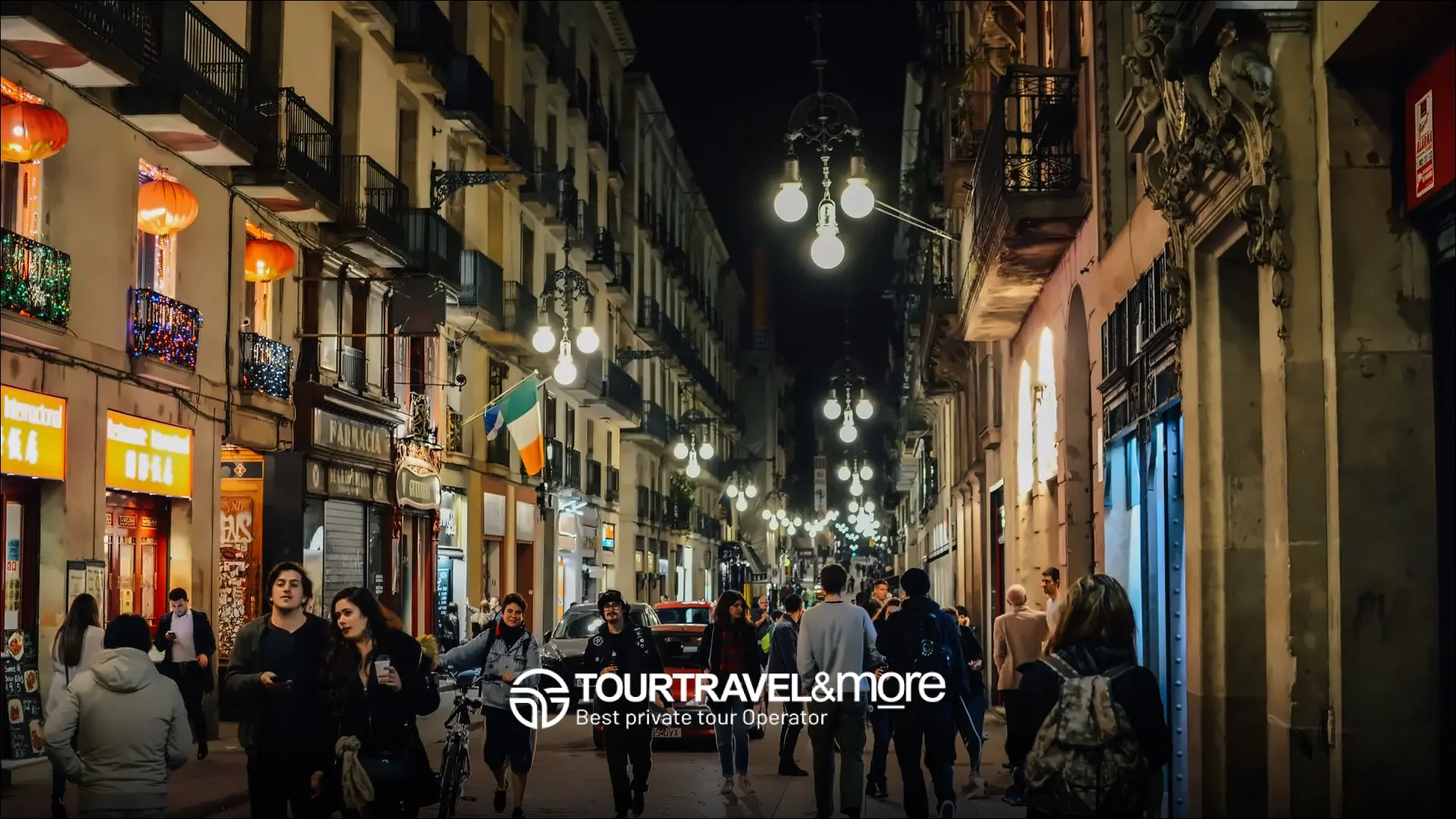
From the harbour, walk up Via Laietana and turn right into El Born. At this hour the neighbourhood’s narrow streets are lit by the lanterns on the façades and by the windows of its small shops.
The heart of the district is Santa Maria del Mar, the church paid for by the neighbourhood’s sailors and dockers in the 14th century. From outside, under the night lighting, the façade and its two octagonal towers take on a depth they don’t have by day. Next to it, in the Fossar de les Moreres, an eternal flame remembers the defenders buried there after the siege of 1714. From here, Passeig del Born leads in a straight line to the old iron market hall, lit up at the far end.
18:45 — Pica-pica before the kitchens open
At quarter to seven, half the bar counters in El Born are already full, but nobody is having dinner. It’s time for pica-pica, the Catalan word for picking at small plates: a glass of vermouth on tap, some anchovies, a few croquetas. That’s how locals hold out until dinner, and how you avoid the most common traveller’s mistake: eating at seven in the only restaurant that’s open, the one with a picture menu in six languages.
Order lightly. The night is long, and dinner comes at ten.
 Private
 Private
 Private
19:30 — Metro to Passeig de Gràcia
From El Born, metro line L4 takes you from Jaume I to Passeig de Gràcia in two stops. You come up on the most elegant stretch of the city, with the illuminated modernista façades of the Block of Discord: Casa Batlló, Casa Amatller and Casa Lleó Morera, side by side. A few minutes’ walk up the avenue brings you to the corner of Carrer de Provença, where La Pedrera stands.
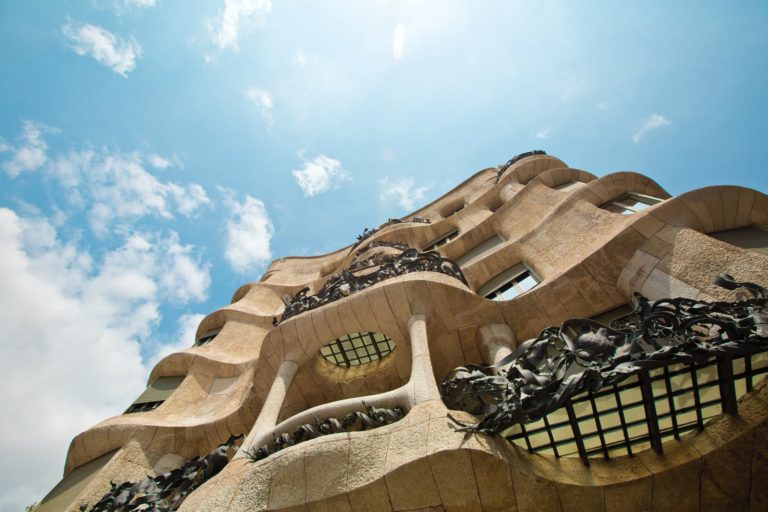
20:00 — La Pedrera by night: the rooftop warriors lit up
At night, Gaudí’s two houses on Passeig de Gràcia offer different experiences, and in winter the one to choose is La Pedrera. The La Pedrera Night Experience is a guided night tour of the building that ends on the rooftop, among the warrior-shaped chimneys, with light projections on them and a glass of cava. In the 2026-2027 winter season there are sessions from 19:00 to 23:00, from 2 November to 25 February, and tickets start at around €40. It often sells out, so book before you arrive in Barcelona.
The rooftop is a different place at night. With the city lit up below and the chimneys casting huge shadows, you understand why Gaudí designed it as a landscape rather than a roof. In the distance, if you look east, you’ll see the towers of the Sagrada Família lit up. That’s where you’re going next, and you have an hour and a half.
21:30 — The Sagrada Família, before the lights go off
From La Pedrera, line L5 takes you from Diagonal to Sagrada Família in two stops. You come up to find the Nativity façade lit up above you. But the best place to look at it is across the street: Plaça de Gaudí, with its pond. From the far bank, the whole basilica is reflected in the water, with the Tower of Jesus Christ, completed in 2026, crowned by its illuminated cross.
What few people know is that the lighting runs to a schedule, and in winter it switches off at ten. According to the calendar published by the basilica, the towers are lit from 18:30 to 22:00 in November and from 18:00 to 22:00 in December. In summer it’s the other way round: they don’t come on until ten at night. Seeing the Sagrada Família lit up is a before-dinner plan in winter and an after-dinner plan in summer. If you also want to see inside, that’s a daytime visit with a ticket; you’ll find how in how to avoid the queues at the Sagrada Família.
The lighting times change from year to year. Check them on the basilica’s website the week you travel.
22:15 — Dinner on Barcelona time
Now it’s time. At quarter past ten, the restaurants of the Eixample and Gràcia are full of locals, and dinner has a different feel. From the Sagrada Família you have two neighbourhoods a short metro or taxi ride away, or about twenty minutes on foot:
- Gràcia, up Carrer de Verdi or towards Plaça del Sol: small restaurants, terraces on the squares and a village feel.
- The Eixample, down towards Carrer d’Enric Granados or around the Mercat del Ninot: more refined cooking, bigger tables and less noise.
In either, most kitchens close between 23:00 and 23:30 on weeknights.
While you wait for your main course, back in Plaça de Gaudí, the couple with the tripod are finally setting up their camera in front of the pond. They ate early, at half past eight, in an empty restaurant near La Rambla, and walked up, arriving at 22:05. The façade is dark. All that’s visible is the cross on the central tower.
23:45 — The Gothic Quarter at night and Plaça Reial
After dinner, a taxi or line L3 drops you at Liceu, and from there you head into the Barri Gòtic, the Gothic Quarter, along Carrer de Ferran. At midnight the neighbourhood changes completely: the streets that are a river of people by day empty out, and the yellow lanterns light up the stone arches. The Pont del Bisbe, the square of Sant Felip Neri and the illuminated façade of the cathedral can be seen almost on your own. For the history of every corner, there’s our Gothic Quarter walking route; at night, it’s enough to walk slowly.
The night ends in Plaça Reial, the arcaded square with palm trees and lampposts designed by a newly qualified Gaudí. At this hour it’s still busy: terraces under the arcades, the basement of the Jamboree, a jazz club with concerts every night, and in one corner Los Tarantos, the city’s oldest flamenco venue. But flamenco comes earlier: its shows are in the early evening, and the last one usually finishes at around half past eight or nine.
A few things worth knowing about Plaça Reial and La Rambla at this hour:
- This is the area with the most pickpockets in Barcelona. Keep your phone and wallet in your front pocket, wear your backpack on your front, and be wary of anyone who stops you to ask a question, offers you a flower or points out a stain on your clothes. The same goes for the Liceu metro platform.
- The street sellers who come up with cold cans of beer have no licence, and drinking in the street carries a fine. Order at a terrace instead.
- If you carry on by yourself, avoid the streets of El Raval closest to La Rambla at this hour, and don’t leave anything on the sand if you head down to Barceloneta beach. The rest of the traps of a first visit are in first trip to Barcelona: tourist traps.
00:00 — The last metro
At five to midnight you go down into Liceu station. On weeknights, the Barcelona metro closes at midnight and doesn’t reopen until five in the morning. On Fridays and the night before a public holiday, it runs until two; on Saturdays, the metro runs all night. Special nights, such as Sant Joan (23 June) or New Year’s Eve, have their own timetable: check the TMB app.
On the platform, the couple with the tripod ask you whether this is the last train. It is. Since five in the afternoon they’ve arrived everywhere ten minutes late: at the bunkers as they were closing, at the Sagrada Família as it went dark. They’ve had the same night as you, covering the same distance. Just in a different order.
If you miss the metro, you have two options:
- A taxi. At night, tariff 2 applies: in 2026, a €2.80 starting fare and €1.66 per kilometre, from 20:00 to 08:00 on weekdays and all weekend. A trip of three or four kilometres within the centre comes to about €10.
- The NitBus. Barcelona’s night buses run from about 23:00 to 05:00, and almost all their routes pass through Plaça de Catalunya. They’re cheap, but slow and infrequent.
If you want to go dancing at midnight
If you want to dance, the night you’ve just read is only the beginning. In Barcelona, clubs open around midnight, don’t fill up until two and close at five or six. Turn up at half past twelve and you’ll be dancing alone.
The areas, depending on what you’re after:
- Port Olímpic: the big clubs on the seafront, such as Opium or Pacha, with commercial music and a largely international crowd. Metro L4, Ciutadella-Vila Olímpica.
- Razzmatazz, in Poblenou: a former industrial warehouse with several rooms, each with a different style of music. Metro L4, Bogatell.
- Apolo, on the Paral·lel: an early 20th-century dance hall with different club nights every evening. Metro L3, Paral·lel.
- El Born and the Eixample: for drinks without a club, in cocktail bars and bars that close at around two or three.
Entry usually costs between €15 and €25 including a drink, and it’s cheaper if you buy online in advance. Many clubs have a dress code (no flip-flops or sportswear) and ask for ID or your passport at the door. To get back, it’s easiest to go out on a Friday or Saturday: on Friday the metro runs until two, on Saturday all night, and the NitBus covers the rest.
How the night changes with the season
In summer, the same route changes order: the sun sets four hours later and some plans change season.
| What | November to February | June to September |
|---|---|---|
| Sunset | Between 17:20 and 18:30 | Between 20:00 and 21:30 |
| Bunkers del Carmel | Close at 17:30, before sunset | Close at 19:30, before sunset |
| Sagrada Família lights | 18:00 or 18:30 to 22:00 (in February, 19:00 to 23:00) | 21:00 or 22:00 to midnight |
| Magic Fountain of Montjuïc | Thursday to Saturday, 20:00 to 21:00 | Wednesday to Sunday, from 21:00 or 21:30 |
| La Pedrera by night | Night Experience, 19:00 to 23:00 | Jazz concerts on the rooftop, late May to July |
| Casa Batlló by night | Until November, without the rooftop | Magic Nights, with a rooftop concert |
| Dinner | 21:30 to 22:30 | 22:00 to 23:00, outdoors |
Approximate times as of November 2026. The Sagrada Família lighting, the Magic Fountain and the night visits change every season: check before you go.
In summer, the logical order is reversed: sunset at the harbour or on the beach at around nine, dinner at ten, and the Sagrada Família lit up after dinner, between eleven and twelve. The Magic Fountain of Montjuïc, which in winter only runs three days a week and stops for a few weeks in early November for maintenance, is a summer plan. You’ll find how to fit it into a trip in Barcelona in 3 days.
The ticketed plan: which one fits your night
A night in Barcelona works best with one paid plan in the middle, not three. These are the options with a fixed time, and what’s worth knowing about each:
| Plan | When and how much | Who it suits |
|---|---|---|
| La Pedrera Night Experience | Winter, sessions 19:00 to 23:00, from about €40 | Anyone who wants to see a Gaudí rooftop at night out of season |
| Casa Batlló by night | March to November, 20:30 to 21:30, from about €25, no rooftop | Anyone who wants Gaudí’s most theatrical interior with fewer people |
| Casa Batlló Magic Nights | Summer, from 20:00, from about €59 | Anyone who wants a rooftop concert; they sell out early |
| Concert at the Palau de la Música | Most nights, from about €35 depending on the concert | Anyone who wants to see the stained-glass hall full and with music |
| Flamenco at Los Tarantos | Shows of about 40 minutes in the early evening, from about €25 | Anyone who wants a short first flamenco before dinner |
| Jazz at the Jamboree | Concerts every night in Plaça Reial | Anyone who wants to stretch the night out after dinner |
Reference prices as of November 2026, which vary with the season and how far ahead you book. Casa Batlló and La Pedrera use dynamic pricing: the later you book, the more you pay.
The rule for choosing: the ticketed plan decides the order of the rest of the night. Flamenco goes before dinner, La Pedrera and Casa Batlló between sunset and dinner, and jazz and the Palau, depending on the concert time, afterwards.
If your night doesn’t look like this one
The night above is a Thursday in winter. If your trip falls in another season, on another day of the week, or you have a different plan in mind, this is what changes:
| If this is you | What to do |
|---|---|
| You’re travelling in summer | Sunset at the harbour at 21:00, dinner at 22:00 and the Sagrada Família lit up at 23:30 |
| It’s a Friday or Saturday | Stretch the night out: the metro runs until 02:00 on Friday and all night on Saturday |
| It’s a Sunday or Monday | Check what’s open first: many restaurants close on Sunday evening or Monday |
| You’re travelling with children | Sunset at the harbour, the Sagrada Família lit up at 18:30 in winter and an early dinner in the Eixample |
| You only want one ticketed plan | La Pedrera in winter; Casa Batlló’s Magic Nights in summer |
| You don’t want to spend anything | The harbour, El Born, the Sagrada Família from the pond and the Gothic Quarter at night: all free |
| You want to go dancing | A late dinner, a drink in El Born and a club from 01:30, ideally on a Friday or Saturday |
| You’re staying far from the centre | Plan your way back before you go out: the last metro or a taxi on the night tariff |
Barcelona at night with Tour Travel & More
Going out at night in Barcelona on your own is easy until the logistics kick in: viewpoints that close before sunset, a rooftop that sells out, a Sagrada Família that goes dark at ten, a dinner booked in the wrong neighbourhood and the last metro at midnight, with your phone in your pocket in the area with the most pickpockets in the city.
With Tour Travel & More, these problems disappear:
- 100% private tour — Just you and yours, with the night planned so you reach every place at the right time.
- Official licensed guide — Who tells you the story of El Born, the Gothic Quarter and Gaudí while the city lights up.
- Tickets handled for you — La Pedrera by night, Casa Batlló or a concert at the Palau, with a set time slot and no queues.
- Luxury vehicle with a professional driver — From the harbour to the Sagrada Família and back to your hotel, without relying on the last metro.
- Guardian Angel Service 24/7 — Real people coordinating everything before, during and after your trip, including last-minute changes.
We’re from Barcelona: the company was founded here in 2014, and today we hold a rating of 4.9 out of 5 from more than 500 reviews by verified travelers.
- Just your group
- Licensed guides
- Free cancellation