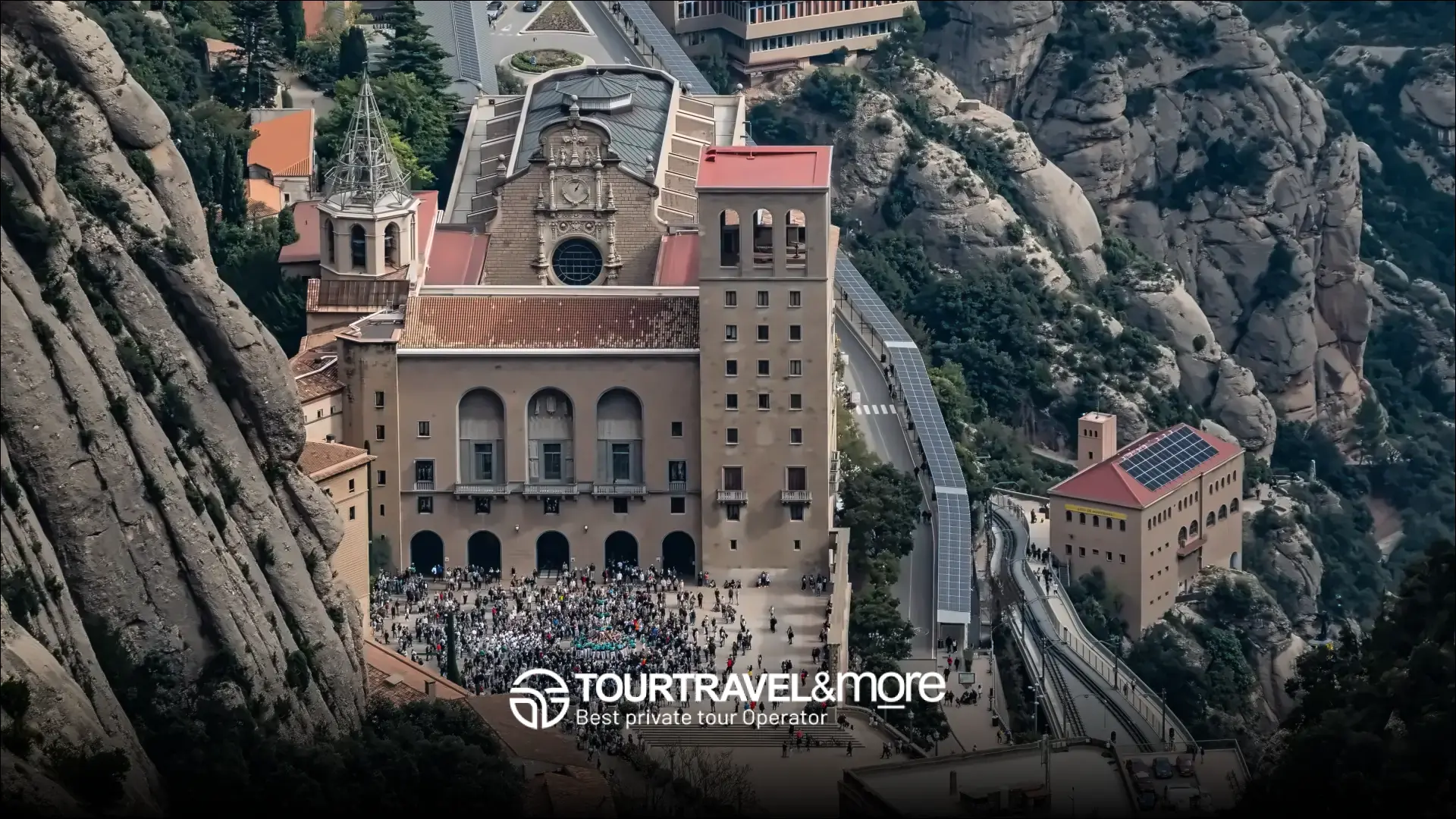
At 12:15, in the basilica at Montserrat, there’s a queue that wraps around the side aisle. It’s the line to see the Moreneta up close, the Black Madonna everyone comes here for. In it is a couple who caught the 10:36 train. They arrived at midday, just as the shrine reopened after closing mid-morning, and they haven’t moved for fifteen minutes. You walked past the Virgin at 10:15, with barely a wait. Right now you’re at the Sant Joan viewpoint, a thousand metres up, with the Montseny massif on one side and, on clear days, the sea on the other.
What follows is one day trip from Barcelona, told hour by hour: Montserrat, from 08:00 to 18:00, because it’s the trip most people take and the one that goes wrong for a single reason, which is the time you arrive. After that come the other day trips from Barcelona, measured in the only way that helps you choose: how many hours you actually get at your destination once you add up the train, the walk from the station into town and the journey back.
| Destination | Getting there | From the station to what you came to see | Real hours there |
|---|---|---|---|
| Sitges | Rodalies R2 Sud, 31-37 min from Sants | 10 min on foot to the beach and old town | 9 h |
| Girona | AVE or Avant high-speed train, 38-40 min | 15 min on foot to the Barri Vell | 8-9 h |
| Montserrat | FGC R5 train, 1 h, plus rack railway (20 min) or cable car (5 min) | You arrive at the monastery | 6-7 h |
| Tarragona | Regional train, about 70 min | 10-15 min on foot to the amphitheatre | 7 h |
| Sant Sadurní d’Anoia (cava) | Rodalies R4, under an hour | Cava houses on foot or a few minutes away | Whatever your booked tours allow |
| Figueres (Dalí Museum) | AVE to Figueres-Vilafant, about 55 min | 1.5 km: 20 min on foot or a shuttle bus | 6-7 h, with the museum closing mid-afternoon |
| Tossa de Mar | Bus from Estació del Nord, around 1 h 30 | You arrive in the village | 7 h |
| Cadaqués | Direct bus, about 2 h 45 | You arrive in the village | 4-5 h |
Real hours assume a day from 08:00 to 20:00, leaving from and returning to Barcelona. Journey times are approximate as of November 2026.
The sum that decides whether a trip fits in a day
Most lists of day trips from Barcelona rank destinations by distance or by minutes on the train. That’s the wrong sum. What decides whether a day works is a different subtraction: the hours you have, minus the journey out, minus the trip from the station to what you came to see, minus the journey back, minus a buffer in case the train runs late. What’s left is your day trip.
Around Barcelona, two things change that sum:
- Two high-speed stations are on the outskirts. The AVE to Figueres stops at Figueres-Vilafant, 1.5 km from the centre, and the one to Tarragona at Camp de Tarragona, about 10 km from the city, out in the fields. The fast train saves minutes and then loses them on the bus or in a taxi. For Tarragona, the regional train drops you in the centre and usually works out better.
- Rodalies needs a buffer. Rodalies, Catalonia’s commuter rail network, has had a difficult 2026, with engineering works and disruption on several lines: the R4 was closed between Martorell and Sant Sadurní for more than two months, and the R2 Sud has run amended timetables because of works between Garraf and Sitges. Check the line status in the Rodalies app before you set off, and don’t plan your return around the last train. The R5 to Montserrat isn’t Rodalies but FGC, the Catalan government railway, and it tends to be far more punctual.
With that sum in mind, the day begins.
08:15 — Plaça d’Espanya: choose your ticket before you reach the platform
The train to Montserrat leaves from the FGC station at Plaça d’Espanya, under the square, not from Sants. It’s the R5 line towards Manresa, with one departure an hour; the 08:36 is the one to catch. You arrive twenty minutes early because there’s a decision most people make on the platform, in a hurry: rack railway or cable car.
- The rack railway (the cremallera) leaves from Monistrol de Montserrat station. It climbs in about 20 minutes, with open views over the Llobregat valley, and it’s the calm option, including for children or anyone who doesn’t like heights.
- The cable car (the aeri) leaves from the stop before, Aeri de Montserrat. It climbs in about 5 minutes, hanging over the rock face. It’s more spectacular and shorter, but the cabins are small, queues build up when several trains arrive at once, and it doesn’t run in strong wind.
There are combined tickets for the train plus either option, and the Trans Montserrat, which also covers the funiculars, the museum and lunch. You can buy them on the FGC website or at the information point in the station itself. Prices change each season, so check them the day before. The key point: if you’re going to take the funicular up to Sant Joan, the full combined ticket usually pays for itself.
09:40 — Monistrol: the mountain from the side
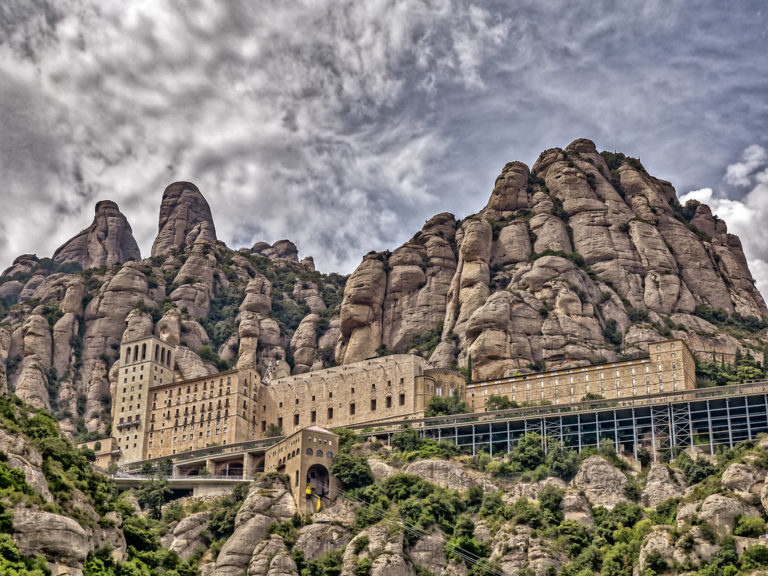
An hour on the train through the industrial estates of the Baix Llobregat and then, suddenly, there it is. Montserrat looks like no other mountain: spires of conglomerate, a rounded ochre rock, rising almost vertically from the river to the 1,236 metres of Sant Jeroni. The name means “serrated mountain”, and from the train you can see why.
You get off at Monistrol and board the rack railway. A little after ten you’re at the top, on the esplanade in front of the monastery, and the coach tours haven’t arrived yet. They usually turn up from around eleven.
10:05 — The Moreneta, before 10:30
Don’t stop at the shops or the viewpoints. Head straight to the basilica and find the side entrance that leads to the Virgin’s shrine, the small chamber behind the altar where the Romanesque statue of the Moreneta stands. Depending on the season, the shrine opens from 08:00 to 10:30 and reopens at midday, from 12:00. If you arrive on the 10:36 train, you’ll find the door shut and, at twelve, the queue of everyone who has arrived in those two hours.
First thing in the morning you climb a staircase decorated with mosaics, pass in front of the statue and touch the orb the Virgin holds in her hand, which is what almost everyone does. The statue dates from the 12th century, and its dark colour is put down to the passing centuries and the smoke from candles. She is the patron saint of Catalonia, and for many Catalans the visit is personal: it’s common to see whole families who come up every year.
10:45 — The museum and the basilica, at your own pace
With the Moreneta done, you can see the rest of the monastery without rushing. The basilica is largely 19th century, because the monastery was destroyed during the war against Napoleon and rebuilt afterwards. Look at the votive lamps in the nave and at the façade with its apostles.
A few steps away, the Museu de Montserrat is the surprise of the day for anyone who doesn’t know it. In a mountain monastery there’s a Caravaggio, an El Greco, early works by Picasso, and paintings by Monet and Dalí, plus a Near Eastern archaeology collection put together by a monk from the monastery in the early 20th century. It’s small and an hour is enough. Hardly anyone from the tour groups goes in, because their visit doesn’t include it.
11:30 — The Sant Joan funicular: the mountain from above
This is the difference between seeing Montserrat and seeing the monastery. The Sant Joan funicular leaves from the esplanade and climbs in a few minutes, on an impressive gradient, to almost a thousand metres. At the top, the mountain paths begin.
The most rewarding is the walk to the Sant Joan hermitage: an almost flat path of 20 to 30 minutes, with railings on the exposed stretches, to a viewpoint where you see the monastery from above, tiny, wedged into the rock face. On clear days you can see the Montseny, the Pyrenees and the sea. If you have more time and good footwear, the path continues to Sant Jeroni, the summit, at 1,236 metres; allow a little over an hour each way.
As you ride back down on the funicular, the couple from the queue are still in the basilica. They’ve still got a long way to go before they reach the Virgin.
 Private
 Private
 Private
13:00 — The Virolai and the Escolania choir
At one o’clock sharp, Monday to Friday, the Escolania de Montserrat sings. It’s one of the oldest boys’ choirs in Europe, with centuries of history. They sing the Salve and the Virolai, the hymn to the Virgin of Montserrat, in the basilica. It lasts about ten or fifteen minutes and it’s free, but the basilica fills up: go in a quarter of an hour early if you want a seat.
Three things to know before you plan your day around the choir:
- It doesn’t sing on Saturdays, and on Sundays it sings at 12:00, not 13:00.
- There’s no singing during school holidays. In 2026, the Escolania didn’t perform from 29 June to 26 August, or on a few individual dates in late June.
- The shrine closes during services. If you’re in the Moreneta queue at one o’clock, the line stops for as long as the singing lasts. That’s exactly what happens to the couple from the 10:36 train: they hear the Virolai from the queue, without seeing the choir.
14:00 — Mató with honey and an unhurried descent
On the path that leads down from the square towards the basilica, local producers set up their stalls: cheeses, honey, nuts and, above all, mató, a fresh curd cheese that Catalans eat for dessert with honey. It’s the thing to take home from Montserrat, and a mató with honey beats a plastic souvenir.
For lunch there’s a self-service cafeteria and a restaurant on site. They’re convenient and they’re not cheap. Plenty of people bring a sandwich and eat on the benches at the viewpoints, which is the best way to have lunch here.
After lunch, if you still feel like walking, take the Camí dels Degotalls, a flat path that leaves from the esplanade, runs along the rock face and is dotted with monuments and plaques dedicated to poets and figures linked to the mountain. It’s half an hour there and back, in the shade of the rock.
16:00 — Heading back, with the couple from the queue
You take the four o’clock rack railway down. In the carriage, sitting opposite, is the couple from the basilica. They reached the Virgin after half past one, ate standing up in the cafeteria and didn’t have time to go up to Sant Joan: the train that got them back to Barcelona in time for dinner was this one. She asks you whether going up was worth it. You show her the photo of the monastery from above, like a model clinging to the rock. She says nothing. She looks out of the window.
You’ve seen what they saw and more, on the same day and with the same ticket. The only difference was the time you left. By around six you’re back at Plaça d’Espanya, with time for a shower before dinner, which in Barcelona doesn’t start until nine.
The opening hours of the shrine, the Escolania and the funiculars change with the season and with religious celebrations. Check them the day before on the monastery’s website and on FGC’s.
Girona: the day trip that works best by train
If Montserrat is the most popular day trip, Girona is the easiest. The AVE or Avant from Sants takes 38 to 40 minutes, the station is inside the city, and a quarter of an hour on foot takes you to the Barri Vell, the old town. Of all the day trips from Barcelona, it’s the one that leaves you the most hours and depends least on timetables.
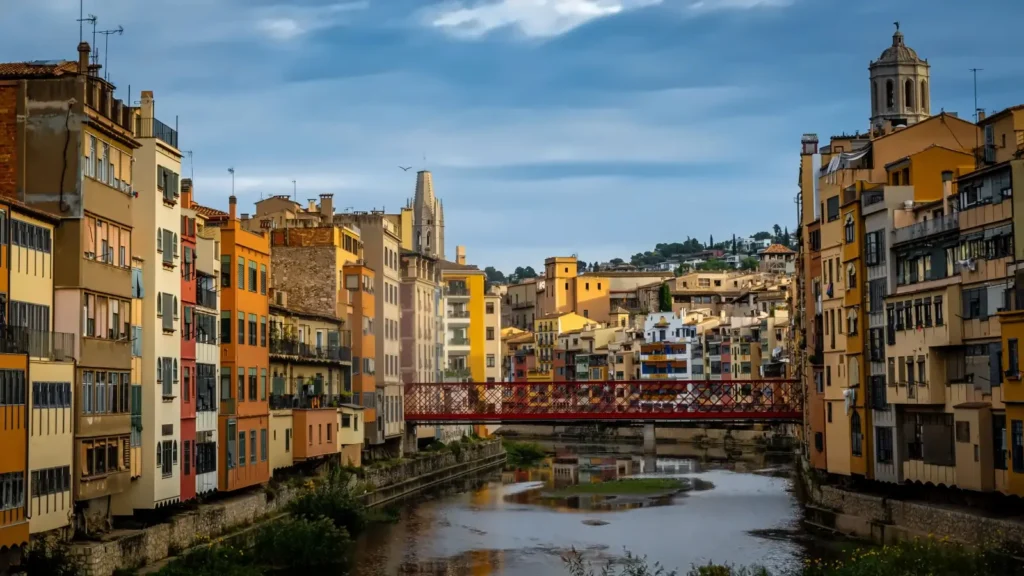
What to see, in a logical order:
- The houses on the Onyar, the coloured façades leaning over the river, best seen from the iron bridge of Pont de les Peixateries Velles, built in 1877 by Gustave Eiffel’s company, a dozen years before his tower in Paris.
- The cathedral, with its Baroque staircase and a Gothic nave that is the widest in the world in its style. The staircase appeared in the sixth season of Game of Thrones, and the whole old town was used as a set.
- The Call, the Jewish quarter, one of the best preserved in Europe, with the Museum of Jewish History at its heart.
- The Passeig de la Muralla, the walkway along the medieval walls, free, with views over the rooftops and the cathedral.
- The Banys Àrabs, which aren’t Arab at all but 12th-century Romanesque public baths, with a dome on columns that lets in the light.
In May, during Temps de Flors, the flower festival, the old town fills with floral installations in courtyards and on staircases, and with people too. If you go that week, catch the first train.
Figueres and the Dalí Museum: when the AVE drops you on the outskirts
The Dalí Theatre-Museum in Figueres is one of the most requested visits in Catalonia, and the easiest to get wrong. The AVE takes about 55 minutes to Figueres-Vilafant, a newer station 1.5 km from the centre: that’s 20 minutes on foot or a shuttle bus. The R11 regional train, on the other hand, stops at Figueres station, about 12 minutes’ walk from the museum, but takes around two hours.
Three facts that decide the visit:
- It’s closed on Mondays, except in July and August.
- Tickets are sold for a set time slot. General admission starts at about €18.50 on the official website, and in high season the slots sell out.
- It opens mid-morning and closes mid-afternoon outside high season, so there’s no room for a late arrival.
The best way to make the most of the train is to combine Figueres and Girona on the same day: the Avant between the two takes about 15 minutes. Dalí in the morning, Girona in the afternoon, and back to Barcelona from Girona.
| Destination | Fast-train station | Distance to the centre | Alternative that drops you in town |
|---|---|---|---|
| Figueres | Figueres-Vilafant (AVE and Avant) | 1.5 km: 20 min on foot or a shuttle bus | R11 regional to Figueres centre: about 2 h, but 12 min from the museum |
| Tarragona | Camp de Tarragona (AVE and Avant) | About 10 km: bus, or 15 min by taxi | Regional to Tarragona centre: about 70 min, by the sea and 10-15 min from the amphitheatre |
| Girona | Girona (AVE, Avant and regional) | Inside the city: 15 min on foot | Not needed: here the fast train wins |
Sitges: the beach in 35 minutes
Sitges is the summer day trip par excellence, but it works just as well out of season. The R2 Sud Rodalies line takes 31 to 37 minutes from Sants, with several trains an hour, and the station is a ten-minute walk from the beach.
It’s a fishing village that became an artists’ retreat at the end of the 19th century. What to see: the church of Sant Bartomeu i Santa Tecla, on the headland above the seafront, which is the image of Sitges; the Cau Ferrat, the home and studio of the painter Santiago Rusiñol, with a collection of wrought iron and two El Grecos; and the Palau de Maricel next door, with rooms overlooking the sea. The rest of the day is for wandering the white streets of the centre, eating a rice dish facing the beach and having a swim.
Watch out for two things: at summer weekends the early trains are packed, and the February carnival and the October film festival transform the town completely.
Tarragona: Catalonia’s Rome by regional train
Tarragona was Tarraco, one of the great Roman cities of Hispania, and its ruins are a UNESCO World Heritage Site. Here the station rule works the opposite way to Girona: don’t take the AVE. The regional train from Sants takes about 70 minutes and drops you at Tarragona station, by the sea, about 10 or 15 minutes’ walk from the amphitheatre.
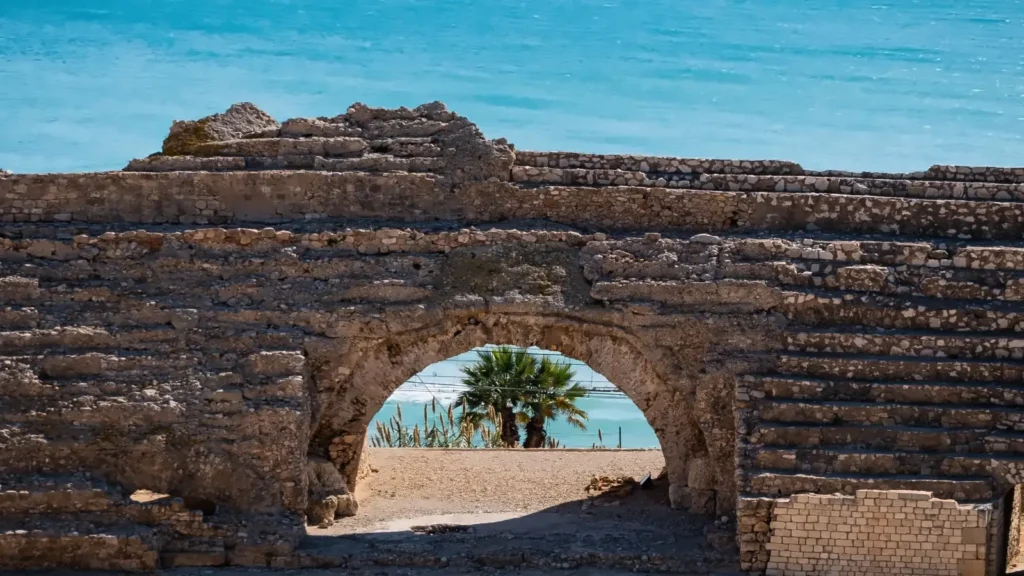
The amphitheatre, facing the Mediterranean, is the city’s signature image. From there you climb to the Pretori and the remains of the Roman circus, whose vaults still stand beneath the houses of the upper town, and on to the cathedral, built in the transition from Romanesque to Gothic. Finish on the Passeig Arqueològic, along the city wall, one of the oldest Roman structures on the Iberian Peninsula. Several monuments and museums close on Mondays, so check before you choose your day.
In summer, Tarragona is also a beach destination. You’ll find the best ones in the best beaches in the province of Tarragona.
The Penedès: cava in under an hour
Sant Sadurní d’Anoia is the capital of cava, Catalonia’s sparkling wine, and it’s under an hour from Barcelona on the R4 Rodalies line. Some of the big cava houses are a few minutes from the station, and others, smaller and family-run, are on estates in the surrounding countryside, where you need a car.
Here the day isn’t set by the train but by the tours: every cava house works by reservation and at fixed times, mostly in the morning. Book before you buy your train ticket. And since the R4 is one of the lines that has had the most disruption in 2026, leave a buffer for the way back.
The Penedès has another advantage: it’s on the way to Montserrat. By car, the monastery and Sant Sadurní are about 35 or 40 minutes apart, and it’s the most common one-day combination: the mountain in the morning and cava in the afternoon. By public transport, on the other hand, you can’t link the two on the same day without going back through Barcelona.
The Costa Brava and medieval villages: the problem isn’t distance, it’s connections
The Costa Brava begins an hour from Barcelona, but almost everything that makes it beautiful (the coves, the whitewashed villages, the medieval villages inland) is a long way from any train. There, the day trip depends on the bus, and the buses don’t run often.
| Destination | By public transport | With a private vehicle | What changes |
|---|---|---|---|
| Tossa de Mar | Bus from Estació del Nord, around 1 h 30 | 1 h 15 | Doable by bus; by car you can add the coves of Lloret or Sant Feliu |
| Cadaqués | Direct bus, about 2 h 45, with few departures a day | About 2 h | By bus you get 4-5 hours there; by car you can combine it with the Dalí Museum |
| Besalú | Direct bus, about 2 h, around four departures a day | 1 h 30 | By car you can add Castellfollit de la Roca or Girona on the same day |
| Pals and Peratallada | No practical connection in a day | 1 h 30 | They go from impossible to a medieval-village route with a beach at the end |
| Calella de Palafrugell | Bus with a change, about 2 h | 1 h 30 | Lets you combine the cove, the coastal path and an inland village |
To choose between them, see the most beautiful villages of the Costa Brava.
The ones sold as day trips that aren’t
Some destinations appear on lists of day trips from Barcelona and, done in a day, leave you more hours on the road than at the place itself:
- Andorra: about 3 hours by bus each way. Six hours of travel for three hours of shopping.
- The Vall de Núria: the train to Ribes de Freser plus the rack railway add up to more than two and a half hours each way. It deserves a night.
- The Ebro Delta: about 2 hours by car, and the delta is big; it’s hard to see in a hurry.
- Carcassonne: about 3 hours by car to the medieval French city. It only fits if you leave very early and do nothing else.
It’s not that they aren’t worth it. It’s that they’re worth more than a day.
If your trip doesn’t look like this one
| If this is you | Which day trip to choose | What to avoid |
|---|---|---|
| It’s your first time in Catalonia and you have one free day | Montserrat on the 08:36 train, or Girona | Trying two destinations by public transport |
| It’s a Monday | Montserrat, Sitges, or Girona’s streets | The Dalí Museum (except July and August) and several monuments in Tarragona |
| It’s a Saturday | Girona or Sitges | Montserrat, if what you want is to hear the Escolania |
| You’re travelling in July or August | Sitges early in the morning, or Girona | Montserrat at midday and the Costa Brava by bus |
| You’re travelling with children | Montserrat, for the rack railway and the funicular, or Sitges | Cadaqués or Andorra: too many hours sitting down |
| You want two places in one day | Figueres and Girona by train, or Montserrat and the Penedès by car | Montserrat and Sitges on the same day |
| You only have half a day | Sitges | Any destination more than an hour away |
If you haven’t seen the city yet, before you leave it there’s Barcelona in one day and Barcelona in 3 days, with room for one of these day trips.
Day trips from Barcelona with Tour Travel & More
You can do a day trip from Barcelona on your own, but the day depends on things you can’t control: a train on a line with disruption, the Moreneta queue at midday, the last bus from Cadaqués, the AVE station on the outskirts, or a cava tour that’s fully booked. And almost every combination that’s really worth it, like Montserrat with the Penedès or Dalí with Cadaqués, can’t be done by public transport in a single day.
With Tour Travel & More, these problems disappear:
- 100% private tour — Just you and yours, at the time you choose, so you reach Montserrat or Girona before the groups.
- Official licensed guide — Who tells you the story of each place and takes you to the corners that aren’t on the signs.
- Tickets handled for you — The Dalí Museum, Girona Cathedral or a cava tour, with a set time slot and no queues.
- Luxury vehicle with a professional driver — Door to door from your hotel, without relying on Rodalies, and with two destinations in the same day if you prefer.
- Guardian Angel Service 24/7 — Real people coordinating everything before, during and after your trip, including last-minute changes.
We’re from Barcelona: the company was founded here in 2014, and today we hold a rating of 4.9 out of 5 from more than 500 reviews by verified travelers.
- Just your group
- Licensed guides
- Free cancellation