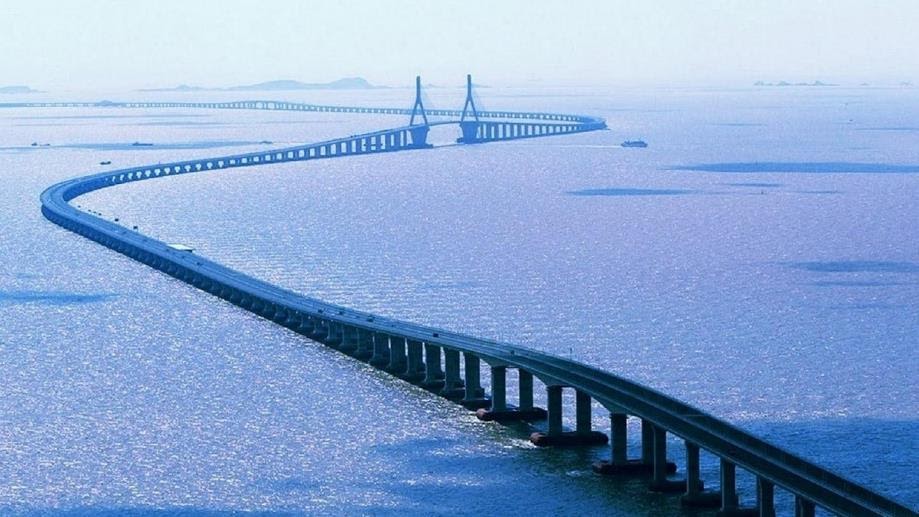
Some of the most impressive feats of human engineering stretch across rivers, lakes, bays, and even entire regions. The longest bridges in the world are not just transportation corridors — they are monuments to ambition, precision, and the desire to connect people across vast distances. From high-speed rail viaducts cutting through China’s Yangtze River delta to causeways crossing Louisiana swamps, these structures redefine what we thought possible.
I’ve always been fascinated by bridges. There’s something deeply moving about standing on a structure that spans kilometers of open water or valley, knowing that thousands of workers spent years making it real. In this guide, I’ll walk you through the 10 longest bridges on the planet, with practical details for those of you who — like me — want to see them in person.
Quick Overview: The 10 Longest Bridges in the World
1. Danyang–Kunshan Grand Bridge, China — 164.8 km
The undisputed champion. The Danyang–Kunshan Grand Bridge holds the Guinness World Record as the longest bridge ever built, stretching an almost incomprehensible 164.8 kilometers (102.4 miles) across the Yangtze River delta in Jiangsu Province, eastern China.
Completed in 2010 after just four years of construction, this viaduct carries the Beijing–Shanghai High-Speed Railway and was built by an army of over 10,000 workers at a cost of approximately $8.5 billion. The bridge crosses rivers, canals, lakes (including a section over Yangcheng Lake), and flat lowland terrain, connecting Shanghai to Nanjing.
Why it matters for travelers
If you ride the Beijing–Shanghai bullet train, you’ll cross this bridge without even realizing it — the ride is that smooth. The train reaches speeds of 300 km/h, and the views of the Yangtze delta’s rice paddies and waterways from the window are quietly spectacular. The bridge has reduced travel time between Beijing and Shanghai from 18 hours to under 5.
Key facts
- Type: High-speed rail viaduct
- Year opened: 2010
- Built to withstand: Magnitude 8 earthquakes, typhoons, and ship impacts up to 300,000 tons
- Cost: $8.5 billion
2. Changhua–Kaohsiung Viaduct, Taiwan — 157.3 km
Taiwan’s engineering marvel runs 157.3 kilometers along the island’s western coast, carrying the Taiwan High Speed Rail from Baguashan in Changhua County to Zuoying in Kaohsiung. It’s the second longest bridge in the world and was designed with one critical priority: earthquake resistance.
Taiwan sits on the Pacific Ring of Fire, making seismic activity a constant threat. The viaduct was built using advanced anti-seismic technology, with each section designed to absorb and dissipate the energy of a major earthquake. The structure was completed in 2004 and opened for commercial service in 2007.
Why it matters for travelers
The Taiwan High Speed Rail is one of the best ways to explore the island. In just 90 minutes, you go from Taipei to Kaohsiung, passing through lush green landscapes and small towns. The viaduct section offers elevated views over Taiwan’s agricultural heartland that you simply can’t get from the road.
Key facts
- Type: High-speed rail viaduct
- Year opened: 2004 (service from 2007)
- Special feature: Advanced seismic-resistant design
- Route: Changhua to Kaohsiung, western Taiwan
3. Cangde Grand Bridge, China — 115.9 km
Another giant on the Beijing–Shanghai High-Speed Railway, the Cangde Grand Bridge stretches 115.9 kilometers across Hebei Province in northern China. Supported by 3,092 pillars, it was completed in 2010 alongside its longer sibling, the Danyang–Kunshan.
The bridge crosses mostly flat agricultural land, and its primary purpose is to keep the high-speed rail line elevated above local roads, waterways, and existing infrastructure. It’s a purely functional structure, but its sheer scale is awe-inspiring when you consider that each of those 3,092 piers had to be precisely placed.
Key facts
- Type: High-speed rail viaduct
- Year opened: 2010
- Supports: 3,092 pillars
- Part of: Beijing–Shanghai High-Speed Railway
4. Tianjin Grand Bridge, China — 113.7 km
The Tianjin Grand Bridge connects the cities of Langfang and Qingxian in Hebei Province, running 113.7 kilometers as part of — you guessed it — the Beijing–Shanghai High-Speed Railway. It was inaugurated in 2011 and uses massive 860-ton box girders that were pre-fabricated and lifted into place.
This bridge held the Guinness World Record as the second longest bridge in the world when it opened. While it may not have the dramatic river crossings of some other entries on this list, the precision engineering required to place those enormous girders across 113 kilometers of terrain is nothing short of remarkable.
Key facts
- Type: High-speed rail viaduct
- Year opened: 2011
- Notable engineering: 860-ton pre-fabricated box girders
- Route: Langfang to Qingxian, Hebei Province
5. Weinan Weihe Grand Bridge, China — 79.7 km
Crossing the Wei River valley in Shaanxi Province, the Weinan Weihe Grand Bridge is 79.7 kilometers long and carries the Zhengzhou–Xi’an High-Speed Railway. What makes this bridge particularly interesting is that it crosses the Wei River not once, but twice, along with several other rivers and highways.
Built between 2008 and 2010 by a workforce of 10,000, the bridge required 2.3 million cubic meters of concrete. Xi’an, the eastern terminus city, is one of China’s most fascinating destinations — home to the famous Terracotta Army and the starting point of the ancient Silk Road.
Why it matters for travelers
If you’re planning a trip to see the Terracotta Warriors in Xi’an, there’s a good chance you’ll ride across this bridge on the high-speed train from Zhengzhou. The Wei River valley views are a bonus.
Key facts
- Type: High-speed rail viaduct
- Year opened: 2008
- Concrete used: 2.3 million cubic meters
- Crosses: Wei River (twice), plus other rivers and highways
6. Hong Kong–Zhuhai–Macau Bridge, China — 55.7 km
This is the one that gets everyone’s attention. The Hong Kong–Zhuhai–Macau Bridge (HZMB) is a 55.7-kilometer sea crossing that connects three major cities across the Pearl River delta. Opened in 2018, it includes a stunning 6.7-kilometer underwater tunnel that dips beneath the sea to allow ships to pass overhead.
The bridge was built using 400,000 tonnes of steel — enough to build 60 Eiffel Towers — at a cost of approximately $7 billion. Two artificial islands were constructed at the tunnel entrances, and the entire structure was designed to withstand a magnitude 8 earthquake, a Category 16 typhoon, and a 300,000-ton ship collision.
Why it matters for travelers
The HZMB has transformed travel in the Pearl River delta. What used to be a four-hour ferry ride from Hong Kong to Zhuhai is now a 40-minute drive. If you’re visiting Hong Kong and Macau, crossing this bridge is an experience in itself — the views of the open sea from the elevated road sections are stunning, and the descent into the underwater tunnel is surreal.
Key facts
- Type: Road bridge with underwater tunnel
- Year opened: 2018
- Includes: 6.7 km underwater tunnel, 2 artificial islands
- Steel used: 400,000 tonnes (60 Eiffel Towers)
- Cost: ~$7 billion
7. Bang Na Expressway, Thailand — 54 km
Thailand’s Bang Na Expressway is a 54-kilometer elevated highway that runs through the outskirts of Bangkok. Completed in 2000, it held the Guinness World Record as the longest road bridge in the world until China’s megaprojects overtook it.
Unlike most bridges on this list, the Bang Na Expressway doesn’t cross water. It’s an elevated highway built directly above an existing ground-level road, designed to relieve Bangkok’s notorious traffic congestion. The concept was revolutionary at the time: instead of building a new road through crowded urban areas, engineers simply built one on top of the old one.
Why it matters for travelers
If you’re visiting Bangkok, you might drive along or beneath this expressway without realizing you’re on one of the world’s longest bridges. The elevated road offers surprisingly good views of the city’s sprawling landscape, from temple spires to modern skyscrapers.
Key facts
- Type: Elevated road expressway
- Year opened: 2000
- Designed by: Louis Berger Group (1994)
- Former record: Longest road bridge in the world (2000–2004)
8. Beijing Grand Bridge, China — 48.2 km
The Beijing Grand Bridge is yet another section of the remarkable Beijing–Shanghai High-Speed Railway, running 48.2 kilometers through the outskirts of China’s capital. Inaugurated in 2011, it helps trains glide above the congested urban and suburban landscape of greater Beijing.
Four of the ten longest bridges in the world belong to the same railway line — the Beijing–Shanghai High-Speed Railway. This single project, which opened in 2011, created more record-breaking bridge infrastructure than most countries have built in their entire history.
Key facts
- Type: High-speed rail viaduct
- Year opened: 2011
- Part of: Beijing–Shanghai High-Speed Railway
- Purpose: Elevates rail above congested Beijing suburbs
9. Lake Pontchartrain Causeway, USA — 38.6 km
The Lake Pontchartrain Causeway is the longest bridge in the United States and the longest continuous bridge over water in the world. It consists of two parallel bridges — the older one completed in 1956, the newer in 1969 — that stretch 38.6 kilometers across Lake Pontchartrain in Louisiana, connecting the city of Metairie (near New Orleans) with Mandeville on the north shore.
Supported by over 9,000 concrete pilings, the causeway is so long that for approximately 13 kilometers in the middle, you cannot see land in any direction. The bridge also features a pivoting section that opens to allow boats to pass through. It famously survived Hurricane Katrina in 2005 with repairable damage, a testament to its sturdy construction.
Why it matters for travelers
If you’re visiting New Orleans, driving across the Lake Pontchartrain Causeway is a bucket-list experience. That moment when the shoreline disappears behind you and there’s nothing but water and sky in every direction is genuinely thrilling. The north shore town of Mandeville makes for a lovely half-day trip with its charming downtown and lakeside parks.
Key facts
- Type: Highway causeway
- Year opened: 1956 / 1969
- Supports: Over 9,000 concrete pilings
- Record: Longest continuous bridge over water
- Survived: Hurricane Katrina (2005)
10. Manchac Swamp Bridge, USA — 36.7 km
Our second Louisiana entry, the Manchac Swamp Bridge carries Interstate 55 through the eerie, beautiful Manchac Swamp on the southeastern edge of Lake Pontchartrain. At 36.7 kilometers, it’s one of the longest bridges in the world — and by far the most atmospheric.
Built in 1979 at a cost of approximately $7 million per mile, the bridge required piles driven more than 250 feet deep into the soft swamp bed. Driving across it, you’re surrounded by cypress trees draped in Spanish moss, dark water, and the occasional alligator. It feels more like a scene from a movie than a highway.
Why it matters for travelers
The Manchac Swamp Bridge is one of the most atmospheric drives in the United States. If you’re road-tripping through Louisiana, take I-55 just for this experience. The swamp around it is also popular for kayaking and airboat tours, giving you a chance to see the landscape from water level.
Key facts
- Type: Interstate highway bridge
- Year opened: 1979
- Pile depth: Over 250 feet into swamp bed
- Cost: ~$7 million per mile
- Atmosphere: Cypress swamps, Spanish moss, alligators
Honorable Mentions
The world of long bridges doesn’t end at number 10. Here are a few more remarkable structures worth knowing about:
- Sheikh Jaber Al-Ahmad Al-Sabah Causeway (Kuwait) — 36.1 km, opened in 2019, crossing Kuwait Bay and connecting Kuwait City to the northern Subiyah area.
- Jiaozhou Bay Bridge (China) — 26.7 km, one of the longest bridges over water, connecting Qingdao to Huangdao across the bay.
- Straits of Mackinac Bridge (USA) — 8 km, not the longest by numbers but one of the most iconic, connecting Michigan’s Upper and Lower Peninsulas since 1957.
Why Does China Dominate This List?
You’ve probably noticed that 7 out of 10 bridges on this list are in China, and most are part of the country’s high-speed rail network. This isn’t a coincidence. China’s massive infrastructure investment over the past two decades has produced more than 40,000 kilometers of high-speed rail — more than the rest of the world combined.
Building elevated viaducts instead of ground-level tracks has several advantages: it avoids land acquisition disputes, preserves agricultural land, keeps the line straight for high-speed travel, and protects the railway from flooding. The result is a network of record-breaking bridges that most passengers cross without a second thought.
Planning a Trip to See These Bridges?
Several of these bridges are easy to incorporate into a broader travel itinerary:
- China: The Beijing–Shanghai High-Speed Railway crosses four of these bridges in a single journey. Book a window seat and watch the engineering unfold at 300 km/h.
- Thailand: The Bang Na Expressway is right outside Bangkok, one of Southeast Asia’s most exciting cities for food, temples, and culture.
- Taiwan: The Changhua–Kaohsiung Viaduct is part of the Taiwan High Speed Rail, an essential transportation link for any Taiwan trip.
- Louisiana, USA: Both the Lake Pontchartrain Causeway and Manchac Swamp Bridge are within easy reach of New Orleans, making them perfect additions to a Louisiana road trip.
Whether you’re an engineering enthusiast, a curious traveler, or someone who simply loves superlatives, these bridges deserve a spot on your travel bucket list. Each one tells a story of human determination, technical innovation, and the simple desire to get from one side to the other — no matter how far apart those sides may be.
Frequently Asked Questions
What is the longest bridge in the world?
The Danyang–Kunshan Grand Bridge in China is the longest bridge in the world at 164.8 km (102.4 miles). It carries the Beijing–Shanghai High-Speed Railway and was completed in 2010.
What is the longest bridge over water?
The Lake Pontchartrain Causeway in Louisiana, USA, holds the record as the longest continuous bridge over water at 38.6 km (24 miles). The Hong Kong–Zhuhai–Macau Bridge is the longest sea-crossing bridge at 55.7 km, though it includes an underwater tunnel section.
Can you walk across any of these bridges?
Most of these bridges are not open to pedestrians, as they carry high-speed rail or highway traffic. However, the Hong Kong–Zhuhai–Macau Bridge has organized tours, and the Lake Pontchartrain Causeway occasionally hosts charity runs.
Why are so many of the longest bridges in China?
China has invested heavily in high-speed rail infrastructure over the past two decades. Building elevated viaducts allows trains to maintain high speeds over flat terrain while preserving farmland and avoiding obstacles. This approach has produced seven of the world’s ten longest bridges.
- Just your group
- Licensed guides
- Free cancellation