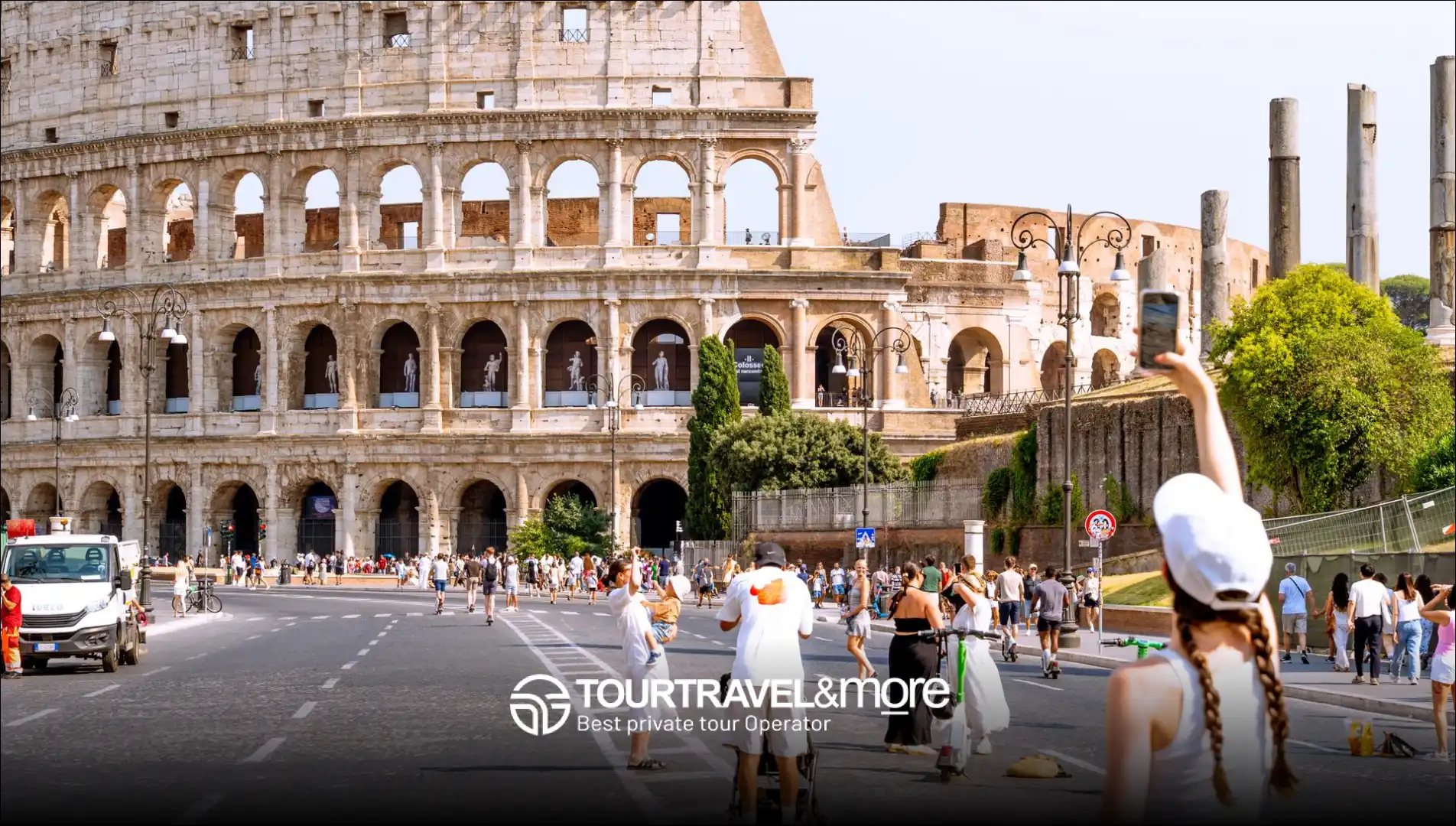
Irene arrived at the Colosseum at 12:30 in the afternoon with Lucía, 6, and Darío, 3, convinced that some time in the line “would do them good, just to pass the time.” Fifteen minutes in, with the July sun beating straight down and not a single patch of shade in sight, Darío was already sitting on the ground crying and Lucía kept saying she was thirsty. They left without going in. The next day they tried the Vatican Museums, and twenty minutes into corridors full of paintings that only adults could appreciate, the same scene played out almost exactly.
The problem wasn’t Rome, or the kids: it was the itinerary. They had copied a plan built for adults with eight hours of legs and patience, and tried to force it onto two children who hold up well for two or three hours before everything falls apart. Changing that logic, not the destination, is what saved the rest of the trip.
Why the “normal” Rome itinerary doesn’t hold up with young children
Rome guides tend to pack the Colosseum, the Roman Forum, Palatine Hill and the Vatican Museums into a single day, assuming hours on your feet on Rome’s cobblestones (the sampietrini, which are also rough on any stroller) and lines under the midday sun. That pace works for a motivated adult; for a child aged 3 to 7, the reserve of energy and patience is much shorter, and heat, hunger or a long line drain it even faster.
Treating the day as a checklist of monuments is what triggers the meltdown. Treating it as a series of short blocks, with a food, water and rest stop already built in, is what makes the day hold together.
| Time of day | The plan built for adults | The plan that holds up with young children |
|---|---|---|
| Mid-morning | Colosseum + Roman Forum + Palatine Hill back to back, no break | Colosseum only, short visit, timed ticket already booked |
| Lunchtime | A restaurant with a long menu and a wait for a table | Pizza al taglio or a quick trattoria, booked ahead if a high chair is needed |
| Early afternoon | The full Vatican Museums, including the Sistine Chapel | A rest break or a park, taking advantage of the fact that Rome shuts down too at that hour |
| Mid-afternoon | One more monument | Villa Borghese, a square with a fountain, or gelato as a reward |
Rome with kids, the quick comparison
Neither column is “all of Rome”: the left one is the version almost nobody with young children finishes without someone ending up in tears.
How to plan the morning with young children in Rome
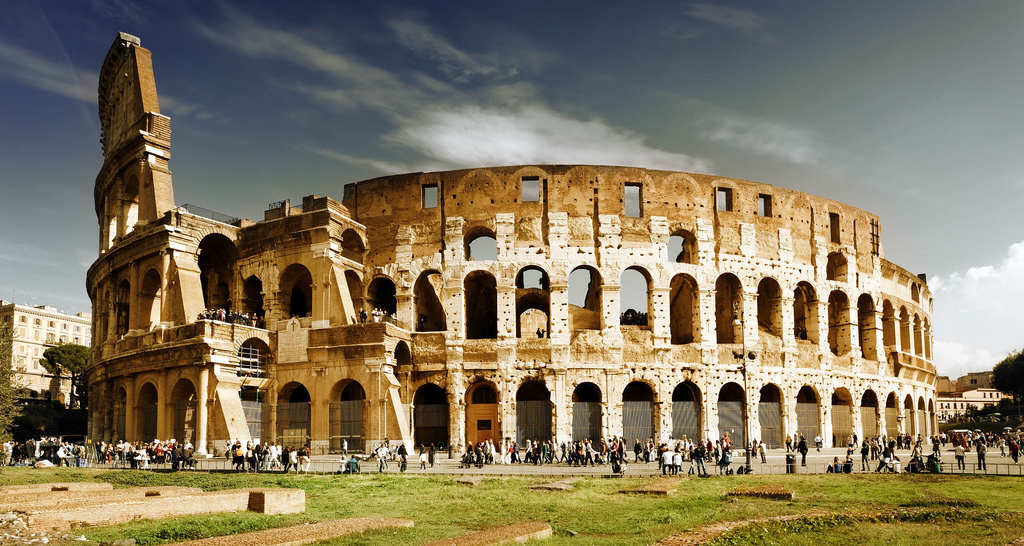
The Colosseum is where the difference between visiting with or without kids shows up the most. A timed ticket booked online in advance is essential, not just for convenience: it skips the ticket-office line under the sun, exactly the kind of wait a young child doesn’t handle well. The first slot of the morning, right at opening, is the best combination possible, since there are fewer people and the heat hasn’t built up yet.
With young children, it’s better to shorten the visit than to try to cover the whole site: the arena level plus a walk around the perimeter is usually enough, leaving the Roman Forum and Palatine Hill for another time, or out of the plan for that day altogether. Access to the underground level (the hypogeum) involves narrow stairs with no elevator, and isn’t comfortable with strollers or with kids who tire quickly going up and down. Along the way there are public fountains (the nasoni) where you can refill a water bottle as many times as needed, which in Rome in summer isn’t optional.
 Private
 Private
 Private
The lunch hour that decides how the rest of the day goes
Eating before hunger turns into a meltdown matters more than finding the perfect restaurant. Pizza al taglio (sold by weight, cut to order, served in minutes) solves an impatient child’s hunger faster than any trattoria with a menu and a wait for a table. If sitting down is preferred, it’s worth asking about a high chair (seggiolone) when booking, since not every place in the center has enough of them, and they run out at peak hours.
Gelato, saved as a reward after lunch rather than as a loose snack during the morning, works as the best “almost there” a young child can be offered: it gives a concrete reason to hold on through the last half hour of any visit.
The mid-afternoon break Rome already has built in
Many shops in central Rome close between one and four in the afternoon, a custom that happens to line up exactly with the hour a child aged 3 to 6 most needs to stop. Instead of forcing another visit at that time, it’s the moment to head back to the hotel for a short nap or find shade in Villa Borghese, which has a lake with rowboats for rent, lawns to run around on, and the Bioparco (Rome’s zoo) as an option if the day allows for more.
This break isn’t wasted time: it’s what makes the rest of the afternoon something to enjoy instead of survive.
Vatican Museums with young children: when it’s worth it, and when it isn’t
The Vatican Museums stretch for several kilometers before reaching the Sistine Chapel, designed for someone who can pause in every room; with young children, that same distance turns into the buildup to a meltdown before you ever get there. If the Sistine Chapel is the real goal, knowing in advance that the walk there is long and short on distractions for a child helps decide whether that day is the day, or not.
St. Peter’s Basilica, on the other hand, is free, doesn’t follow the same linear route, and allows you to come and go as the kids can handle. Climbing the dome only really makes sense for somewhat older children: it’s hundreds of narrow steps with no elevator, and the final stretch is done in a very tight space. With young children, staying at the basilica level is usually the option everyone enjoys more.
When to do each thing so the kids can keep up
| Activity | Best time slot | What it avoids |
|---|---|---|
| Colosseum | Opening, first thing in the morning | The heat and lines at midday |
| Lunch | 12:00-12:30 PM, before real hunger sets in | The mid-afternoon meltdown from hunger |
| Rest or park time | 1:00-4:00 PM | Forcing another visit during the most tired hour |
| St. Peter’s Basilica | Late afternoon, with smaller crowds | The Vatican Museums’ busiest hours |
Fitting each thing into its own time slot is what makes the difference between a day everyone remembers fondly and one everyone wants to forget.
What to pack so it doesn’t ruin the day
- A reusable water bottle, to refill at the nasoni instead of buying water every so often.
- A hat, sunscreen and some portable shade (a fan or a small parasol) for the waits outdoors.
- A snack and a small toy or pocket distraction, meant for the line that will happen sooner or later.
- Small change in cash, useful for gelato and for ordering something quick at a café just to use the bathroom.
- The timed ticket already downloaded on the phone, so you don’t depend on signal or on finding the ticket office.
Where everything is


Rome with young children, without planning every minute, with Tour Travel & More
Matching the right timed ticket, figuring out how long each child will hold up before needing a break, and having a backup plan if someone falls asleep mid-visit is the part of the trip that eats up the most time before you even land in Rome, and the first thing to fall apart if the itinerary isn’t realistic.
With Tour Travel & More, these problems disappear:
- 100% private tour — The pace is set by the kids, not by a group following a fixed schedule.
- Official licensed guide — Knows which parts of each visit actually interest a young child and which can be shortened without missing what matters.
- Priority access to the Colosseum, Roman Forum, Palatine Hill and Vatican Museums, no line that no young child handles well.
- Luxury vehicle with air conditioning and driver, ideal for the mid-afternoon break, or if a child falls asleep between stops.
- Guardian Angel Service 24/7 — Human coordination if the plan needs to change on the fly, which happens more than once with young children.
The day Rome finally worked for them
On their next trip, Irene arrived at the Colosseum at 8:15 in the morning with the ticket already on her phone, and by 9:00 Lucía and Darío were already eating pizza al taglio sitting in the shade. After lunch they went back to the hotel for a short nap, and in the afternoon they ended up feeding the ducks at the lake in Villa Borghese with a gelato in the other hand.
They didn’t see everything the guides recommended. They saw what two young children could actually enjoy, and this time nobody sat down on the ground crying.
- Just your group
- Licensed guides
- Free cancellation