The question seems simple enough. You have spent weeks planning your trip to Naples, scrolled through a thousand photos, and someone in a travel forum told you Pompeii is “the most incredible thing you will ever see in your life.” Someone else said they came back disappointed.
Both of them are right. And the problem is not Pompeii.
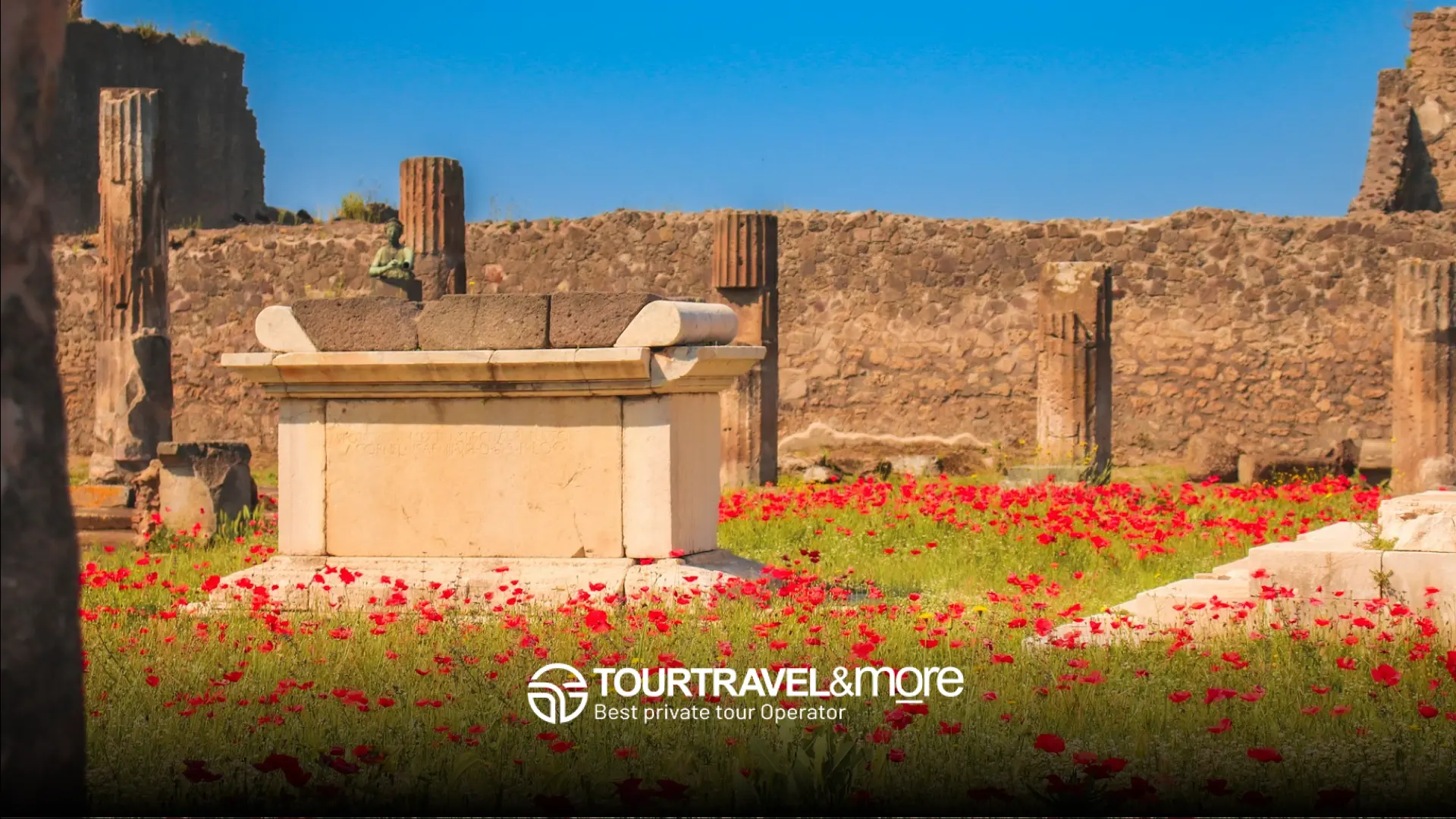
The problem is that most travellers arrive without really knowing what they are going to find. They expect an orderly museum with display cases and explanatory signs. What they actually find is a 66-hectare city baking under the Campanian sun, with Roman cobblestones that punish bad footwear and almost no shade.
What nobody tells you is exactly what separates a visit that will mark you for life from an exhausting afternoon with no context to hold it together.
Is Pompeii Worth Visiting? The Direct Answer
Yes, Pompeii is absolutely worth visiting — with one condition: you go prepared. It is the only place in the world where you can walk through a nearly complete Roman city, with its streets, homes, baths and shops exactly as they were in 79 AD. Without preparation, without a guide, and in August, Pompeii can be an exhausting experience that does the place no justice at all.
| Aspect | What You Need to Know |
|---|---|
| Overall rating | 9/10 with good preparation · 5/10 without |
| Minimum time recommended | 4–5 hours (full day to see it properly) |
| Admission price | €18 (reduced €2 for EU citizens aged 18–25) |
| Train access | Circumvesuviana from Naples, 40 min, €3.30 |
| Best time to visit | April–May or September–October |
| Worst time to visit | July–August: extreme heat, no shade, peak crowds |
| Booking | Mandatory: personalized tickets, 20,000 visitors/day limit |
| Guide or no guide? | With a private guide, the difference is substantial |
Nowhere else on earth can you walk along the ruts left by Roman carts in the paving stones, step inside the baths where the city’s residents bathed, or come face to face with someone who died two thousand years ago and whose body was frozen forever in their final moment. But Pompeii does not reward a casual visit.
What Pompeii Is Not: The Mental Trap That Ruins the Visit
Here is the most common mistake: arriving expecting a museum.
Pompeii has no display cases, no explanatory signs on every corner, no marked route with arrows on the ground. It is literally a city. With streets, apartment blocks, baths, a brothel, theatres, bakeries and necropolises. But without any of the 11,000 inhabitants who lived there when Mount Vesuvius erupted on 24 August 79 AD.
Travellers who come away disappointed almost always made the same mistake: they went on their own, without background knowledge, and spent hours walking past stone walls without understanding what they were looking at. The feeling is understandable. You see a column and think: right, a column. Without context, Pompeii is impressive but opaque.
What Pompeii is:
- A Roman city from the 1st centuries BC and AD, excavated to just two thirds of its total area (one third is still underground)
- Italy’s most-visited archaeological site: over 4 million visitors a year
- A place where details tell everything: election posters painted on walls, citizens’ graffiti, the daily menu chalked on the thermopolium counter
What Pompeii is not:
- A museum with protected collections: the most valuable objects are at the National Archaeological Museum of Naples
- A site where everything is open: houses open and close on a rotating schedule, and on Tuesdays many of the most interesting ones stay shut
- A place you can enjoy without preparation or historical context
Go prepared and it will probably mark you for life. Go unprepared and you will likely leave without understanding why millions of people have been visiting this site since the 18th century.
The Plaster Casts: The Moment Pompeii Changes You
There is a moment during the visit when Pompeii stops being archaeology and becomes something much harder to define.
That moment happens at the Garden of the Fugitives.
What you are about to see is 13 people. Adults, children. They were found trying to escape the city when the eruption caught up with them. Their bodies were buried under layers of ash and pumice. The flesh disappeared over the centuries. But the ash, as it hardened around them, preserved the exact mould of their final moments.
In 1860, archaeologist Giuseppe Fiorelli devised a technique that changed forever how we understand Pompeii: injecting liquid plaster into those cavities. Once set, the result is a perfect cast. A human being captured in their last second.
The postures are what hits hardest. They are not heroic poses. They are postures of terror, of pain, of someone trying to cover their face. They are quite possibly the most emotionally intense archaeological objects you can see anywhere in Europe.
What for decades was interpreted as death by asphyxiation was confirmed in 2023 through X-ray fluorescence analysis applied directly to the casts. The study showed that the victims died as a cloud of fine ash fell over them while they tried to protect themselves on the ground. It was not instantaneous. It was an agony that lasted minutes.
Fiorelli’s technique is still in use today. Every time archaeologists find a cavity in the still-unexcavated zone, they fill it with plaster and someone else appears. A third of Pompeii is still underground. We literally do not know how many more people are down there.
The most striking casts in the site:
- Garden of the Fugitives (Via dell’Abbondanza): 13 people, including children. The most emotionally powerful spot in Pompeii
- House of the Menander: holds some of the finest individual casts with details of clothing and posture
- Antiquarium: reopened in 2021, displays several restored casts with full museum-style context
 Private
 Private
 Private
The New Ticketing System: What Changed in November 2024
If you have read guides written before 2025, the ticketing information may be out of date. In this case, arriving with incorrect information can quite literally mean not getting in.
Since November 2024, all Pompeii tickets are personalized. When purchasing, you must enter the full name of each visitor. On the day of the visit, you are required to present a photo ID that matches the name on the ticket.
There is also a daily cap of 20,000 visitors, split across time slots:
- 9am–1pm: up to 15,000 visitors
- 1pm–5:30pm: up to 5,000 visitors
In peak season — June to August and national holidays — morning time-slot tickets can sell out weeks in advance. Turning up on a Saturday in August expecting to buy at the gate is a mistake that can leave you with nothing to show for the trip.
How to book correctly:
- Use only pompeiisites.org (the official channel; online booking carries no added cost)
- Select your date and time slot
- Enter the full name of each visitor
- Bring a valid photo ID on the day
A warning that few guides include: there are resale websites and unofficial platforms selling tickets at inflated prices, or outright fakes. At the entrances, people sometimes offer tickets “without queuing” or claim “the entrance is closed” to redirect you to a fake alternative. If anyone tells you that, walk away.
The first Sunday of each month, admission is free. But capacity is still limited and you still need to book in advance.
The Crowds: The Real Problem and How to Handle It
Over 4 million visitors a year. That is more than 10,000 people a day at peak. And many of them arrive at the same time: between 10am and 1pm, when cruise ship coaches from Naples and Sorrento drop off passengers with a two or three-hour window.
The result is predictable: the most famous monuments — the Forum, the House of the Faun, the baths, the Lupanar — fill up with guided groups wearing headsets. Progress slows. Explanations overlap each other.
Three strategies genuinely work:
Arrive at 9am, not 10am. The difference between arriving at opening time and arriving an hour later is striking. The first 60 minutes are in a different league: you can photograph Via dell’Abbondanza without the crowds, enter houses without waiting, and get your bearings before the group flow begins.
Walk the opposite direction to the standard route. Most people enter through Porta Marina — the gate closest to the train station — and head towards the Forum. Starting at the Amphitheatre and the Great Palestra, at the far end, places you in the quietest areas during the first hours. By the time the bulk of the groups reaches the Amphitheatre, you are already at the Forum with far fewer people around.
Avoid July and August if you can. Not just because of the crowds, but because of the heat. Pompeii has very little shade. In August, the cobblestone floors radiate heat from early afternoon and the visit becomes a physical endurance test that takes away from the intellectual experience. April–May and September–October are a completely different story.
Pompeii vs. Herculaneum: The Honest Comparison Nobody Makes
This is the question with the most value before planning the trip, and the one that gets answered with concrete data the least.
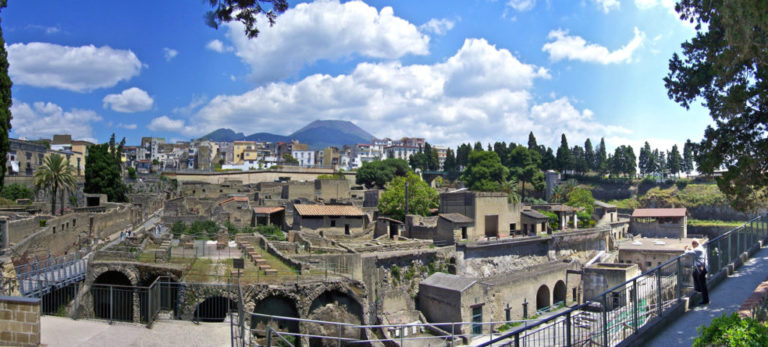
Pompeii and Herculaneum are two cities destroyed on the same day, by the same volcano, just 15 kilometres apart. But the eruption treated them in radically different ways.
Pompeii was buried by a shower of pumice and ash. That destroyed roofs and upper floors but preserved ground levels with great fidelity. Herculaneum, by contrast, was engulfed by an avalanche of gases and volcanic mud that carbonised everything — wood, food, papyri — preserving them with almost unbelievable precision. In Herculaneum you can see wooden furniture from 79 AD. In Pompeii, you cannot.
| Pompeii | Herculaneum | |
|---|---|---|
| Excavated area | ~44 hectares | ~4.5 hectares |
| Annual visitors | ~4 million | ~300,000 |
| Preservation | Very good at ground level | Exceptional: wood, food, frescoes |
| Crowds | High during peak season | Low throughout the year |
| Time needed | 4–6 hours | 2–3 hours |
| Admission | €18 | €13 |
| Unique strength | Complete picture of a Roman city | Detail and preservation quality |
| Human remains | Plaster casts | 300+ real skeletons on the shoreline |
What nobody tends to say clearly: the 300 skeletons at Herculaneum, found in the fishing boats where residents took shelter as they tried to escape by sea, are every bit as intense an experience as Pompeii’s plaster casts — and almost entirely unknown. Herculaneum receives ten times fewer visitors.
If you have time for only one visit, go to Pompeii. If you have two days, give the afternoon of the second to Herculaneum: it is 15 kilometres on the same train, and the combination makes for one of the finest archaeological days out in Europe.
The Real Cost of a Day at Pompeii from Naples
Travel guides give you the ticket price. They rarely give you the total cost of the day. Here is an honest breakdown for two people travelling from central Naples:
| Item | Estimated Cost (2 people) |
|---|---|
| Circumvesuviana train return | ~€13 |
| Site admission | €36 |
| Audio guide (optional) | €16 (€8 per person) |
| Food inside the site | €20–30 (single bar, high prices) |
| Total estimated without private guide | €85–95 |
There is an alternative to the Circumvesuviana that few people mention: the Campania Express, a more comfortable and faster train (25 minutes, ~€15 per journey), without the usual peak-season crowding. The Circumvesuviana is functional and cheap, but in summer it is packed, has no air conditioning and frequently runs late.
For food, the most practical option is to bring lunch and water from Naples. Inside the site there is just one bar with high prices and limited options. Around Pompei Scavi station there are several restaurants with set lunch menus from €12–15 per person.
A note on the audio guide: it costs €8 and the content is generic, with fixed stops and no possibility of asking questions. Experienced travellers routinely describe it as a waste of time and money. If a private guide is not an option, the free official map handed out at the entrance, combined with information downloaded to your phone beforehand, is a far more flexible alternative.
Visiting Pompeii with a Private Guide: Why It Changes Everything
The difference between understanding what you are looking at and simply seeing it is the single biggest factor in whether the visit is worth it or not.
A private guide knows Pompeii in a way no leaflet can replicate: they know which houses are open that day and which are not, they know the corners that groups never visit, they can adapt the route to your interests — social history, architecture, Roman food culture, the eruption itself — and they turn every plaster cast into a specific story rather than an unnamed object.
The difference is not one of luxury. It is one of understanding.
Why Tour Travel & More Transforms Your Visit to Pompeii
Tour Travel & More offers 100% private tours to Pompeii from Naples for travellers who want to get the most from the site without sacrificing comfort or their own pace.
What you get with the service:
- 🔒 100% Private Tours — No Crowded Groups. You decide the itinerary, the pace and the stops. No strangers, no shared agendas.
- 🏅 Official Licensed Guide — With local permits at Pompeii and deep knowledge of the archaeological site.
- 🚗 Luxury Vehicle with Private Driver — Pick-up at your hotel in Naples. No crowded Circumvesuviana, no improvised transfers.
- ⭐ Guardian Angel Service 24/7 — A human coordinator available before, during and after your tour for any changes or unforeseen events.
Over 500 travellers have rated Tour Travel & More’s tours with an average score of 4.9 out of 5. 99% recommend them. Founded in 2014 and headquartered in Barcelona, the company operates in over 40 destinations with officially licensed guides in each one.
This is not a group of twenty people following a raised umbrella. This is your visit to Pompeii, at your pace, with someone who knows exactly what you are looking at.
Frequently Asked Questions About Pompeii
How much time do you need to visit Pompeii?
The bare minimum is 4–5 hours to see the most important areas. If you want to explore at a relaxed pace, a full day (6–7 effective hours) is ideal. Pompeii has 66 excavated hectares: there is no way to see everything in one afternoon.
Is it worth visiting Pompeii from Rome?
Yes, with caveats. The high-speed train from Rome to Naples takes 70 minutes. From Naples to Pompeii, 40 minutes by train. Two hours of travel each way in total. With an early start and 5–6 hours on site, it is perfectly feasible and well worth it.
Is Pompeii better than Herculaneum?
It depends on what you are looking for. Pompeii gives you a complete picture of what a Roman city looked like. Herculaneum has superior preservation quality — wood, food, intact frescoes — and ten times fewer visitors. If you can only do one, choose Pompeii. If you can combine both, do it.
What should you not miss in Pompeii?
The Garden of the Fugitives, the House of the Faun, the Forum Baths, the Lupanar, the Villa of the Mysteries (outside the walls, with 1st-century BC frescoes) and the Amphitheatre. If time is limited, prioritise in that order.
Is it worth paying for a private guided tour?
Yes. The difference between understanding what you are seeing and simply seeing it is the biggest factor in whether Pompeii is worth it or not. A private guide adapts the route to your interests, knows which houses are currently open and turns the site into a narrative experience rather than a list of monuments.
- Just your group
- Licensed guides
- Free cancellation