Marta searched “the 7 wonders of Rome” before her trip expecting to find an official, closed, internationally validated list. What she found instead were fifteen different articles with fifteen different selections, none of them explaining why those seven and not another seven.
There is no official list of the wonders of Rome. What does exist is a fairly broad consensus among historians, guides and travelers about which seven places capture what makes the city unique: engineering that still isn’t fully explained, art that changed hands empire after empire, and squares that have been the center of Roman life for centuries without ever losing that role.
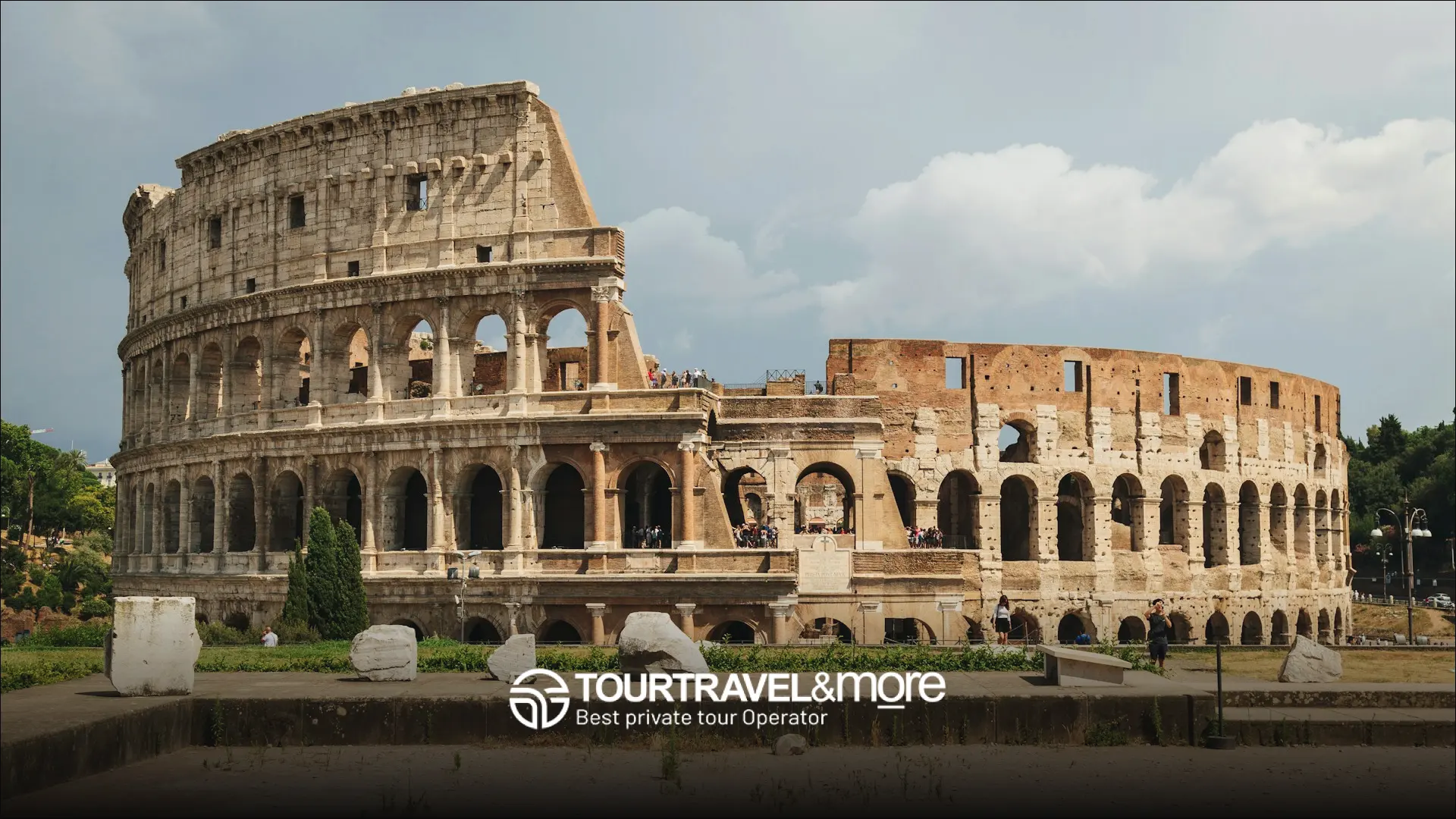
The Colosseum, the only wonder of Rome with an official world title
The Colosseum has something none of the other wonders on this list can claim: in 2007 it was voted one of the New 7 Wonders of the World, the only “seven wonders” list that is actually official, in a global vote with over one hundred million participants. That’s why so many people search “the 7 wonders of Rome” expecting a single ranking, without realizing that list is about the whole world, not just the city.
Built in 80 AD to hold up to 50,000 spectators, the Colosseum is visited with a timed entry ticket booked in advance on the official archaeological park website. Without a reservation, the ticket-office queue in high season easily runs over two hours. Inside, walking the stands and the arena walkway takes between one hour and an hour and a half.
What sets the Colosseum apart from any other preserved Roman amphitheater is the scale: no other building from antiquity conveys as clearly what public spectacle meant in the Roman Empire.
The Roman Forum and Palatine Hill, the political heart of an empire
Right next to the Colosseum, on the same ticket, the Roman Forum was for centuries the center of public, judicial and commercial life in Rome, and the Palatine is the hill where, according to tradition, Romulus founded the city.
The most common miscalculation is underestimating the size of the Forum: from outside, peering through the fence, it looks like a loose cluster of columns, but walking it in full, then climbing the Palatine to see Rome from above, takes a full extra hour on top of the Colosseum visit. Anyone who plans “Colosseum and Forum” as a ninety-minute stop almost always falls short.
What makes this complex a wonder rather than just ruins is that here you can follow, step by step, Rome’s transition from village to capital of an empire that came to rule much of the known world.
The Pantheon, the dome modern engineering still studies
Almost two thousand years after it was built, the Pantheon still holds the world record for the largest unreinforced concrete dome, a record no later building has matched using the same technique. It’s the fact almost never mentioned in “what to see in Rome” lists, and it explains why architects and engineers still visit it the way someone visits a textbook.
Since 2023, a free advance reservation is required, even for the same time slot on the same day; without it, you simply don’t get in. Inside, the visit takes between thirty and forty minutes, but the contrast between the columned façade and the oculus open to the sky at the center of the dome is one of the few moments in Rome where silence is part of the experience.
Trevi Fountain, the baroque wonder that changes face at night
Completed in 1762 after thirty years of construction, the Trevi Fountain is the largest fountain in Rome and, for many people, the image that defines the city before they’ve even set foot in it.
At midday it’s practically impossible to get within three meters of the water through the crowds; before 9:00 am or after 10:00 pm, on the other hand, you can have the fountain almost to yourself for several minutes, something very few itineraries mention. The tradition of throwing a coin backward over your shoulder while making a wish raises hundreds of thousands of euros every year, which the city puts toward social programs.
Piazza Navona, the Roman stadium that became a baroque square
The long, oval shape of Piazza Navona is no accident: it’s built directly on the stands of an ancient first-century Roman stadium, the Stadio di Domiziano, whose remains can still be seen below the level of today’s square.
Today the square revolves around three fountains, the most famous being Bernini’s Fountain of the Four Rivers, surrounded by street performers and outdoor cafés. It connects on foot to the Pantheon in under ten minutes, so it makes sense to walk both in the same outing rather than treating them as two separate stops on the map.
The Spanish Steps, the staircase that’s been in more films than it seems
Built in the 18th century to connect the square with the church of Trinità dei Monti above, the Spanish Steps are the most photographed staircase in Rome and have appeared in dozens of film and TV productions since the 1950s.
Sitting on the steps has been banned since 2019, with fines of up to €400, a rule that surprises plenty of people who arrive without looking it up. Early morning, before the crowds arrive, is the only time you can climb all the way up at a relaxed pace and take in the view from the Trinità dei Monti lookout without the crush of people.
The Vatican, the wonder that technically isn’t in Rome
St. Peter’s and the Vatican Museums, with the Sistine Chapel inside, make up the seventh wonder on this list, though with a detail almost nobody factors in: the Vatican is its own sovereign state, not a Roman neighborhood, however small its territory may be.
St. Peter’s Square is free and requires no reservation, but entry into the basilica goes through a security checkpoint that in high season adds up to an hour-long queue. The Vatican Museums require a timed-entry ticket bought online days in advance, and the full visit takes between two and a half and three hours, which turns the Vatican into half a day on its own. The dress code — shoulders and knees covered — applies without exception in both spaces.
The 7 wonders of Rome at a glance
Before planning the order of the visit, it helps to know what each one requires, since the time and reservation needs vary a lot from one wonder to the next.
| Wonder | What makes it unique | Recommended time |
|---|---|---|
| Colosseum | Only one with an official world title (New 7 Wonders, 2007) | 1-1.5 hours |
| Roman Forum and Palatine | Political heart of the Empire, same site as the Colosseum | 1-1.5 hours |
| Pantheon | Largest unreinforced concrete dome in the world | 30-40 minutes |
| Trevi Fountain | The most photographed baroque fountain in Italy | 20-30 minutes |
| Piazza Navona | Built over a first-century Roman stadium | 30-40 minutes |
| Spanish Steps | The most filmed staircase since the 1950s | 20-30 minutes |
| Vatican | Sovereign state with St. Peter’s and the Sistine Chapel | 2.5-3 hours |
Adding in travel time between them, the seven wonders fit comfortably into two full days, leaving the Vatican as its own day because of the distance and the time it requires.
How to visit the seven wonders without losing half a day in line
The order matters almost as much as the list itself. The Colosseum, Forum and Palatine sit right next to each other and share a ticket, so it makes sense to give them a full morning. The Pantheon and Piazza Navona, a ten-minute walk from each other, fit well into the same afternoon, and the Trevi Fountain is a short walk from both, ideal for closing out the day right before dinner, just as it starts to empty out.
The Spanish Steps can be added to that same walk through the historic center or saved for the next morning, before the heat sets in. The Vatican, given the distance and the nearly three hours it requires just inside, works better as its own half-day, never as a last-minute add-on to the rest of the route.
The factor that ruins this plan most often isn’t the route itself, but arriving without having booked what requires booking: the Colosseum, Forum, Vatican Museums and Pantheon run out of slots for the most in-demand time windows one to two weeks ahead in high season.


The 7 wonders of Rome with Tour Travel & More
Fitting the seven wonders into two or three days, working around queues that change month to month and booking each ticket separately weeks in advance, is exactly the kind of planning that eats up time before a trip has even started.
With Tour Travel & More, that part disappears:
- 100% private tour — You set the pace, with no waiting on a large group stopped at every corner.
- Licensed official guide — Designs the route through the seven wonders around your real available time and reorganizes it on the spot if a queue or the weather calls for it.
- Priority access — To the tickets that sell out fastest: the Colosseum, the Vatican Museums and the Pantheon.
- Luxury vehicle with driver, if you decide to combine the Vatican with the rest of the historic center without relying on public transport.
- Guardian Angel Service 24/7 — Human coordination before, during and after the tour, in case a booking or a schedule runs into trouble.
Seven wonders, no official list
Marta never found the official list she was looking for at the start, because it doesn’t exist. What she took away from Rome was something else: the certainty that the Colosseum is the only one of the seven with a real world title, that the Pantheon has been defying modern engineering for almost two thousand years, and that no photo of the Trevi Fountain at nine in the morning looks anything like the fountain packed at two in the afternoon.
The 7 wonders of Rome don’t need an official seal to justify the trip. What they need is time well spread out and reservations made far enough ahead not to miss any of them to last-minute rushing.