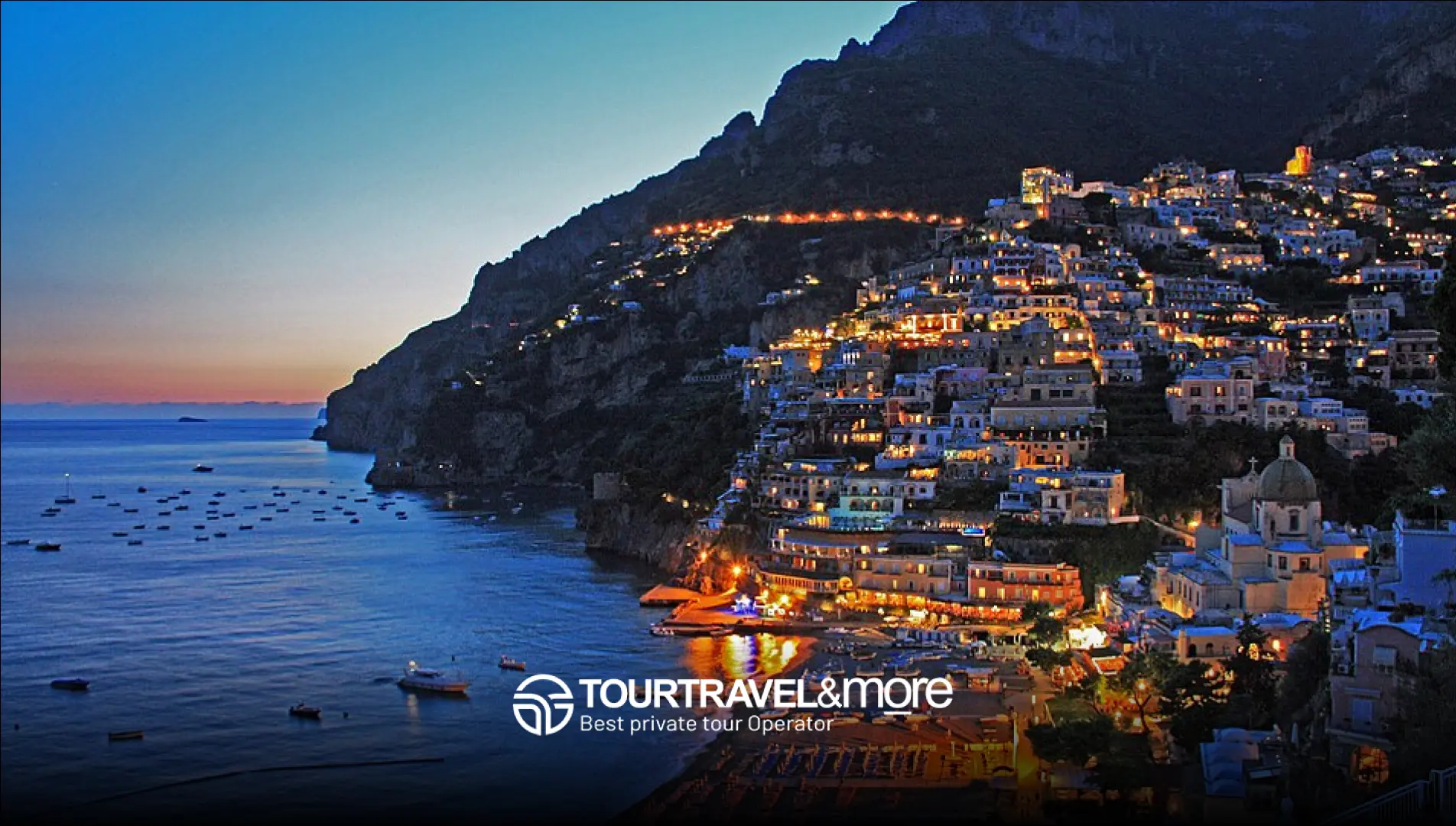
The Amalfi Coast is one of those stretches of road that stays with you forever. 50 kilometres of cliffs, colourful villages stacked above the sea, and bends that demand your full attention. Driving along the SS163 feels like a ritual: hands on the wheel, the Mediterranean to your right, the world on pause.
But there’s something the photos don’t show. The dual nature of this route. On one hand, the freedom to stop whenever you want, wander into a village you didn’t even know existed, wait for that perfect moment of light. On the other hand, nine in the morning in August, stuck in a queue of line buses with a truck right on your rear bumper.
This article gives you both sides. How many days you need depending on what you want to experience, where to stop beyond the three villages that appear in every guide, how to handle parking without losing your morning, and when it makes sense to swap the steering wheel for a back seat.
| Aspect | What you need to know |
|---|---|
| Total distance SS163 | ~50 km between Positano and Salerno |
| Direct driving time | 2 h without stops; +6 h in peak season |
| Recommended days | 3 days minimum, 5 days ideal |
| Best time to drive | April–June and September–October |
| Average parking price | €5–8/hour in peak season |
| Essential villages | Positano, Amalfi, Ravello, Atrani, Cetara |
| Traffic restrictions | ZTL in historic centres + alternate licence plates in summer |
How Many Days Do You Need for the Amalfi Coast by Car?
The direct answer: 3 days is the minimum if you don’t want to regret it, and 5 days is where the trip starts to have a real rhythm. With 2 days you can see the main villages, but you’ll constantly feel like you’re leaving something behind. And you’ll be right.
The Amalfi Coast isn’t a road to be driven through. It’s a dozen distinct destinations connected by a spectacular highway. Each village deserves at least 2 or 3 real hours — not a photo and an ice cream.
With 3 days you can divide the route into logical stretches: one day for the western section (Positano, Praiano, Furore), another for the central area (Amalfi, Atrani, Ravello), and a third for the eastern villages that almost nobody visits (Cetara, Minori, Maiori). This split eliminates the most common mistake: trying to cover everything in a single day and arriving at the third village with your energy at zero and parking at hotel prices.
With 5 days the trip changes category entirely. You can spend a whole afternoon in Ravello without watching the clock, swim in a cove at Furore, take the ferry from Positano to Capri and return in the evening, or spend a morning at Minori’s market buying artisan limoncello directly from local producers. The car stops being a mode of transport and becomes part of the experience itself.
| Days | What you can see | Stress |
|---|---|---|
| 2 days | Positano + Amalfi + Ravello | High |
| 3 days | Full route at a good pace | Medium |
| 5 days | Full route + Capri + hiking | Low |
| 7 days | All of the above + eastern villages + excursions | Very low |
The SS163: The Direction You Drive Matters (and Almost Nobody Explains It)
The main road is the SS163, officially called the Strada Statale Amalfitana, although locals simply call it “the road”. It runs from Vietri sul Mare in the east to Positano in the west — approximately 50 kilometres of tight bends, sea views, and encounters with SITA buses that give no quarter.
What no guide explains in detail: the direction you drive this route directly affects your experience, and it’s not a minor detail.
If you go east to west (from Salerno towards Positano), the sea is on your left. You get the best views from the driver’s side, but overtaking and turns are more complicated because you approach the cliffs from the inside lane.
If you go west to east (from Sorrento towards Salerno), the sea is on your right. Passengers get the best views, overtaking is somewhat easier, and the morning light falls directly on the village facades if you set off early. For most drivers, this direction feels more comfortable.
The practical recommendation: leave Sorrento or Positano before 8:30 am and head east. You arrive at each village before the crowds, the sea stays to the right for passengers, and the morning sun lights up the facades instead of blinding you.
Another detail that often gets overlooked: petrol stations on the SS163 are very scarce. There are a few near Positano, Amalfi, and Salerno. If you start with a half-full tank, fill up before beginning the route. There’s no sign warning you that the next one is 25 kilometres away.
Where to Stop: The Five Villages You Cannot Skip and the Ones Everyone Ignores
Positano
Positano is the postcard. The colourful houses on the cliff, the bougainvillea, the steps leading down to the beach. You cannot visit the Amalfi Coast without stopping here, even if it’s just to confirm it with your own eyes.
The problem: it has the most expensive and scarce parking on the entire route. Expect to pay between €6 and €8/hour. The main car parks are Parcheggio Mandara and Di Gennaro, both in the upper part of the village. From there you walk down — many steps — to the Marina Grande. Recommended time: 2–3 hours.
Amalfi
Amalfi was one of the great medieval maritime republics of Italy. Its Cathedral of Sant’Andrea, with its 62-step staircase, is breathtaking. The historic centre is full of alleyways and shops selling artisan paper: Amalfi has had a papermaking tradition since the 13th century and still has active workshops.
The main car park is at Piazza Flavio Gioia, next to the harbour. From there to the Cathedral is a 5-minute walk. Recommended time: 2–3 hours.
Ravello
Ravello sits at altitude, around 350 metres above sea level, and from its gardens you command the entire bay. Villa Rufolo (entry €7) and Villa Cimbrone (entry €8) have two of the most impressive gardens in Italy. The famous Terrace of Infinity at Villa Cimbrone offers one of the finest panoramas in the Mediterranean. If you can stay until sunset, do it. Parking is relatively straightforward and cheap compared to the coastal villages.
Recommended time: 3–4 hours.
Atrani: The Village Most People Drive Past
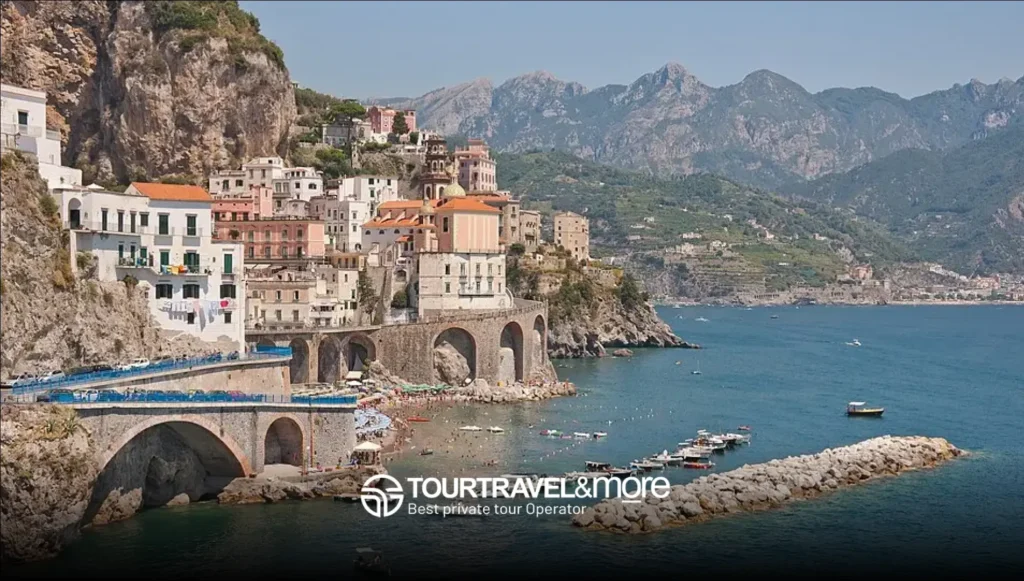
Atrani is the smallest municipality in Italy (under 1 km²) and sits literally 500 metres from Amalfi, separated by a headland. Most cars pass through without stopping because there’s no large car park visible from the road.
That’s a mistake. Atrani is exactly what Amalfi was thirty years ago: authentic, quiet, with a small pebble beach almost free of tourists and a piazza where locals take their morning coffee. Park in Amalfi and walk over. It’s 10 minutes along the seafront promenade.
Cetara: The Village Everyone Skips and Foodies Don’t
Cetara sits at the eastern end of the route and most visitors drive past it because “it’s too far out of the way”. It’s probably the most repeated mistake on the entire route.
Cetara is the most authentic fishing village on the Amalfi Coast and the only producer of colatura di alici, a fermented anchovy sauce that has been made here since the 13th century. It is, literally, the direct heir of Roman garum. The village restaurants serve spaghetti with freshly pressed colatura that bears no resemblance to what you find bottled in a supermarket. If you visit in October, you’ll coincide with the Sagra del Tonno, one of the most authentic food festivals in the region. Parking is relatively easy by the area’s standards. Recommended time: 2 hours.
Praiano and Furore
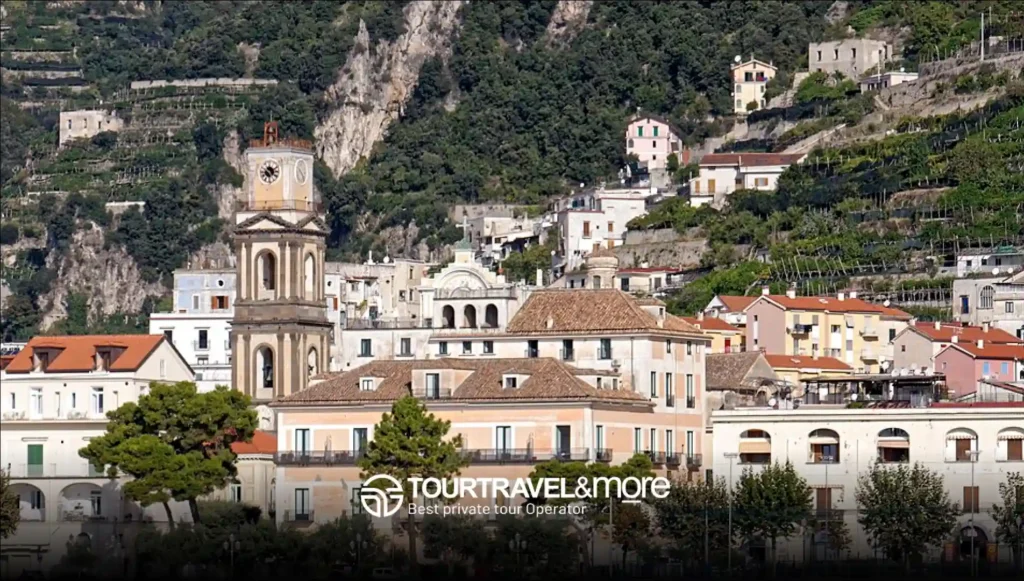
Praiano lies between Positano and Amalfi and many travellers use it as an overnight base. Less tourism, lower prices, and from the Church of San Gennaro one of the best sunsets on the coast. It’s a fact locals acknowledge but few guides develop.
Furore is different. The Fiordo di Furore is a spectacular cove wedged between cliffs, accessible by descending a steep staircase or arriving by kayak. The village of Furore itself is up in the hills and sees very few visitors even in August.
| Village | Type of stop | Time | Parking |
|---|---|---|---|
| Positano | Must-see | 2–3 h | Difficult, €6–8/h |
| Amalfi | Must-see | 2–3 h | Medium, €5–7/h |
| Ravello | Must-see | 3–4 h | Easy, €2–3/h |
| Atrani | Don’t skip it | 1–1.5 h | Park in Amalfi |
| Cetara | For those who want more | 2 h | Relatively easy |
| Praiano | Base or stop | 1 h | Medium |
| Furore | Optional but spectacular | 1.5 h | Limited |
Parking on the Amalfi Coast: How Not to Lose Your Morning Looking for a Space
Parking is the topic that causes the most stress. And the reason is simple: the road is narrow, the villages are built on cliffs, and there is no physical space to add more spots. What exists is expensive and fills up fast.
The Alternate Licence Plate System Nobody Warns You About
From June through September, the Campania Regional Government enforces a traffic restriction on the SS163 known as the alternate licence plate system: on even-numbered days, only cars with even-numbered plates may circulate, and on odd-numbered days, only odd-numbered plates. The restriction applies during peak hours, generally from 10:00 to 18:00.
If you’re renting a car for the route, you need to check the vehicle’s licence plate before planning your itinerary. It’s a detail many people discover too late, already on the road.
The exception: cars registered in the provinces of Salerno or Naples can circulate every day. Rental vehicles usually carry plates from these provinces, but it’s worth confirming at the agency counter.
The Practical Rules of Parking
Arrive before 9:00 am. In peak season, the car parks in Positano and Amalfi start filling from 9:30 onwards. If you arrive before that, you have real options. If you arrive at 11:00, you start going in circles.
Book accommodation with parking included. Hotels with a garage space spare you the main problem. Use that saving in time and money elsewhere on the route.
ZTL — Zona a Traffico Limitato: several historic centres have active ZTL zones in season. If you enter without a permit, the fine goes directly by letter to the rental agency and gets charged to your card. The signs are small and easy to miss. Pay attention to the yellow signs at the entrance to each village.
Useful apps: Google Maps for navigation, EasyPark to pay cashlessly in car parks, Waze to see real-time traffic on the SS163.
Day-by-Day Itineraries: What to Do Based on Your Time
3 Days: The Route That Works
Day 1 — Western section: Sorrento (starting base) → Positano → Praiano → Furore. Leave before 8:30 am. Positano until midday, lunch in Praiano, afternoon at the Fiordo di Furore. Return to Sorrento or stay overnight in Praiano.
Day 2 — Central section: Amalfi → Atrani → Ravello. Arrive in Amalfi before 9:00 am, park at the harbour car park and don’t move the car until the end of the day. Explore Amalfi on foot, walk over to Atrani, drive up to Ravello from Amalfi (12 km) or take the local bus. Stay for sunset.
Day 3 — Eastern section: Minori → Maiori → Cetara. The least known and most authentic stretch. The quiet beaches of Minori and Maiori, the fishing village of Cetara, and if you have time, an afternoon in Salerno — a real city with its own life, not just an endpoint.
5 Days: The Itinerary with Room to Get Lost
Use the three days above and add:
Day 4: Ferry from Positano or Amalfi to Capri. A day in Capri is enough to see the Piazzetta, the Blue Grotto (if there’s no queue), and the views from Monte Solaro.
Day 5: Hiking the Sentiero degli Dei (Path of the Gods). The classic stretch runs from Bomerano to Positano: 9.4 km with spectacular sea views. One of the best hikes on the entire Italian coastline. Leave the car in Positano and take the bus up to Bomerano to do the route downhill.
Where to Stay to Reduce Driving Stress
Your choice of base makes the difference between a comfortable trip and an exhausting one. There’s one option that very few articles mention, and it completely changes the parking equation.
Sorrento is the classic base. It has the best train connection from Naples (Circumvesuviana, ~1 hour), a wider range of accommodation at different price points, and more accessible parking than the coastal villages. The trade-off: every day of sightseeing means driving into the route and back again.
Praiano is the base that repeat visitors choose. It sits exactly in the centre of the route — 9 km from Positano and 11 km from Amalfi — parking is easier than in its neighbours, prices are lower, and the restaurants are geared towards residents rather than tourists.
Ravello or Scala in the hills: the option nobody considers that changes everything. Ravello and Scala sit between 300 and 600 metres of altitude. They have comfortable, cheap car parks (or free overnight parking in Scala), a quality of life very different from the coastal frenzy, and from either you can reach any coastal village in 15–20 minutes without crossing the entire SS163 each time.
The savings on parking are real: instead of paying €40–60/day in Positano or Amalfi, you leave the car in Ravello for €2–3/hour and use the local bus or ferry to get around during the day. The only caveat: Ravello has no beach of its own. If you need a swim every day, this base isn’t ideal.
The Keys to Driving the SS163 Without Nerves
The SS163 is not dangerous if you’re prepared. It’s narrow, with tight bends and heavy traffic in summer. But thousands of people drive it every year in ordinary cars without any problem.
Take a compact car. A small hatchback — Fiat 500, Renault Clio, or similar — is the most manageable. Avoid large SUVs, vans, or any vehicle over 1.80 m wide. On some stretches two cars passing each other will literally brush mirrors.
Always yield if you have room to reverse. When two cars meet on a narrow bend, whoever has the easier reverse does so. No discussion, no staring. It’s the unwritten rule of the road and everyone respects it.
SITA buses have de facto right of way. When you see one coming, find the nearest pull-off, hug the wall, and let it through. There’s no sign that says so, but that’s how it works.
Avoid the road between 10:00 and 18:00 in July and August if you can choose. If you have no other option, be patient. But if you leave before 9:00 am and return after 7:00 pm, the drive is a radically different experience.
Don’t follow GPS if it suggests shortcuts on mountain roads. There are alternative routes that navigation apps propose via tracks that are not suitable for ordinary passenger cars. Stay on the SS163.
When the Steering Wheel Is the Problem: The Private Guided Tour Alternative
All of this logistics — the parking, the ZTL zones, the alternate plates, the departure times — has one clean solution: let someone else drive while you enjoy the scenery.
Tour Travel & More has been organising private tours of the Amalfi Coast since 2014 with a clear principle: the trip is yours, not the operator’s.
What a private tour with TT&M includes:
- No groups or strangers — the tour is exclusively for you and the people you choose
- Luxury vehicle with a professional driver — he knows the access points, the reserved parking spots, and the shortcuts that appear on no app
- Licensed official guide — with local permits and genuine knowledge of the area, not a brochure read aloud
- Door-to-door pick-up — from your hotel in Sorrento or Naples, no prior transport needed
- Guardian Angel Service 24/7 — a human coordinator available before, during, and after the tour for any last-minute changes
- 4.9 ⭐ across more than 500 verified reviews — 99% recommend
The itinerary adapts to what you want to see. You spend as long as you need in each village. You arrive in Ravello at sunset because that’s what you decided.
Available from Sorrento (8 hours, from €160/person) and from Naples (8 hours, from €150/person).
Frequently Asked Questions
Are there tolls on the route?
The SS163 has no tolls. There are tolls on the motorways approaching from Naples or Rome (A3/E45). Budget between €5 and €10 in tolls depending on your starting point.
Can you do the route in a campervan or motorhome?
Technically it’s allowed, but not recommended. The narrowest stretches of the SS163, especially between Positano and Amalfi, are very challenging for vehicles over 2 metres wide. Some villages have access restrictions for long vehicles.
Is it worth renting a motorbike instead of a car?
Motorbikes have an advantage with parking and overtaking. But the road has loose gravel on some bends, SITA buses take up the entire lane, and in rain the conditions become significantly more complicated. If you have real motorcycle experience and this isn’t your first time on Italian mountain roads, it can be an option. If not, take the car.
What is the best month to visit the Amalfi Coast by car?
April, May, and the first half of June are the best months: good weather, a driveable road, and reasonable prices. September and October also work well. July and August are possible but the traffic and parking stress multiplies the cost and reduces the enjoyment.