




What to Do in Florence in Summer: Activities, Tips and How to Experience It for Real

I arrived in Florence on a Tuesday in July. It was ten in the morning and the heat was already beating hard against the cobblestones of the Piazza della Repubblica. I had booked months in advance, had the itinerary on my phone, and still felt that vertigo of not knowing where to start: too many museums, too many queues, too much beauty in too little time. If you have that trip ahead of you, this guide is for you.

Florence in summer can be overwhelming or it can be perfect. It all depends on how you organise your hours. With temperatures climbing to 35–38 °C in July and August, and the city receiving tens of thousands of tourists each day, the key is not to do more things but to do the right things at the right moment.

Time of Day What to Do Summer Trick
8:00 – 11:00 Museums, Duomo, historical walks Get up early: fewer queues, less heat, better photos
11:00 – 16:00 Covered markets, Palazzo Pitti, gelato, siesta Avoid direct sun; look for AC or dense shade
16:00 – 20:00 Gardens, Oltrarno neighbourhood, Piazzale Michelangelo The golden light makes everything more photogenic
20:00 onwards Late dinner, Lungarno terraces, aperitivo The heat eases and the city becomes something else entirely

Florence in Summer: Heat, Art and a City That Never Stops

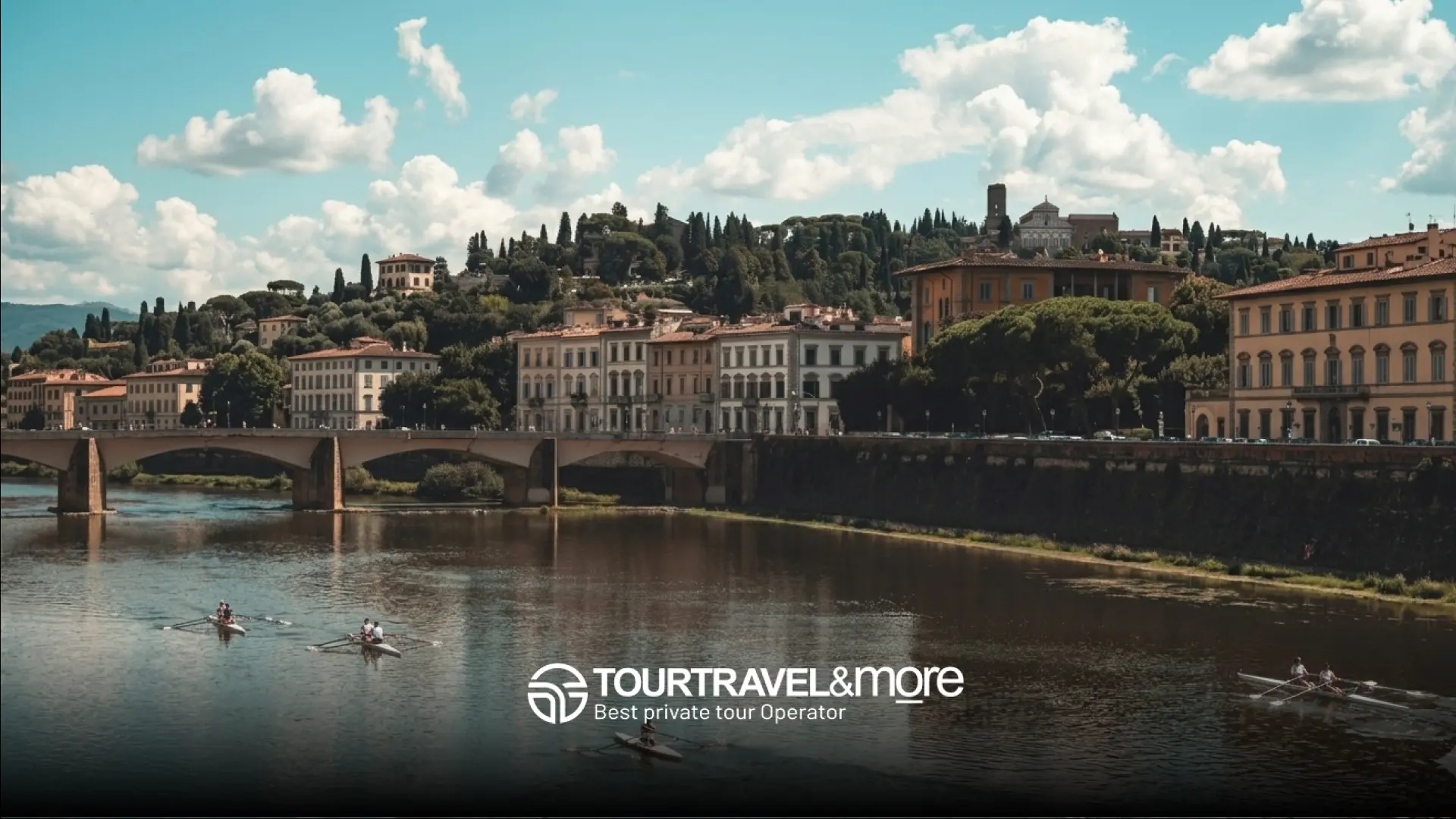
Florence in summer is not the “easy” destination some people imagine. Temperatures can exceed 38 °C in August and the main attractions fill up weeks in advance. But there is something travel guides rarely tell you: summer is also when Florence is most alive. The squares fill with music at nightfall, restaurants set out pavement tables until 23:00, and the Arno reflects a light that in no other season carries that ancient orange.

June is the best of the three months: the heat is already pleasant (26–30 °C on average) but the crowds have not yet reached the August peak. Terraces start operating, museums have their summer hours active — most open until 21:00 or 22:00 on Thursdays — and accommodation prices have not yet hit their maximum. If you are travelling in July or August, do not be discouraged. Simply adjust the pace: Florentines have been living with this heat for centuries and have known how to build a city with shaded courtyards, drinkable public fountains on every corner — the fontanelle — and the midday siesta habit that any sensible visitor should adopt without shame.

The most common mistake I see in travellers arriving in summer is wanting to cover the entire historic centre on foot between eleven in the morning and four in the afternoon. Don’t do it. Florence during those hours under direct sun is not a cultural experience; it is a marathon. The city is compact — the main monuments are less than twenty minutes’ walk from each other — and there is more than enough time if you distribute activities well between the cool morning, the midday spent indoors, and the long afternoons of the European summer.

Essential Cultural Visits: What Time to Go and How to Beat the Queues

The Uffizi Gallery is, probably, the main reason you are reading this. It houses Botticelli’s Birth of Venus, the same artist’s Primavera, Leonardo da Vinci’s Annunciation, Rembrandt’s self-portraits and dozens of works that shift your perspective on what a human hand with a brush can achieve. It is, without exaggeration, one of the five most important museums in the world.

In summer, tickets sell out weeks in advance if you try to buy them at the ticket office. The museum opens Tuesday to Sunday at 8:15 and closes at 18:50 (last entry at 18:20). On Thursdays in July and August it has evening opening until 22:00 with reduced tickets: if you can choose, this is the best option of the week. Less heat, fewer people and different lighting on the paintings.

The trick I learned the hard way: book your entry for 8:15 or 16:30. First thing in the morning, the organised groups have not yet arrived and you can stand alone in front of the Botticelli for minutes. At 16:30, most of the tourist coaches have already left. Allow at least three hours to go through it without rushing; four if you want to spend time in the less-visited rooms, which have equally impressive works and almost nobody inside.

Online booking carries a €4 surcharge, but in summer it is money well spent: the queue for those with reservations is fast; the queue for those without can be 90 minutes in the sun.

Galleria dell’Accademia and Michelangelo’s David

The David is taller than you expect. It stands 5.17 metres high and when you enter the Tribuna hall, the scale of the sculpture hits you physically. Michelangelo was 26 when he started working on it and 29 when he finished. The room was designed specifically to house it: the glazed dome above creates a changing natural light that no photograph reproduces.

The Galleria dell’Accademia is smaller than the Uffizi — the full visit takes between 60 and 90 minutes — which means that queues at the door can be disproportionately long for what is inside. In August, without a reservation, waiting 90 minutes in full sun is common. The museum opens Tuesday to Sunday from 8:15 to 18:50. On Thursdays it also has evening opening during high season.

Book at least two weeks in advance in July and August. The ticket costs €16 (€12 base + €4 booking fee). It is not worth skimping here.

The Duomo, the Dome and the Campanile: The Complex That Defines the City

The Duomo complex is actually five monuments in one: the Cathedral of Santa Maria del Fiore, Brunelleschi’s dome, Giotto’s campanile, the Baptistery of San Giovanni, and the Museo dell’Opera del Duomo. The complex ticket (€18) gives access to everything for 72 hours, meaning you can spread the visits across different moments.

Brunelleschi’s dome has 463 steps with no lift and in July the interior temperature can exceed 40 °C in the upper sections. But the view from the top — the whole city, the terracotta rooftops, the Apennines in the background — justifies every step. Go up first thing or from 17:00 onwards to avoid the worst heat. The dome opens at 8:15 and online booking is compulsory: in summer there are no same-day tickets available.

Giotto’s campanile (414 steps) offers a different perspective: facing the dome, not inside it, which allows photographs that most visitors never manage to get. The basilica itself can be visited for free, but you need covered shoulders and knees: a light scarf solves the problem in seconds.

The Museo dell’Opera del Duomo is the most underrated part of the complex. It has air conditioning, is almost always uncrowded, and houses original pieces that have been replaced by copies outside: Ghiberti’s baptistery doors (the ones Michelangelo called the Gates of Paradise), Michelangelo’s Pietà sculpture, and the original interior candelabras. It is the perfect plan for midday.

How to Survive Midday: What the Smart Traveller Does

Between 11:00 and 16:00, the sun in Florence shows no mercy. This is the time for museums with air conditioning, cool palaces, covered markets and the sacred Italian institution of the midday break.

Palazzo Pitti and the Boboli Gardens

Palazzo Pitti is one of the largest palaces in Italy and in summer it is a perfect refuge: its stone walls, more than a metre thick, keep the interior several degrees below the outside temperature. It houses four independent museums: the Palatine Gallery (with Raphaels, Titians and the finest Rubens in Italy), the Museum of Fashion and Costume, the Modern Art Galleries, and the Tesoro dei Granduchi.

The combined ticket (palace + Boboli Gardens + Bardini Garden) costs €16 and allows access to everything for one day. It is worth every cent if you use it well: two or three hours in the palace during the hottest hours and the garden from 17:00 onwards, when the temperature is already pleasant.

The Boboli Gardens have 45,000 m² of Italian gardens with 16th-century sculptures, fountains, terraced slopes and views over Florence’s rooftops and the Chianti hills. At the highest point of the garden there is a small gelato kiosk that few tourists know about: locals who work near the palace use it as a daily stop.

San Lorenzo Central Market: Eating and Understanding the City

San Lorenzo Central Market has two completely different floors. The ground floor is Florence’s oldest traditional market for fruit, vegetables, meat and charcuterie: opened in 1874, with a cast iron and glass structure designed by Giuseppe Mengoni — the same architect as the Galleria Vittorio Emanuele in Milan. Restaurants in the neighbourhood have been shopping here every morning since 7:00.

The first floor has been transformed into a gastronomic food court with specialist stalls: fresh pasta made to order, tripe and lampredotto, bollito, Tuscan wine by the glass. It runs Monday to Saturday from 10:00 to 17:00 and is air conditioned. The lampredotto — veal stomach braised with green sauce and parsley — is the Florentines’ sandwich. A panino costs between €4 and €5. In summer, the trippai kiosks on the street (especially Nerbone inside the market, with over 130 years of history) have a queue of locals at lunchtime. Try it even if the name puts you off.

The outdoor stalls of leather goods and souvenirs that surround the building operate every day. Prices are negotiable, especially in the afternoon.

Cool Churches and Smaller Museums: The Best-Kept Midday Secrets

Florence has museums and churches that deserve a visit and which in summer are practically empty because everyone is queuing at the Uffizi. Santa Croce — the basilica where Michelangelo, Galileo, Machiavelli and Dante are buried — is cool, magnificent and rarely has a wait. The Bargello is the finest museum of Renaissance sculpture after the Accademia and almost never has a queue. Santa Maria Novella, with its Ghirlandaio frescoes and Masaccio’s Trinity, can be visited in an hour and a half without crowds.

Afternoons and Evenings You Won’t Forget

From 16:00 onwards, Florence shifts gear. The heat eases slightly, the light turns golden and the city recovers a more human rhythm. These are the hours that travellers who only see the historic centre during the day miss entirely.

Piazzale Michelangelo: The View That Makes the Trip

Piazzale Michelangelo is Florence’s most famous viewpoint for a simple reason: from here you can see everything. The Duomo, Brunelleschi’s dome dominating the skyline, the Palazzo Vecchio with its tower, the bridges over the Arno, the cypress-covered hills in the distance. In summer, the sunset from here has a reputation that extends across all of Europe and which, once witnessed in person, turns out to be completely deserved.

Arrive 30–40 minutes early to find a spot with a view; in August there can be hundreds of people on the steps. Walk up from the San Niccolò neighbourhood (20 minutes along a tree-lined ramp that is mostly shaded) or take bus 13 from the Piazza Ferrucci. The bar on the square serves aperitivos with views; it is not the cheapest in Florence, but the price includes that horizon.

Just below the Piazzale, barely two minutes on foot, is the Rose Garden: in June it blooms with more than a hundred varieties of roses and entry is free. Very few tourists make their way down here.

The Oltrarno Neighbourhood: Florence Without the Instagram Filter

On the other side of the Arno is the neighbourhood that life-long Florentines still feel as their own. Oltrarno has that mix of furniture restoration workshops, second-hand bookshops, centuries-old herbalist shops and taverns without an English menu that barely exists any more in the historic centre.

Piazza Santo Spirito is the heart of the neighbourhood: a square with an unfinished basilica at one end and bar tables under trees at the other. At 19:00 on any summer evening it is full of locals having aperitivo. A negroni here costs between €6 and €8 and comes with something to eat.

Via Maggio is the antique dealers’ street: galleries and shops with furniture, paintings and objects from the 17th to 19th centuries. Many leave their doors open in summer and can be browsed freely even if you have no intention of buying anything. At the end of the street, the Ponte Santa Trinità has the best view of the Ponte Vecchio without the crowd on the bridge itself.

For dinner in Oltrarno, the tourist-trap-free options are on the side streets: Via dei Serragli, Via dell’Orto and the area around Piazza Tasso have trattorias where half the diners are from the neighbourhood.

The Lungarni at Nightfall: Florence in Summer Mode

The Lungarno is the name given to the promenades that run along both sides of the Arno. In summer, from 21:00 onwards, the riverside terraces and bars come alive. There is improvised live music, street stalls and that feeling that everyone in the city has come out at the same time.

The most active stretch in July and August runs between the Ponte Vecchio and the Ponte alle Grazie, on the south bank (Oltrarno), where the summer event Lungarni programmes concerts, craft markets and outdoor cinema screenings on some evenings of the week. Entry is always free. The Comune di Firenze website publishes the updated calendar each season.

Summer Food in Florence: What to Eat and Where

Florentine cooking is traditionally a winter affair — ribollita, peposo, bistecca alla fiorentina — but summer has its own dishes and it would be a shame not to know them.

Panzanella. Florence’s summer salad: hard Tuscan bread soaked in water and vinegar, ripe tomato, cucumber, red onion and basil. Without panzanella, summer in Florence is incomplete. Almost every trattoria serves it from June to September.

Schiacciata all’uva. In August and September, when the harvest begins in the Chianti, bakeries bring out this sweet focaccia with black grapes, sugar and olive oil. You will find it in any forno in the centre.

Quality gelato. Not all gelato in Florence is the same. Industrial gelato, dyed in fluorescent colours and piled in mountains on the counter, is generally mediocre. Artisan gelato comes in flat, covered containers. Trusted addresses: Gelateria dei Neri (Via dei Neri, 9), Sbrino Gelatificio Contadino (Via dei Serragli, in Oltrarno), Gelateria della Passera (Piazza della Passera). Average price: €2.50–3.50 per cone.

Tuscan aperitivo. Unlike Milan, where aperitivo sometimes includes a full buffet, in Florence it is more understated: a glass of Campari Spritz, Aperol or Negroni with a few snacks. Reasonable prices are in Oltrarno and in bars on the side streets of the centre; bars on the main squares charge between 30 and 50% more.

Wine. You are in Italy’s most important wine-growing region. A Chianti Classico in a city centre enoteca costs between €4 and €7 per glass. Enoteca Pitti Gola e Cantina (Piazza Pitti) has more than 600 labels and serves glasses from 11:00.

Day Trips from Florence: When the City Gets Too Much

Florence is the perfect base for exploring Tuscany. In summer, leaving the city for a day or two is not just an option: it is almost a necessity to catch your breath and see a different Tuscany.

Chianti: Vineyards, Castles and 4 Degrees Cooler

The Chianti Classico is Italy’s most famous wine zone and it is literally on Florence’s doorstep. By car it is 45 minutes to Greve in Chianti, the main village in the denomination. By road bike — the Via Chiantigiana is a classic route of European cycle tourism — it is between 3 and 4 hours of pedalling through vineyards, olive groves and medieval villages.

What to do in Chianti in summer: a tasting at a winery (Antinori, Castello di Verrazzano, Badia a Coltibuono and Castello di Brolio are the best known; booking in advance is advisable), lunch at any agriturismo with a terrace, and an afternoon in Radda in Chianti or Panzano in Chianti, which have a perfectly human scale and almost no mass tourism.

The temperature in the Chianti hills is between 4 and 6 degrees lower than in central Florence. In August, when the city reaches 38 °C, heading up to the Chianti is one of the best plans of the trip.

Siena: Florence’s Great Rival and the July Palio

Siena is 75 kilometres south of Florence: 1 hour 15 minutes by direct bus from Santa Maria Novella station (Tiemme/SENA, frequent departures), or 45 minutes by car. The Piazza del Campo is, for many, the most beautiful square in Europe. It has a unique shell shape, is completely surrounded by medieval palaces, and at its centre stands the Palazzo Pubblico with the Torre del Mangia (502 steps, spectacular views).

In July the Palio takes place on the 2nd and 16th: Europe’s oldest horse race, with jockeys representing the different city neighbourhoods. If it coincides with your trip, it is a unique spectacle, although on Palio days the city is completely overwhelmed with people. If you want to see the square in peace, avoid those dates.

Beyond the piazza: Siena’s Duomo (bicolour marble, 14th-century mosaic floor, Piccolomini library with Pinturicchio frescoes), the Museo Civico with Ambrogio Lorenzetti’s frescoes, and the Pinacoteca Nazionale. Siena can be done in a long day or as an overnight escape.

San Gimignano: Medieval Towers and the World’s Best Ice Cream

San Gimignano is 55 km southwest of Florence (1 hour 30 minutes by bus with a change at Poggibonsi, or 50 minutes by car). It is small — fewer than 8,000 inhabitants — and has been declared a UNESCO World Heritage Site for its 14 surviving medieval towers, of the 72 it had at its peak in the 14th century.

The town can be walked in full in a couple of hours. What makes it special in summer: Gelateria Dondoli (Piazza della Cisterna), winner of the World Gelato Championship on multiple occasions. The saffron and pine nut flavour is the most famous; the queue in August can be 20 minutes, but it is worth it.

San Gimignano is the most touristic of the three destinations, especially between 10:00 and 16:00. If you can arrive before 9:30 or stay until sunset when the tourist coaches have gone, the experience is completely different.

Map Legend
  1. Uffizi Gallery
  2. Galleria dell’Accademia
  3. Duomo – Santa Maria del Fiore
  4. Boboli Gardens
  5. Palazzo Pitti
  6. Piazzale Michelangelo
  7. Ponte Vecchio
  8. Piazza della Signoria
  9. San Lorenzo Central Market
  10. Piazza Santo Spirito (Oltrarno)

Tickets and Prices: What You Must Book in Summer

Attraction Approximate Price When to Book
Uffizi Gallery €25 (€21 + €4 booking fee) 2–3 weeks in advance in July–August
Galleria dell’Accademia (David) €16 (€12 + €4 booking fee) At least 2 weeks in advance
Duomo Complex (dome included) €18 Compulsory online; no same-day availability in July–August
Palazzo Pitti + Boboli + Bardini €16 combined Can be purchased online the day before
Santa Croce €8 No booking required, but recommended in August
Bargello €10 Generally no booking required
Piazzale Michelangelo Free No booking required
Ponte Vecchio and city streets Free No booking

Don’t Waste Half a Day Queuing

Booking the Uffizi weeks in advance, coordinating the Accademia schedule with the Duomo, making sure the tour fits your flights and airport transfer, finding an excursion to Siena or Chianti that does not fill a forty-person coach… Planning Florence in summer can become a second job before the trip even begins.

That is exactly what Tour Travel and More’s private tours and transfers solve: you arrive and they have already handled the access, the itinerary and the logistics. Their local guides know the least-crowded time slots, the shortcuts through the historic centre that appear in no paper guidebook, and the difference between a Chianti tasting that is worth the trip and one that is not. If you are planning to arrive in Florence by cruise, if you want a private excursion to Siena without depending on the public bus schedule, or if you simply prefer someone with real experience to ensure that every hour of your holiday is worth it, their private transfers make the logistics disappear entirely. With 5-star TripAdvisor ratings and personalised service, they are the difference between a good trip and one you remember years later.

Mistakes Almost Everyone Makes (and How to Avoid Them)

Going to the Duomo without a reservation and queuing in the wrong line. There are four different queues depending on which part of the complex you want to enter. The long queue you see from the street is usually for the basilica (free, no reservation needed). The dome queue is different and shorter if you have a reservation. Check the sign carefully before joining any line.

Buying Uffizi tickets on the day. In July and August it is practically impossible to get in without a prior reservation. Those who try to buy at the ticket office on the day normally find themselves turned away or waiting for hours. Book at least two weeks ahead.

Taking a taxi when there is a tram or bus. Tram line T1 connects Peretola airport with Santa Maria Novella station in about 20 minutes and costs €1.50. A taxi from the airport to the centre costs between €22 and €30 (official fixed fare). If you arrive by car, remember that almost the entire historic centre is a ZTL (Limited Traffic Zone): entering without the appropriate permit generates fines that arrive by post weeks later.

Underestimating the midday heat. Florence is a city of stone and cobblestones that absorbs heat. At 13:00 on an August day, the street temperature can be 5–7 degrees higher than the official temperature measured in the shade. Hydration, a hat and a long midday break are not optional: they are part of the plan.

Eating at restaurants on the front rows of the main squares. Restaurants with tables directly on the Piazza della Signoria or immediately around the Duomo have inflated prices and inconsistent quality. Two streets in, the value for money improves dramatically.

Not exploring beyond the historic centre. The centre of Florence — the area enclosed by the old city walls — is only part of the city. The Oltrarno, San Frediano and Campo di Marte neighbourhoods have a daily life that tourism has not yet fully homogenised.

Practical Tips for Summer in Florence

Free hydration. The fontanelle — drinking water fountains scattered throughout the city — are marked with a blue sign and serve fresh, clean water. Bring a reusable bottle: tap water in Florence is perfectly drinkable and free.

Appropriate clothing. To enter churches (Santa Croce, Santa Maria Novella, the cathedral, Santo Spirito) you need covered shoulders and knees. In summer this clashes with the heat, but a light scarf or shawl in your bag solves the problem in seconds. Some churches lend coverings at the entrance, but not all.

Firenze Card. If you plan to visit more than four museums in 72 hours, the Firenze Card (€85) includes access to the main museums with priority entry. Do the maths first: for fewer than four museums, individual tickets usually work out cheaper.

Comfortable shoes. Florence’s cobblestones are uneven and slippery. Thin-strapped sandals and platform shoes are a common mistake that makes itself known on the second day of walking. Flat-soled or lightly cushioned footwear is what works.

Late dinners. Italian restaurants start dinner service at 19:30–20:00 and fill up between 20:30 and 22:00. In summer, dining at 21:30 on a terrace with the heat already easing is perfectly normal and much more pleasant than doing so in the midday sun.

Transport card. If you use the bus (ATAF) or tram more than twice a day, the 24-hour card (€5) or the 72-hour card (€12) is worthwhile.

Frequently Asked Questions About Florence in Summer

What is the best month to visit Florence in summer?
June is the most balanced: pleasant heat, long days and fewer crowds than July or August. Average temperatures are between 25 and 30 °C and museums still have reasonable availability for last-minute bookings. If you can only go in August, do not give up on the trip: simply adjust the pace, get up early and make the most of the evenings.

Is it too hot to visit Florence in August?
It is hot — between 32 and 38 °C — but perfectly manageable if you organise your hours well. Museums in the morning, siesta at midday in your accommodation or in a café with AC, outdoor activities from 17:00. Thousands of people visit Florence in August every year and enjoy it.

How many days do I need to see the essentials?
With three days you can cover the Uffizi, the Accademia, the Duomo complex, Oltrarno and Piazzale Michelangelo. With four or five days you can add Palazzo Pitti, the smaller churches and a full-day excursion to the Chianti or Siena.

Do I need to book all the museums?
The Uffizi and the Accademia: yes, essential in summer. The Duomo dome: also compulsory online. Palazzo Pitti and Boboli: highly recommended. The rest (Bargello, Palazzo Davanzati, Santa Croce, smaller museums) generally do not require advance booking, although in August the Bargello may have a wait.

Can you visit Florence with children in summer?
Yes, with planning. The Boboli Gardens have plenty of space to move around. The Museo Galileo (science and Renaissance instruments) has content that engages children from age 8–9. The gelato stalls and street markets appeal to all ages. The main challenge is the heat: plan mornings for intensive activities and leave midday for the hotel pool or AC.

Is Florence safe in summer?
Florence is one of the safest cities in Italy. The only real warning: watch out for pickpockets in very crowded areas such as the Ponte Vecchio, the area around the Duomo and inside the tram. Cross-body bag worn at the front, and do not keep your phone in your back trouser pocket.

That July morning, after climbing the 463 steps of the dome with burning lungs, I stayed at the top longer than I had planned. The whole city at my feet, the Arno shining, the Chianti hills in the distance. I thought that if I had arrived without a plan — without the reservation, without knowing what time the museum opened, without knowing the trick of bus 13 to the Piazzale — I would probably have been left at the door. Florence in summer does not forgive improvisation, but it rewards handsomely those who arrive prepared. That, in the end, is what makes this city great: it gives you nothing for free, but what it gives you cannot be found anywhere else in the world.

Posted in Florence, Italy.
Share