




The night I understood who cooks and who serves
It happened in peak season: a family wanted “everything locked in, no surprises” for the Riviera Maya. With three chats open, I realized tourism has two very clear roles. The tour operator is the chef in the big kitchen: buys in volume, designs the menu, plates the dish. The agency is your trusted adviser: listens, recommends, serves it, and stays for dessert. Since then I explain the difference exactly like I wish someone had explained it to me.
What each one actually does
When a tour operator “cooks” a package, they bundle flights, hotel, transfers and tours, negotiating allotments (room blocks) and prices regular mortals never see. The agency, instead, turns your budget and wishes into a concrete recommendation, compares options, and handles paperwork so you only think about packing.
| Role | Core task | Sells to |
|---|---|---|
| Tour operator | Builds packages (volume buys) | Agencies (B2B) |
| Travel agency | Advises & sells packages/services | Travelers (B2C) |
| Local DMC | Runs on-site ops | Operators & agencies |
When I worked with an operator holding air blocks and hotel allotments, the jump was huge: availability on impossible dates and a stable final price. You could tell the “pizza came from the factory.”
Responsibilities when something goes wrong (and why it matters)
In a package holiday there are two hats: the organizer (often the wholesaler) and the retailer (the agency). If something derails, the traveler doesn’t care about contracts—they want a fix. That’s why regulation usually treats organizer and retailer as jointly responsible to the traveler. In practice, you call your agency, and they hit the “red phone” with the operator or whichever provider is needed.
I’ve lived through the classic “hotel overbooked at 11 p.m.” With a solid operator, re-accommodation took 15 minutes because they already had allotments and direct lines in destination. With a weak one, the agency takes the heat and the night gets long.
Wholesale, retail, and mixed: the “Apple model”
Think Apple: they design the iPhone and also sell it in their own store. In travel there’s the mixed agency (wholesaler-retailer): they create the trip and sell it through their own network. Real-world advantages I’ve seen:
- End-to-end control: one window for changes and after-sales.
- Volume pricing when packaging in-house.
- Higher commitment: no “passing the buck” between different companies.
I put it this way: when the same house cooks and serves, if the wine runs out, the waiter has the cellar key.
Buying channels at a glance
A quick map so you choose without wasting time.
| Channel | What it is | Use when |
|---|---|---|
| Direct operator | Buy from the maker | Peak season / niche product |
| Agency (store/online) | Advisor & representative | Need options & after-sales |
| Mixed (organizes & sells) | Same company makes & sells | Want 360° control & speed |
Price and margins without fluff
Operators work with net rates and make margin by packaging (flight + hotel + extras). Agencies usually live off commissions or service fees. Why is the operator’s package sometimes cheaper than building it yourself?
- Hotel allotments: buy 100 rooms and the average cost drops.
- Air blocks and release dates: secured seats when demand is hot.
- Smart add-ons: excursions, insurance, better room views.
When I built a circuit with closed allotments, the final price was ridiculously good compared to piecing it together. The key wasn’t haggling—it was scale.
How Tour Travel & More helps on your trip
And to land all this in a real case, here’s an example I use when people ask me about operators who handle everything:
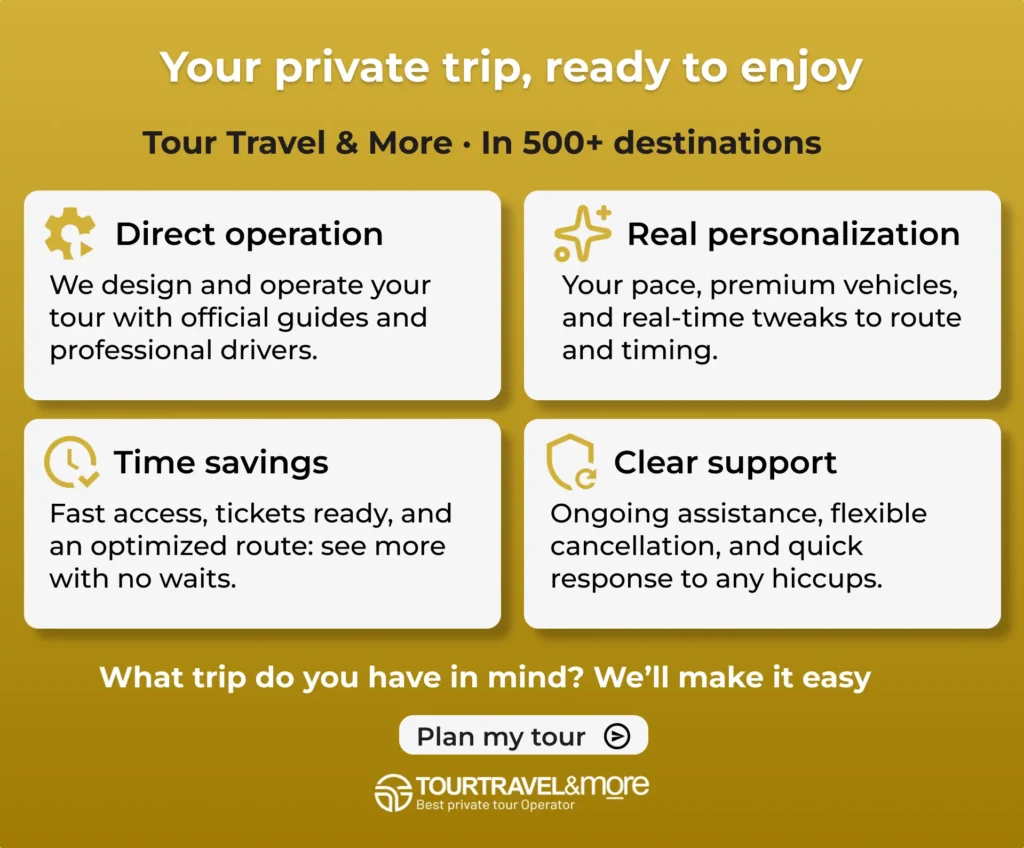
What it is: a direct and retail tour operator that designs and operates premium private tours.
What they do: coordinate official guides, professional drivers, and high-end vehicles; handle the full package (transfers, tickets, timings).
Where they operate: 500+ destinations with in-house logistics and real curation (not just listing offers).
Difference vs. a marketplace: there’s door-to-door control; the same team that designs also executes and serves you.
Fast and clear: quick confirmations, up-to-date documents, and clear comms before and during the tour.
Time-savers: priority access to landmarks and optimized routes to squeeze the day with fewer lines.
Continuous support: live follow-up and agile resolution if something pops up.
Clear policies: transparent cancellations and flexible options by service and destination.
Sustainability: responsible practices and vetted partners without sacrificing the experience.
Best for: travelers seeking privacy, personalization, and no logistics friction.
Shall we plan it? Discover our services and tell us what you’d like to experience.
Quick cases by traveler type
- Families with kids: better an agency or mixed player who knows family-friendly hotels, connecting rooms and realistic schedules. Consider priority access to avoid lines with little ones.
- Couples wanting a worry-free plan: a strong operator or mixed agency with allotments secures seats and stable pricing in peak season.
- Senior travelers: an agency with strong after-sales and solid insurance; avoid brutal connections, pick central hotels with flexible cancellation.
- Groups of friends: an operator with air blocks and hotel allotments; coordinate private transfers to optimize time.
- Luxury/anniversary trips: direct operator or mixed with high-end vehicles, top guides and nice touches (in-room welcome, special dinners).
- Adventure & complex destinations: local DMC + specialist operator; check permits, weather and on-the-ground logistics.
- Weekend city breaks: an online agency to compare fast—watch change conditions; an operator with allotments can beat prices on holidays/bridges.
The insurance that saves the trip (and your workday)
Buying insurance where you book the trip saves time when trouble hits, because they already have your data and locator. For travel, these coverages are pure gold:
| Coverage | What it covers | Protects from |
|---|---|---|
| Public liability (ops) | Day-to-day business risks | Office/fair accidents, third-party damage |
| Pure financial loss | Economic loss w/o damage | Booking/info errors |
| Vicarious/solidary + legal defense | Provider faults & legal costs | Third-party claims & attorney fees |
I call it the “legal parachute.” More than once, a good policy and a mixed agency spared us the perfect storm—delay, hotel change, canceled tour—and the traveler only made one call.
When to choose each one (quick shortcuts)
- I want a locked price and availability in peak season: go with a strong tour operator or a mixed agency with allotments.
- I want someone to know me and fine-tune my trip: a trusted agency; if it’s mixed, even better for after-sales.
- I’m going somewhere specific/complex: look at a specialist operator and a solid local DMC; a good agency will line them up for you.
- I book online without advice: an online agency works fine; read conditions and know who to contact if something happens.
The toast that closes the trip
That Riviera Maya family came back thrilled. They brought me a fridge magnet and this line: “It felt like someone cooked this thinking about us.” That’s the secret: the operator cooks, the agency serves and pampers you. If you find someone who does both well, you just toast on the beach while others wear the earpiece.
