Elena asked the same question to four different Romans on four different days: “what’s the most beautiful place in the city?” She got four different answers, none repeated, each defended with the same certainty of someone who won’t be argued out of it.
That’s the first real clue about this question: it has no official answer, and any article that gives just one without nuance is oversimplifying. But there is a handful of places that keep coming up in those four different answers, and understanding why they compete with each other matters more than settling on a single name.
Why this question doesn’t have a single answer
Rome doesn’t concentrate its beauty in a single spot because no one designed it all at once: it’s the layering of an empire, a papacy and a baroque renaissance built literally on top of each other. That means “most beautiful” changes depending on what kind of beauty you’re after.
Someone looking for a lively square, with people sitting around and music in the background, isn’t going to agree with someone looking for a quiet elevated view, or with someone looking for a fountain lit up at night. All three answers are right for what they’re looking for, and that’s exactly why the question sparks debate among Romans instead of consensus.
The candidates that show up in (almost) every answer
Ask enough people, and the same handful of names keeps repeating, even if the order changes depending on who you ask.
None of the four wins in every category, and that’s exactly why none of them manages to beat out the other three.


The Giardino degli Aranci, the winner when you only get one photo
If you reframe the question as “where do you take the photo that sums up Rome in a single image?”, the Giardino degli Aranci wins more often than any other place on the list.
It’s a small garden on the Aventine Hill, free, with no opening-hour restrictions, and practically unknown to first-time visitors who only follow the Colosseum-and-Vatican route. From its lookout point you can see St. Peter’s dome rising above the terracotta rooftops of the historic center, with the Tiber cutting across the scene from side to side.
The difference from the city’s better-known viewpoints is that here there’s almost never a crowd: since it’s a garden and not a monument, most tourist itineraries skip right past it, so you get the view without the lines or the elbowing you’d find at Rome’s other panoramic spots. Timing matters: an hour before sunset, the low light hits the dome head-on and the garden starts emptying out of anyone who was just passing through.
A few meters from the garden is the famous keyhole at Piazza dei Cavalieri di Malta, where peering through a keyhole frames St. Peter’s dome at the end of a perfectly aligned tunnel of hedges. It’s the other must-stop on the same hill, and pairing it with the garden takes less than ten minutes on foot.
Piazza Navona and the Fontana di Trevi, the other category of “most beautiful”
If instead the question is “where does Rome feel most like itself without climbing to any viewpoint?”, the answer shifts from the Aventine to the historic center, where Piazza Navona and the Fontana di Trevi go head to head.
Piazza Navona is oval-shaped because it was literally built over the stands of an ancient Roman stadium, and that legacy shows in how the space wraps around anyone crossing it. Bernini’s three fountains, with the Fontana dei Quattro Fiumi at the center, share the square with cafe terraces, street painters and ambient music that keep it alive at any hour of the day — something no quiet viewpoint can offer.
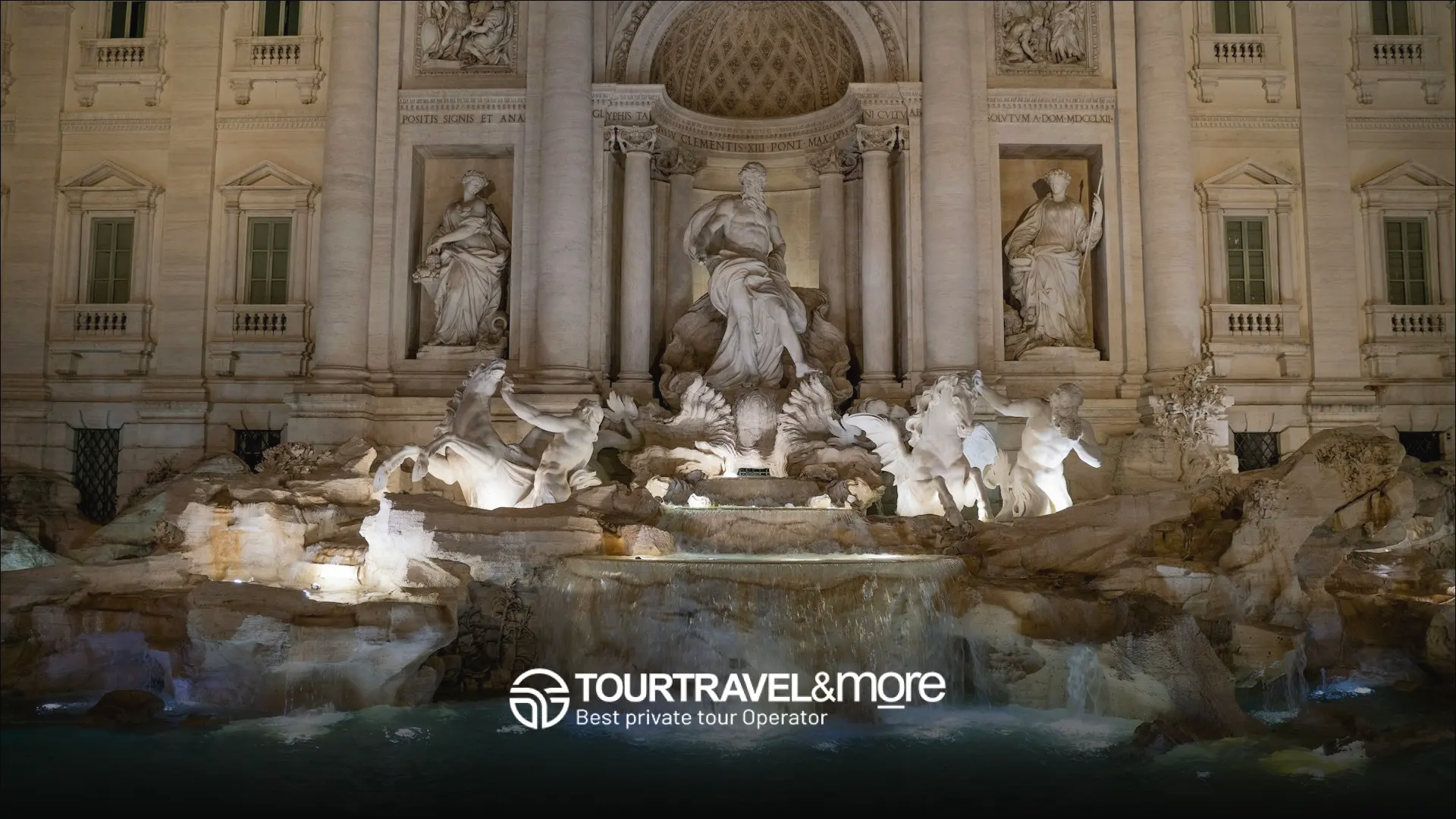
The Fontana di Trevi plays a different game: it’s not about the space, it’s about a single sculptural centerpiece — Neptune meeting his tritons amid cascades of water against a palace façade. At night, with the lights on and the square finally thinning out, it’s one of the few corners of Rome where a fountain alone carries the entire scene without needing anything else around it.
Both share the same drawback: they’re among the most photographed squares in Italy, which means you rarely get them to yourself. Making up for that is a matter of timing, not luck.
When to go to each one to see it at its best
The same place can be a postcard or a letdown depending on what time you show up, and that matters just as much as picking the right spot.
Showing up at the right place at the wrong time is the most common mistake made by anyone chasing “the most beautiful spot in Rome” off a name pulled from a list, without checking what time that list was written for.
The most beautiful place in Rome with Tour Travel & More
Finding the exact garden, the exact time, and the gap between tour groups on your own takes either having been to Rome before or hours of research that almost no one has to spare before a trip.
With Tour Travel & More, these problems disappear:
- 100% private tour — The itinerary is built to arrive at the Giardino degli Aranci or Piazza Navona right in their sweet spot, not whatever slot a group happens to get.
- Officially licensed guide — Knows the viewpoints and corners that don’t show up on standard routes, on top of the classic must-sees.
- Priority access to the paid-entry sites that pair well with these viewpoints, like the Colosseum or the Vatican Museums.
- Luxury vehicle with chauffeur, if the plan involves moving between several hills or neighborhoods without relying on public transport.
- Guardian Angel Service 24/7 — Human coordination before, during and after the tour, in case plans change on the fly.
Four answers, none of them wrong
Elena ended her trip without settling on a single answer to her question. She watched St. Peter’s dome from the Giardino degli Aranci at sunset, crossed Piazza Navona two nights in a row on her way to dinner, and tossed her coin into the Fontana di Trevi past eleven at night, with the square nearly empty by then.
There’s no single most beautiful place in Rome because the city isn’t competing with itself: each corner wins in its own category, at its own hour, for whoever is looking for exactly what that corner offers. The question that actually deserves an answer isn’t which one is the most beautiful, but which one matches what each traveler hopes to feel when they get there.