




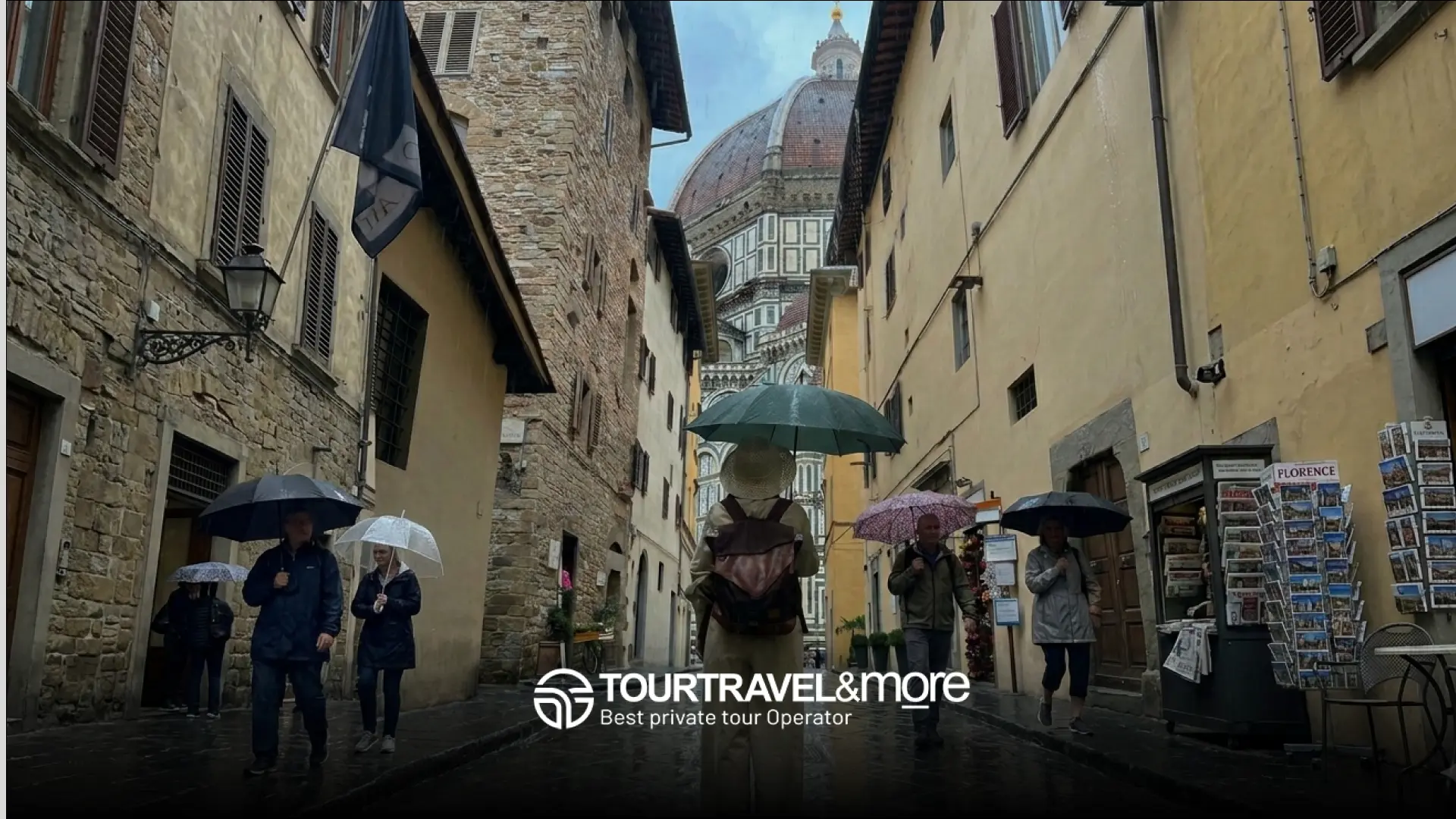
You’ve been planning Florence for months. Flights booked, a charming hotel in the center, reservations made. Then the night before you open the weather app and see that symbol you never want to see. The cloud with lightning. Or worse: the cloud with lightning for three days straight.
Don’t let it ruin you. Seriously.
Florence in the rain isn’t half a Florence. It’s a different Florence. And if you know where to go and in what order, a rainy day can turn into the best day of the trip. I say this from experience: a summer storm hit me just as I was leaving the hotel with a bag full of outdoor plans. I ended up in a library overlooking Brunelleschi’s dome, drinking the best café au lait I can remember, with half the city to myself. Nobody else had made it there. Because nobody else knew about it.
Here are the plans that actually work when it rains in Florence.
| Activity | Price | Time |
|---|---|---|
| Uffizi | ~€20 | 3-4 h |
| Galleria dell’Accademia | ~€12 | 1-1.5 h |
| Mercato Centrale | Free | 2-3 h |
| Santa Croce | ~€8 | 1-2 h |
| Palazzo Pitti | ~€10 | 2-3 h |
| Biblioteca delle Oblate | Free | 30-60 min |
| Cooking class | €60-90 | 3-4 h |
| Opera concert | €25-35 | 1.5-2 h |
| Leonardo da Vinci Museum | ~€7 | 1.5-2 h |
| La Cité Firenze | Drinks | 1-2 h |
The Uffizi: Florence’s most complete museum and the best rainy-day refuge
If there’s one museum that justifies a trip to Italy on its own, it’s the Uffizi. And if there’s a perfect day to visit, it’s precisely a rainy one. Not because fewer people go, but because the experience inside doesn’t depend on the weather outside. Renaissance art doesn’t get wet.
The Galleria degli Uffizi holds the world’s largest collection of Italian Renaissance art. Botticelli, Leonardo da Vinci, Michelangelo, Raphael, Caravaggio. Forty-five rooms that tell the history of Western art from the 13th to the 18th century. Minimum plan: three hours. Realistic: four. Anyone who says they saw it in an hour and a half was either rushing or saw nothing.
How much time you need and when crowds are thinnest
The usual trap is arriving without a reservation assuming the rain will have kept people away. Big mistake. On rainy days everyone has exactly the same idea: go to the museum. Queues double. The difference between getting in within ten minutes or waiting two hours comes down to whether you booked online in advance.
Arrive first thing, between 8:15 and 9:00. The first-floor rooms, where the Botticellis hang, are practically empty until 10:00. After that, tour groups fill the corridors and the experience changes completely.
If you’re traveling with kids or have little patience for art without context, consider booking a two-hour guided tour. It completely transforms the experience: the Renaissance stops being a parade of paintings and starts making narrative sense.
Why the covered entrance portico makes all the difference
A practical detail nobody mentions in guidebooks: the Uffizi has a covered exterior portico where the queue forms. If it’s raining while you wait to get in, you’re sheltered. That’s not the case for all museums in Florence, as you’ll see in the next section. It makes the Uffizi the most logistically comfortable option on a rainy day.
The official admission is around €20, with variations depending on the season. Booking through the official website or operators like Tiqets or GetYourGuide in advance is, during high season and bad weather days, practically mandatory.
The Galleria dell’Accademia — and the mistake almost everyone makes without a reservation
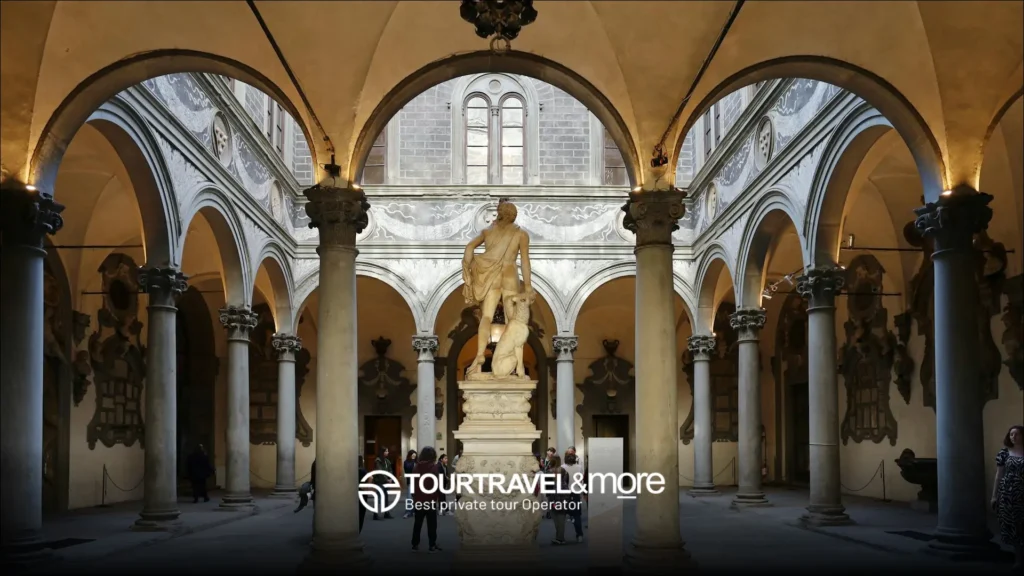
The Accademia has Michelangelo’s David. That alone makes it a must-see. But there’s something almost no guidebook tells you that becomes critical information when it rains.
What nobody warns you about the uncovered entrance
The Galleria dell’Accademia has no covered portico at the entrance. If it’s raining and you’re queuing without a reservation, you’re standing in the street getting soaked. Full stop. The Uffizi has shelter. The Accademia does not.
Tickets sell out weeks in advance during mid and high season. A traveler who arrives on a rainy Tuesday thinking the bad weather will have put people off may find no tickets available on the day. Because bad weather doesn’t discourage people: it redistributes them. Everyone who was going to be in gardens or squares heads to the museum instead.
The lesson is simple: book the Accademia at least ten days in advance in mid-season, and three weeks ahead in summer or around public holidays.
When to go to avoid endless queuing
If you somehow have a ticket, the trick locals who know Florence use is to go one hour before closing. The organized tour groups have left, the museum light is calmer, and the David is practically yours.
The Accademia visit is short compared to the Uffizi: one hour, an hour and a half at most. The David and the Prigioni — Michelangelo’s unfinished sculptures in the corridor leading up to it — are the heart of the visit. Get an audio guide: understanding why the David was revolutionary completely changes the experience.
| Uffizi | Accademia | |
|---|---|---|
| Price | ~€20 | ~€12 |
| Time | 3-4 hours | 1-1.5 hours |
| Covered entrance | ✓ Yes | ✗ No |
| Booking | Essential | Essential |
| What to see | Complete Renaissance art | David + Michelangelo’s Prigioni |
| No ticket, go to | Palazzo Pitti | Santa Croce |
The Mercato Centrale: how to spend a rainy morning without any regrets
The Mercato Centrale is one of those places where you can arrive hungry and leave three hours later without having accomplished anything specific, yet having had a genuinely wonderful time. All indoors. All at a comfortable temperature. All smelling of spices and fresh bread.
The building dates from the 19th century — an iron-and-glass structure in the San Lorenzo neighborhood. Two floors. Two different worlds.
Ground floor vs. upper floor — what time gets the most out of it
The ground floor is the traditional market: butchers, fishmongers, cheese sellers, fruit stalls, spices, fresh pasta. Beautiful to walk through, but it closes at midday. If you want to see it in full swing, get there before 12:00.
The upper floor is a different story: more than twenty food stalls open from 9:00 to midnight every day. Fresh pasta, bistecca alla fiorentina, pizza, truffles, artisan gelato, Tuscan wine tastings. You can drink a glass of Chianti at 11 in the morning without anyone batting an eye, because in Florence that’s completely normal.
The sweet spot is between 11:00 and 15:00. Before that, not all stalls are ready. After that, it fills up. Arriving at 11:30 means choosing without crowds and sitting wherever you like.
My personal recommendation: start on the ground floor even just to walk between the stalls, then head upstairs to eat. The upper floor atmosphere has something of a permanent Italian fair that you won’t find in any restaurant.
The Basilica of Santa Croce: Galileo, Michelangelo and Machiavelli under one roof
If you had to choose just one church in Florence for a rainy day, make it the Basilica di Santa Croce. Not because it’s the most beautiful from the outside — though the neo-Gothic marble facade in white and green is stunning — but because of what’s inside.
Santa Croce is the pantheon of great Italians. The tombs of Michelangelo, Galileo Galilei and Niccolò Machiavelli are here. So is the cenotaph of Dante Alighieri. And Giotto’s frescoes in the Bardi and Peruzzi Chapels, considered some of the most important in the history of Western art.
You’ve spent the morning looking at art in the Uffizi or the Accademia and think you’ve maxed out your capacity for amazement. Then you walk into Santa Croce and see Giotto’s frescoes, painted in the 14th century, and you realize the Renaissance had to start somewhere.
Admission is around €8 and includes the basilica interior, the museum and the cloisters. The full visit takes a comfortable one to two hours. Santa Croce sits in the neighborhood of the same name, less touristy than the Duomo area: cafés and restaurants without inflated prices.
Palazzo Pitti: the museum your hotel roommates won’t choose today
There’s a paradox in Florence: the city’s largest palace, originally designed by Brunelleschi and the official residence of the Medici, is systematically overlooked by travelers who prioritize the Uffizi and the Accademia. That’s an opportunity you shouldn’t pass up on a rainy day when those other museums are at capacity.
Palazzo Pitti actually houses several museums within the same building: the Palatine Gallery with works by Raphael, Titian and Rubens; the Royal Medici Apartments; the Costume Museum; and the Museum of Modern Art.
The most worthwhile with limited time is the Palatine Gallery. The rooms named after planets — Saturn Room, Jupiter Room, Mars Room — are decorated with ceiling frescoes and hung with paintings from floor to ceiling, as was the custom in 17th-century palaces. It’s different from modern museum presentation and has something overwhelming that proves utterly fascinating.
Crowd levels at Palazzo Pitti are noticeably lower than at the Uffizi. Arriving first thing in the morning means exploring the rooms with a calm that’s impossible in the other museum.
The Biblioteca delle Oblate: coffee with views of the dome and nobody knows about it
This is Florence’s best-kept secret for a rainy day. You won’t find it in standard itineraries and it barely appears in travel guides.
The Biblioteca delle Oblate is at Via dell’Oriuolo 26, a five-minute walk from the cathedral. It’s a public municipal library installed in a 14th-century convent, with a small café on the third floor with a covered terrace offering direct views of Brunelleschi’s dome.
Free to enter. The coffee costs what coffee costs in any bar in the city.
The view from that covered terrace — with the rain falling and the orange-grey dome emerging between the rooftops — is one of the best images of Florence you can take home. No museum admission. No queue. No tour groups.
The library is open Monday to Saturday. Perfect for stopping half an hour, getting something to drink, and calmly deciding your next move.

A Tuscan cooking class that turns the rain into the best part of the trip
There are moments when the rain is no longer the obstacle: it’s the perfect excuse to do something you’d always put off in good weather. A Tuscan cooking class is one of those plans that sound good in theory but become real on exactly a day like this.
The best classes start with a market visit, choose their ingredients, then spend two to three hours cooking and eating what they’ve made. Fresh handmade pasta, potato gnocchi, bistecca alla fiorentina cooked to the perfect temperature, proper tiramisu with mascarpone, artisan gelato. Many schools offer options for special diets: gluten-free, vegan, vegetarian.
The average price is between €60 and €90 per person for a three-to-four-hour session including ingredients and the meal you’ve prepared. It’s not the cheapest plan of the day, but it’s the one you remember most when you get home. Book at least two or three days in advance, as group sizes are limited.
Opera and craft workshops in Florence: culture that doesn’t depend on the weather
Florence didn’t just invent the Renaissance. It also invented opera. Literally: the first documented opera in history premiered in Florence in 1597. That puts things in perspective when you say you’re going to a concert in the city.
Several churches organize regular opera and classical music concerts in Florence: Santo Stefano al Ponte, Santa Monaca and St. Mark’s Anglican Church have almost daily programming in season. Prices range from €25 to €35 and performances typically last an hour and a half to two hours. The atmosphere is intimate, groups are small, and the acoustics of 13th-century churches do the rest.
If opera isn’t your thing, Florence has another resource that makes it unique: craftsmanship. The city has centuries of tradition in Florentine bookbinding, leatherwork, hardstone mosaic, perfumery and marbled paper making. Workshops open their doors to small groups for two-to-three-hour experiences. Making Florentine paper, hand-binding a book, or learning the basics of mosaic work is something you can’t do in any other city with this concentration of master craftspeople.
The local strategy when it rains in Florence (what people who live there actually do)
Florentines have a relationship with rain that takes visitors a while to understand. Rain in Florence, especially in summer and early autumn, rarely lasts all day. These are intense, short storms: lightning, thunder, a vertical downpour for twenty or thirty minutes, and then the sky clears as quickly as it closed in.
The local tactic is simple: when it starts raining, you step into the first covered place nearby. A church, a bar, a building entrance, a convent cloister. You wait twenty minutes. In many cases, when you come out, the ground is wet but the rain has stopped.
This completely changes how you plan the day. Rather than assuming the whole day will be indoors and blocking out museums from eight to eight, Florentines mix it up: an hour in the museum, a coffee when it clears, a walk through Oltrarno, back inside when it starts again.
A practical warning no guidebook gives you: Florence’s cobblestones become dangerously slippery in the rain. Basalt polished by centuries of footsteps has zero grip when wet. Rubber-soled shoes. No heels. Seriously.
The Oltrarno, the neighborhood south of the Arno, has a concentration of cafés, bookshops and wine bars that makes wandering its streets in the rain genuinely pleasant. La Cité Firenze, at Borgo San Frediano 20r, is an independent bookshop with coffee, wine by the glass and occasional live music. Local atmosphere, not touristy, and the kind of place you stay longer than planned.
Florence in the rain with kids: the plans that actually work
If you’re traveling with children, the equation changes. Four hours of Renaissance painting in the Uffizi is not the plan for under-tens. But there are two places in Florence that work especially well when it rains with young children.
The Interactive Leonardo da Vinci Museum (near the Piazza dei Giudici) has working replicas of Leonardo’s machines: bridges, catapults, a helicopter, flying mechanisms. Kids can touch and try most of them. Admission is around €7 and the visit takes between an hour and a half and two hours. It’s the plan most recommended by parents traveling to Florence with children under 12.
The Pinocchio and Toys Museum, at Via dell’Oriuolo 47, has a collection of toys and puppets over a hundred years old. Smaller and quieter, ideal for children aged 3 to 8 who want something different.
After the museums, the Mercato Centrale works perfectly with kids: large space, variety of food, lively atmosphere and none of the pressure to be quiet that museums demand.
| Plan | Age | Price | Time |
|---|---|---|---|
| Leonardo da Vinci Museum | 5-14 years | ~€7 | 1.5-2 h |
| Mercato Centrale | All ages | Drinks | 1-2 h |
| Pinocchio Toy Museum | 3-8 years | Check website | 45-60 min |
| Basilica of Santa Croce | 8+ | ~€8 | 1 h |
| Cooking class | 10+ | €60-90 | 3-4 h |
Frequently asked questions about what to do in Florence when it rains
Can you climb Brunelleschi’s dome in the rain?
Technically yes, the interior access doesn’t close for rain. But Giotto’s Campanile and the Palazzo Vecchio tower do close during electrical storms for safety reasons. Check the status before going if a storm is forecast.
Do you need to book the Uffizi far in advance?
In mid-season (April-June, September-October) book at least a week ahead. In July and August, two to three weeks. On a rainy day without a reservation, it’s nearly impossible to get in without waiting two hours in the street.
Does the Galleria dell’Accademia have a same-day waiting list?
Occasionally they release some tickets on the day, but it’s not reliable. The solution is to book online in advance. If you don’t have a ticket, Palazzo Pitti or Santa Croce are the best alternatives of comparable quality.
How many museums is it realistic to do in one rainy day?
Two museums is the realistic maximum for a good experience. Uffizi plus Accademia in the same day is possible but exhausting. A more balanced combination: Uffizi in the morning and Santa Croce or Palazzo Pitti in the afternoon.
Which restaurants should you avoid near the Ponte Vecchio when it rains?
Restaurants immediately adjacent to the Ponte Vecchio are known for inflated prices and tourist-trap quality. When it’s raining and you’re hungry, it’s easy to fall into that trap. Better to walk five minutes toward the interior of Oltrarno or the Santa Croce neighborhood: same prices as anywhere else in Italy, not tourist-trap prices.
Is Florence worth visiting even when it rains?
Yes. Without any doubt. The city has enough culture, gastronomy and covered spaces to fill several full days without needing good weather. Many travelers who visit in the rain say they found a quieter, more authentic and easier-to-enjoy city than on summer days with thirty-degree heat and crowds in every square.
