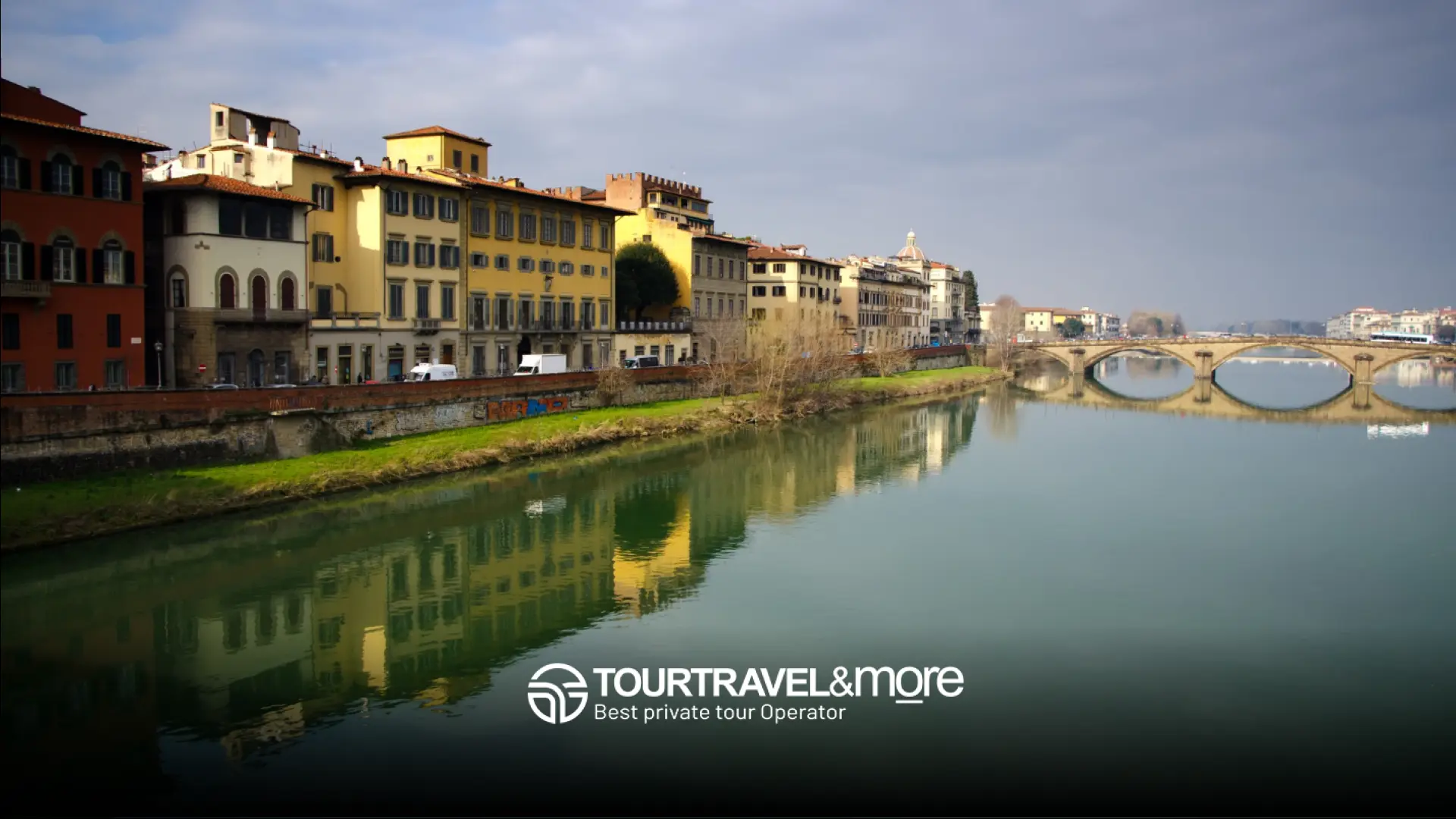
There is something nobody tells you about Florence in February. While the rest of the world waits for spring to visit, you could be standing in front of the Birth of Venus at the Uffizi Gallery with the room practically to yourself. No queues. No pushing. No tour guides shouting into earpieces.
February is this city’s best-kept secret. Yes, it is cold. Yes, it might rain. But Florence in winter has a different kind of light, a stillness that simply does not exist in summer, and a cultural calendar that surprises anyone who does not know about it.
This guide is designed to help you make the most of every day — from the great museums to the most authentic corners of the city — with the bonus of Carnival and, if you visit in the second week, Valentine’s Day in the city that invented the Renaissance.
| Aspect | What you need to know |
|---|---|
| Temperature | 4 °C – 12 °C · cold but manageable |
| Rainfall | Moderate · 5-7 rainy days per month |
| Tourists | Low season · minimal queues |
| Prices | Flights and hotels up to 40% cheaper |
| Star event | Carnaval di Firenze + Feb 17th (free museums) |
| Valentine’s Day | Feb 14th · Italy’s most romantic city |
| Key perk | Domenica al Museo · free museums every 1st Sunday |
| Clothing | Winter coat, layers, waterproof jacket, comfortable shoes |
Why February Is One of the Best Months to Visit Florence
Most people believe Florence is only worth visiting in spring or summer. It is one of the most common travel mistakes I have seen people make.
No crowds, full magic
Florence receives between 25,000 and 40,000 visitors per day during peak season. In February, that number drops sharply. The result is a city that breathes differently. The piazze have space. The museums do not drain you. You can stand in front of a Botticelli without someone nudging you from behind to take a selfie.
The first time I went in winter, I stood in front of Primavera for a full ten minutes. Nobody gave me a strange look. Nobody was waiting for my spot. That feeling, in August, is literally impossible.
And there is one practical detail that makes a real difference: tickets are much easier to get. In July, the Duomo and the Uffizi sell out weeks in advance. In February, you can book a few days ahead — or even find availability the same day.
Low prices and discounted entry
February is pure low season. What that means in practice:
- Flights to Florence (or Pisa, just 1 hour by train) are often far cheaper than in peak months
- Central hotels that cost €200 a night in summer drop to €90–120 in February
- Some museums and attractions offer reduced rates outside high season
Not every trip has to break the budget. February is the month where you get the most Florence for the least money.
Domenica al Museo: free entry every first Sunday
Every first Sunday of the month, Italian state museums open their doors completely free of charge. It is called Domenica al Museo and in Florence it applies to some of the biggest names — including the Uffizi complex and several others.
If your trip falls on that Sunday, plan your entire day around it. The downside: it tends to be slightly busier, since locals take advantage too. The solution: arrive when doors open.
Florence Weather in February: What to Really Expect
I am not going to sugarcoat it: February in Florence is cold. It is not Scandinavian cold, but it is not spring either. If you arrive expecting sunny terraces and a light jacket, you are in for a surprise.
Temperatures, rain and sunshine hours
Temperatures range between 4°C and 12°C. Mornings and evenings are genuinely cold. At midday, if the sun comes out, the historic centre becomes a perfectly pleasant place to walk around.
Rain is moderate — between 5 and 7 rainy days per month, usually drizzle rather than heavy storms. The second half of the month tends to be sunnier and drier than the first.
Snow is possible but rare. When it falls — and it does sometimes — Florence looks like something out of a 15th-century painting. Needless to say, it is worth experiencing.
What to wear in Florence in February
The key is layering. A good approach:
- Thermal base layer for the mornings
- Mid-layer fleece or jumper
- Winter coat that blocks the wind
- Light waterproof jacket or raincoat for wet days
- Comfortable, waterproof shoes: you will be walking a lot on wet cobblestones
Scarves and gloves are not optional. And if you plan to climb Brunelleschi’s Dome, brace yourself for the wind at the top.
Florence Carnival in February
Here is something many travellers know nothing about. Florence has its own Carnival, and while it cannot match Venice for spectacle, it has something Venice does not: Renaissance authenticity.
Florence Carnival typically begins in the first week of February and runs through Shrove Tuesday, a date that varies each year according to the Easter calendar.
What Florence Carnival is like
Do not expect Venice. The Florentine Carnival is more intimate, more neighbourhood-level, more local. There are parades with elaborate costumes, music, traditional seasonal sweets — the cenci, strips of fried dough dusted with icing sugar, are dangerously addictive — and a festive atmosphere that fills the streets of the centre.
The Oltrarno and San Frediano neighbourhoods are especially lively during this period. And if you are travelling with children, February is an excellent month: the city fills up with activities designed for them.
| Event | When | Where |
|---|---|---|
| Official opening | First week of February | Historic centre |
| Parades and costumes | Weekends in February | Piazza della Repubblica |
| Children’s workshops | Throughout the month | Various neighbourhoods |
| Cenci and sweets | All of February | Bakeries and markets |
| Grand finale | Shrove Tuesday | Entire city centre |
February 17th: the day of Anna Maria Luisa de’ Medici
This is one of those days only people who dig deep into Florentine history know about. On February 17th, the city commemorates Anna Maria Luisa de’ Medici, the last member of the Medici family, who died in 1743 and whose will bequeathed the entire Medici art collection to the city of Florence on the condition that it never leave Tuscany.
Without her, the Uffizi as we know it today would not exist.
On this day, there is a solemn ceremony at Palazzo Vecchio with period costumes and a ceremonial procession — and, best of all for visitors: free entry to several municipal museums. It is a date worth marking on the calendar.
What to Visit in Florence in February: The Must-Sees Without the Crowds
February is the month when Florence’s museums return to their original purpose: letting art speak without the noise of the masses. And in a city with this concentration of masterpieces, that changes everything.
The Uffizi Gallery: Botticelli without elbows
The Uffizi Gallery is arguably the most important collection of Italian Renaissance art in the world. Botticelli’s Birth of Venus and Primavera are here. So are Leonardo, Caravaggio, Michelangelo, Raphael — the list would be endless.
In peak season, the corridors become a human bottleneck. In February, you can walk slowly, look properly, and spend as long as you want in front of each work.
Book tickets online regardless: even though demand is lower, free-entry days can make walk-in access tricky.
The Accademia and Michelangelo’s David
The David is one of those works that tends to generate scepticism before you see it. There is so much fuss around it that you sometimes wonder if it is overhyped. And then you see it.
Its 5.17 metres of height, carved from a single block of Carrara marble, carry a presence that no photograph conveys. In February, with fewer visitors, you can get close enough to see the details of the face, the veins in the hands, the muscular tension in the neck.
If you are travelling with children and worried they will get bored: the Accademia is the Florence museum they handle best. It is small, focused, and the David is a visual magnet even for those with no interest in art.
The Duomo and Brunelleschi’s Dome in winter
The Cathedral of Santa Maria del Fiore and Brunelleschi’s Dome are Florence’s symbol. And there is something special about seeing that orange and green marble contrasting against a grey winter sky.
Climbing the dome (463 steps, no lift) in February has its advantages: shorter queues, and the view from the top with mist over the Arno has a painterly quality that summer’s haze simply cannot match.
The cathedral interior is free and always worth a visit. The Baptistery and Giotto’s Bell Tower complete the Duomo complex and require separate tickets.
Palazzo Vecchio, Palazzo Pitti and the Boboli Gardens
Palazzo Vecchio is Florence’s historic city hall, built in the 14th century, and one of the most imposing medieval civic buildings in Italy. Its interior rooms hold frescoes and works that surprise anyone who enters without expectations.
Palazzo Pitti, on the other side of the Arno in the Oltrarno neighbourhood, is a museum complex inside a Renaissance palace that most travel guides underrate. It is worth it for the Palatine Gallery (works by Raphael, Titian and Rubens) and, on good-weather days, for the Boboli Gardens: 45 hectares of historic parkland with sculptures, fountains and a panoramic city view that in February, with the trees bare, has a particular melancholic beauty.
What to Do in Florence in February if It Rains
February can bring days of continuous rain. It does not matter. Florence has enough indoor content to fill an entire week without setting foot outside.
Indoor plans for grey days
A Tuscan cooking class is probably the best indoor activity in all of Florence. They run mornings and afternoons, in small groups, and often include a visit to the Mercato Centrale to buy ingredients. In winter, the dishes are the best ones: ribollita, pappardelle al ragù, cantucci with vin santo.
The Mercato Centrale itself is a destination. The ground floor is a traditional market of fruit, vegetables, meat and cheese. The upper floor is an artisan food court with stalls selling fresh pasta, truffles, wines and lampredotto sandwiches.
Other plans for rainy days:
- Museo Nazionale del Bargello: early Renaissance sculpture, including works by Donatello. Very uncrowded and very underrated
- Museo dell’Opera del Duomo: the original artworks that once adorned the Duomo, now preserved indoors. One of the most surprising visits in the city
- Cappelle Medicee: the Medici funerary chapels decorated by Michelangelo. Intimate and overwhelming
- Historic cafés: Caffè Gilli (1733) or Caffè Rivoire on Piazza della Signoria, for a cappuccino and a moment of old-world elegance
Florence in February as a Couple: Valentine’s Day in the Renaissance
February 14th in Florence carries a weight that few destinations can match. This is the city where love was painted, sculpted and celebrated for centuries. The Medici made it the centre of the Renaissance world. Dante wrote here. Botticelli painted love in all its forms here.
Using it as a backdrop for Valentine’s Day feels almost obvious. And yet it surprises every time.
Romantic plans for two
| Activity | When | Why it works |
|---|---|---|
| Sunset at Piazzale Michelangelo | Late afternoon | Best panoramic views of Florence |
| Evening walk on Ponte Vecchio | Night | Jewellery shops lit up over the Arno |
| Dinner in Oltrarno | Night | Bohemian neighbourhood, authentic trattorias |
| Tuscan pasta class | Morning or afternoon | Shared experience, memory you take home |
| Uffizi Gallery alone | Early morning | Renaissance art as your backdrop |
| Tuscan wine tasting | Late afternoon / evening | Chianti, Brunello, Vernaccia in the city |
| Brunelleschi’s Dome | Morning | Florence views at dawn in winter |
The Oltrarno neighbourhood is the recommendation for dinner. It is the least touristy Florence, with trattorias where menus are not translated and wine is served in clay jugs. The contrast with the historic centre is total, and the distance is barely ten minutes on foot across the Arno.

February Food in Florence: Eat Like a Florentine
Here is one of the best reasons to visit in winter. Tuscan cold-weather cooking is different — and better. It is not the same summer salad. It is slow-cooked stew, rich broth, wood-fired meat. The kind of food that makes sense when it is cold outside and the stone streets are wet.
The winter dishes you cannot miss
Ribollita is February’s signature dish. A thick soup of bread, cavolo nero (Tuscan black kale), cannellini beans and winter vegetables, made the day before and reheated — ribollita literally means “re-boiled”. Every trattoria has its own version. Trying two or three is already a complete gastronomic tour.
Pappardelle al cinghiale (wide pasta ribbons with wild boar ragù) is another winter staple that appears on nearly every Tuscan menu during these months. Wild boar ragù has a depth of flavour that beef simply cannot match.
Lampredotto deserves a special mention. It is the fourth stomach of the cow, slow-cooked in vegetable broth and served in a bread roll soaked in the same broth. It sounds strange. It tastes like pure Florence. The stalls at the Mercato Centrale or Mercato di Sant’Ambrogio are the place to try it without hesitation.
Cantucci with vin santo are the winter dessert of choice. Hard almond biscuits dipped in sweet Tuscan wine. A table ritual that no modern patisserie has managed to improve upon.
And specifically in February, during Carnival, the cenci appear: strips of fried dough dusted with icing sugar, sold at every market stall. They are addictive in a way that defies rational explanation.
Practical Tips for Visiting Florence in February
How to book and where to stay
Book museum tickets in advance even in low season. The Duomo complex, the Uffizi and the Accademia all have online booking systems that skip queues and guarantee your time slot. In February they rarely sell out days ahead, but booking a week in advance is sensible.
For the free first Sunday and for February 17th, book with more lead time — local demand is higher on those dates.
Where to stay: the Oltrarno / Santo Spirito neighbourhood is the choice for travellers who want the real Florence. Quieter, more authentic, slightly cheaper than the tourist core and 10–15 minutes on foot from everything that matters. For those who prefer being at the heart of the historic centre, the areas around Piazza della Repubblica or Santa Croce are excellent options.
Getting there: Florence Airport (Amerigo Vespucci) has good international connections, but it is also worth checking Pisa Airport, less than an hour away by train and often cheaper with low-cost airlines. Bologna Airport is another option, around 35–40 minutes by train.
Getting around: Florence is a walking city. The historic centre is compact and most major monuments are within 20 minutes of each other on foot. Taxis and the tram are available for longer journeys or very rainy days.
Frequently Asked Questions About Florence in February
Is February a good time to visit Florence?
Yes, very much so. February offers the perfect combination of no crowds, low prices and an active cultural calendar. It is one of the best months of the year to visit if you are looking for a quality experience without the chaos of peak season.
How cold is Florence in February?
Temperatures range from 4°C to 12°C. Nights are genuinely cold; sunny middays are pleasant with a good coat. It is not extreme cold, but you need real winter clothing: coat, scarf, gloves and waterproof shoes.
Is there Carnival in Florence in February?
Yes. The Carnaval di Firenze starts in the first week of February and runs through Shrove Tuesday. There are parades, costumes, traditional sweets (cenci) and events across various neighbourhoods, especially in Oltrarno and around Piazza della Repubblica.
What happens on February 17th in Florence?
The city commemorates the death of Anna Maria Luisa de’ Medici, the last of the Medici, who bequeathed the family’s entire art collection to Florence. There is a solemn ceremony with period costumes at Palazzo Vecchio and free entry to several municipal museums.
Do museums open in February?
Yes, all major museums operate on normal schedules in February. Some have reduced hours on Mondays (the Uffizi closes on Mondays). On the first Sunday of each month, state museums offer free entry.
What should I pack for Florence in February?
A winter coat, layers (jumper plus thermal base), a light waterproof jacket or umbrella, scarf, gloves and comfortable waterproof footwear. Florence is walked on cobblestones that are often wet in winter.
Is Florence good for Valentine’s Day?
It is hard to find a more romantic destination in Europe for that date. The combination of Renaissance art, winter cuisine, walks along the Arno and the intimacy of low season makes it a near-unbeatable option.
Is Florence Carnival worth it compared to Venice?
They are different experiences. Venice is more spectacular and more crowded. Florence is more authentic, more intimate and far less saturated. If you want atmosphere without the masses and a more local feel, Florence wins.