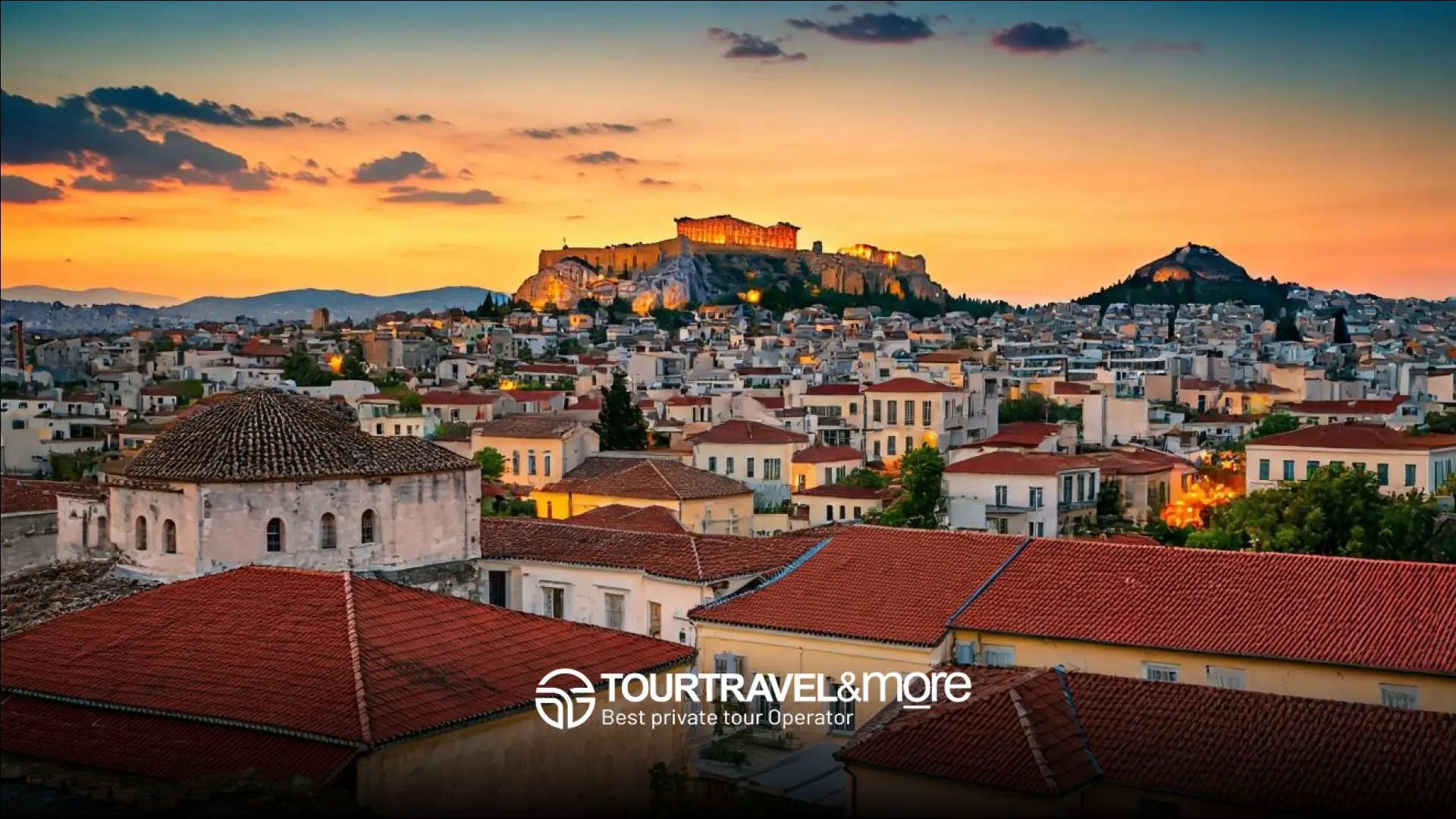
Most people arrive in Athens with a single idea in their head: the Acropolis. They climb up, take photos, come back down, and leave thinking they’ve seen Athens. Monumental mistake. The Acropolis is the excuse to be there; what will stay engraved in your memory is everything else.
I’ve visited Athens several times and each time I discover a new layer. A chaotic, noisy city, full of contradictions, that can seem ugly in the first five minutes and completely irresistible in the next two days. This guide is not about the Acropolis. It’s about everything below, around and beyond.
The Ancient Agora: Where Democracy Was Born (and Almost Nobody Makes It to the End)
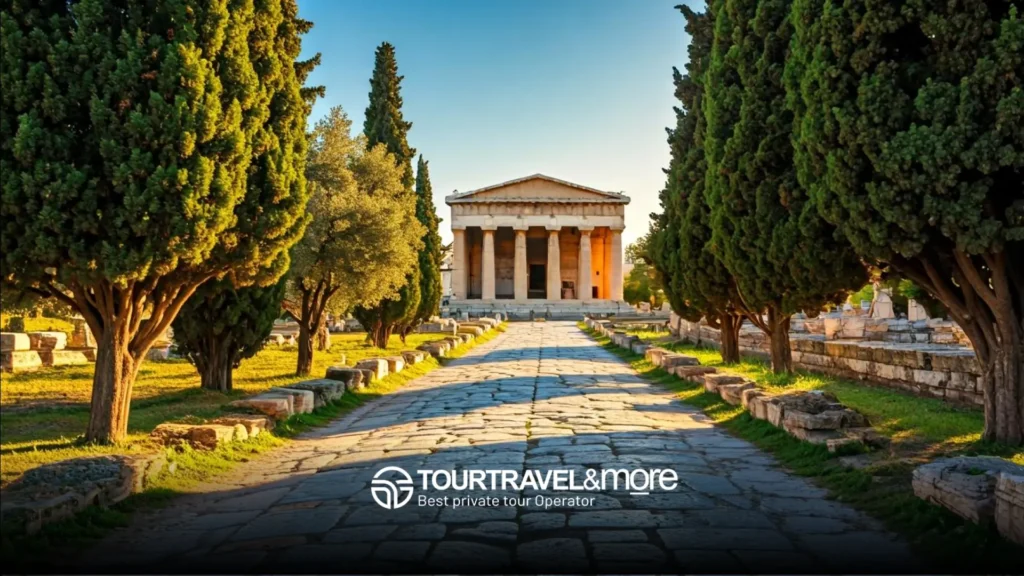
There’s something that strikes me as curious: everyone pays for the combined ticket that includes the Acropolis and the Ancient Agora, and then half of them don’t go down to the Agora. It’s a mistake that hurts.
The Agora was for centuries the heart of Athens. Not the symbolic or spiritual heart — that was the Acropolis — but the real heart: where people debated, traded, judged, philosophized and did politics. Socrates lived here. Aristotle taught here. Here were made the decisions that invented democracy as we understand it.
Going down to the Agora is walking through terrain that still smells of history in its raw state. Without the immaculate restoration of the Acropolis. Without the orderly scaffolding. Just stones, dust, cypresses and silence.
| Site | What it is | Price | Hours |
|---|---|---|---|
| Ancient Agora | Political and commercial heart of classical Athens | Included in combined ticket (€30) | 8:00 – 20:00 (summer) |
| Temple of Hephaestus | The best-preserved Doric temple in Greece | Included | Same hours |
| Roman Agora | Market built by Romans, more intimate | €8 separate | 8:00 – 20:00 |
| Hadrian’s Market | Library and porticoes of Emperor Hadrian | €4 | 8:00 – 20:00 |
The Temple of Hephaestus: The Best Preserved in Greece
If the Parthenon is under almost permanent construction and doesn’t let you see it properly, the Temple of Hephaestus is the antithesis. Two thousand five hundred years overlooking the Agora from its hill, with almost all the original columns standing and the frieze still visible.
It was built in the 5th century BC — almost contemporary with the Parthenon — to honor the god of fire and blacksmiths. During the Middle Ages it was converted into a Christian church, and that, paradoxically, is what saved it from the systematic looting that other monuments suffered.
Arriving before nine in the morning makes it an almost private experience. The early morning light hits the marble and stone in a way that’s not possible at midday.
The Roman Agora and Hadrian’s Market
Five minutes’ walk from the Greek Agora there’s another one: the Roman. Built when Athens was already a province of the Empire, it has a completely different feel. More compact, more commercial, with the Tower of the Winds at its center — a 1st-century BC weather-clock that remains a marvel of engineering — and an Ottoman mosque that recalls that this city has had more historical layers than any guidebook can cover.
Neighborhoods That Will Grab You Without Warning
Athens is not beautiful in the conventional way. But it has neighborhoods that hook you with a force that more “perfect” cities rarely achieve.
Anafiotika: The Cyclades in the Middle of Athens
There’s a moment, climbing through the alleyways that start from Plaka toward the Acropolis rock, when the noise of the city completely disappears. The houses turn white. The doors, blue. Cats lie on stone stairways. And you think: this can’t be here.
Anafiotika is a neighborhood built in the 19th century by workers who came from the island of Anafi — hence the name — who reproduced their Cycladic architecture here. Whitewashed houses clinging to the rock, bougainvillea overflowing the facades, alleyways so narrow that barely two people can fit.
There are no restaurants here. No shops. Just residents, silence and the feeling of having found something that wasn’t on the map. For me, one of the most surprising corners in all of Greece.
Monastiraki: Chaos, Market and the Best View of the Acropolis From Below
Monastiraki is the antonym of Anafiotika. Here chaos is the norm: souvenir stalls, music at full volume, street vendors, tourists photographing and locals passing through with the naturalness of someone who has spent their whole life in that environment.
The Sunday flea market is legendary. Vintage clothing, dubious antiques, ceramics, books, vinyl records and all kinds of objects you wouldn’t know how to define. Going with no intention of buying anything and ending up with a full bag is almost inevitable.
But there’s something nobody tells you: from Monastiraki square, with the Ottoman mosque in the background and the remains of the Roman Agora beside it, you have one of the most striking views of the Acropolis. Not from above, but from below, in contrast with the neighborhood, the life, the market. That image is worth more than any photo from the hills.
Psyrri and Thissio: Where the People of Athens Eat and Drink
Ten minutes from Monastiraki, the neighborhoods of Psyrri and Thissio are where real Athenians go out at night. Restaurants with terraces, tavernas with lanterns, natural wine bars and the occasional live music venue you don’t expect to find around the corner.
Thissio also has a perfect logistical advantage: its terraces look directly onto the illuminated Acropolis at night. Sitting with a glass of Assyrtiko wine watching the Parthenon from a terrace at the perfect temperature is, without exaggeration, one of the most rewarding experiences any European city can offer.
The Museums Most People Skip (and Shouldn’t)
The Acropolis Museum is on every list. And rightly so. But there are three museums in Athens that are major works and that quick circuits systematically overlook.
Benaki Museum: From Prehistory to the 20th Century in a Mansion
The Benaki is not a ruins museum. It is the complete history of Greek culture from 7000 BC to the 20th century, installed in a 19th-century neoclassical mansion in the Kolonaki neighborhood. Mycenaean jewelry, Byzantine icons, 18th-century regional costumes, objects from the Greek War of Independence and contemporary Greek art, all under one roof with a museographic quality that puts many more famous European museums to shame.
What surprised me most the first time I walked in was the prehistoric goldsmithing collection. Pieces from the second millennium BC with a fineness of workmanship that seems incomprehensible without modern tools. The museum opens until midnight on Thursdays and Fridays, making it a perfect option for a night visit.
Museum of Cycladic Art: The Oldest Art in Europe
Three blocks from the Benaki, the Museum of Cycladic Art holds the world’s most important private collection of Cycladic figures — those white marble sculptures, schematic, of almost contemporary appearance, that are between three thousand and five thousand years old.
Their influence on modern art is direct: Modigliani, Picasso and Brancusi studied them and found in them the pure form they were looking for. Seeing the originals in the display cases, without barriers, in a space designed with overhead natural light, is understanding in one blow why Aegean art changed the history of Western sculpture.
National Archaeological Museum: If You Can Only Do One, Make It This
The largest archaeological museum in the Hellenistic world. Mycenaean golden masks, the statue of the Artemision Poseidon, the Artemision Jockey, the Akrotiri frescoes, the throne of Augustus. Five thousand years of Greek civilization in a single building.
The usual trap is trying to see everything in two hours. You can’t. And it’s not worth trying. Choose two or three rooms, research what’s in them beforehand, and give them real time. I always return to the bronze collection room: there are pieces there that literally stop you in your tracks.
Athens Viewpoints: Beyond Lycabettus
Lycabettus Hill is in every guidebook as the ultimate viewpoint in Athens. And it’s right to be there: the 360-degree views are impressive. But it has two problems: the funicular may be out of service, and when it works, the queue to go up can ruin your afternoon.
There are two alternatives that, in my opinion, give better experiences.
| Viewpoint | Height | Highlights | Queues | Access |
|---|---|---|---|---|
| Lycabettus | 277 m | 360° views, sea and mountains | High season: long wait | Funicular or on foot (20 min) |
| Filopappos | 147 m | Perfect view of the Acropolis at sunset, tree-lined path | Almost none | On foot from Thissio (15 min) |
| Areopagus | 115 m | Free, central, views of the Agora | Moderate | 5 min walk from the Acropolis |
| Acropolis Museum Terrace | 90 m | Face-to-face view of the Parthenon, with a drink | Depends on museum | Inside the museum |
Filopappos Hill: The Best-Kept Secret at Sunset
Filopappos Hill takes its name from a Syrian prince from the 2nd century who built his mausoleum there. Climbing it is a walk through Mediterranean pines that smell of warm resin, with well-marked paths and benches where the people of Athens come to read or exercise.
From the top, the Acropolis sits directly opposite, at the same height and a short distance away. The perspective is unique: you don’t see it from below looking up, but face to face, as if placed at your level. At sunset, with the orange light hitting the Parthenon, the scene is one of those that justifies the trip all by itself.
A traveler on a forum described it better than I can: “Climbing at sunset to the Filopappos viewpoint and then heading down toward the Acropolis for dinner.” No need to add more.
Areopagus Hill: Views Without Queues and With History Underfoot
The Areopagus is the flat rock just next to the Acropolis, where the Apostle Paul preached to the Athenians in 51 AD. There’s a plaque commemorating it. The rock is polished by millions of footsteps and on rainy days it can be slippery; on dry days, perfect for sitting.
The views look directly at the Agora, Monastiraki and the city spreading south. Free, accessible in five minutes from the Acropolis, and almost always less crowded than Lycabettus. Ideal for the late morning, when the light is good and the mass visits have already passed.
A Morning at the Panathenaic Stadium (and Syntagma Square)
The Panathenaic Stadium is the only stadium in the world built entirely of white marble. Rebuilt for the first modern Olympic Games of 1896 on the ruins of the original 4th-century BC stadium, it has a history that isn’t obvious at first glance: beneath that gleaming marble is a structure that existed when Alexander the Great was alive.
You can run on the Olympic track. You can climb to the highest stand and watch the city stretch out to the sea. And the entrance includes an audio guide that tells stories of ancient Greek athletics that you didn’t expect to find interesting and that turn out to be fascinating.
The Evzone Changing of the Guard: Theatrical and Punctual
Ten minutes from the stadium, Syntagma Square offers every hour one of the most peculiar spectacles in Europe: the changing of the Evzone guard in front of Parliament. Elite soldiers in traditional uniform — pleated skirt, white stockings, shoes with pompoms — performing a choreography that blends formality with something I couldn’t describe except as dance.
The Sunday midday change, with the full military band, is the most spectacular. The weekday change lasts ten minutes and is equally absorbing. Nobody who sees it for the first time can help asking how something like this is trained.
Day Trips From Athens Worth Every Kilometer
Delphi: The Navel of the Ancient World
The Greeks believed Delphi was the exact center of the world. Zeus released two eagles from opposite ends of the Earth and they met here. It’s not a metaphor: there’s a stone at the site, the omphalos, that marks that point.
Delphi is 180 kilometers from Athens, ninety minutes by bus from Liossion station. And it is absolutely worth every minute of the journey. The archaeological site literally hangs over a cliff on Mount Parnassus, with the Phocis Valley stretching kilometers to the south. The Sacred Way climbs between treasuries of rival city-states — Athens, Sparta, Corinth — that competed in magnificence even here, on sacred ground.
The theater, the stadium at the top and the sanctuary of Athena on the outskirts of the main site deserve unhurried exploration. Travelers who have done it agree: Delphi is “a bloody marvel” that exceeds expectations even coming with high expectations.
Aegina: Island, Pistachios and Temple in Under 2 Hours
If you want island without complications, Aegina is the answer. Forty minutes on a fast boat from Piraeus port, and you’re on an island that has a 5th-century BC Temple of Aphaia in perfect condition — almost a rival to the Parthenon — and the most famous pistachio production in Greece.
The village of Aegina has the charm of the Aegean islands without the overcrowding of Santorini or Mykonos. Eat at the harbor, buy half a kilo of pistachios — the local ones are a different category from what you know — and return to Athens for dinner. It’s a complete and satisfying day that requires no complicated planning.
Gastronomy as an Excuse to Get Lost in Athens
Gyros, Souvlaki and Kaimaki: The Street Food Essentials
Athens has one of the most satisfying street food scenes in Europe, and it’s also cheap. A lamb gyros with tzatziki, tomato, onion and chips inside the pita bread costs between two and a half and four euros in any establishment away from the tourist zones. It’s filling, genuinely good, and you eat it standing up or sitting on a curb as Greeks do.
Kaimaki deserves its own paragraph: it’s a Greek ice cream made with mastic milk — the resin of the lentisk tree from the island of Chios — that has an elastic, slightly sticky texture, with an aroma that doesn’t resemble anything you’ve eaten before. Finding it at a traditional ice cream shop instead of at tourist stalls is the difference between something ordinary and something memorable.
Where to Eat Without Falling Into the Tourist Trap
The golden rule in Athens: move two streets away from the nearest tourist attraction. In Plaka, 80% of restaurants have paper tablecloths and menus with photos. In Thissio, two streets up, the same dishes cost half the price and are better cooked.
Psyrri has the city’s best tavernas for a slow dinner. Mikrolimano, the small harbor next to Piraeus, offers fresh seafood and fish that have nothing to envy of the most expensive islands. And for quick orientation: ask the accommodation owner where they eat. That question, in Athens, never fails.
Frequently Asked Questions About What to See in Athens Beyond the Acropolis
How many days do I need to see Athens properly? With three days you can cover the essentials: the Agora, the main neighborhoods, two or three museums and a day trip. With four days you can add Delphi or Aegina without rushing. Less than three days means choosing and giving up a lot.
What is the best neighborhood to stay in Athens? Thissio and Monastiraki are the best options for getting around on foot. Plaka is more touristy but very central. Kolonaki is quieter and oriented toward a more unhurried type of tourism. Avoid Omonia for accommodation.
Is it worth booking guided tours in Athens? For the Acropolis and Agora, a guide adds a lot: the historical context completely changes the experience. For neighborhoods and museums, going alone or with an audio guide is perfectly sufficient and more flexible.
What is the best time to visit Athens? April, May and the first half of June, or September and October. The Athenian summer is relentless: 38-42 degrees in July and August, no wind, with very long queues at all monuments. Winter is mild but with fewer hours of daylight.
Are there beaches near Athens? Yes. The Athenian Riviera, 30-40 minutes by metro heading south, has organized beaches with sun loungers, bars and clean water. Vouliagmeni also has a thermal water lake beside the sea that is worth a visit in itself.
Is Athens safe? Generally, yes. The usual precautions are needed with pickpockets in very crowded areas like Monastiraki, and it’s best to avoid the Omonia neighborhood at night. Traffic is chaotic and drivers rarely respect pedestrian crossings: cross with care.